Spencer's Day

Total Pageviews

Wednesday, December 6, 2023

A needlessly long retrospective of the entire Five Nights at Freddy's Core Collection.

 Well, I mentioned it in my Halloween Special for this year so I might as well start covering it while it's fresh in my mind. This is the post where I finally review Five Nights at Freddy's. But in what might be my most ambitious project yet, I am not stopping at the first game. There are 10 games in the franchise, and 8 of those games are canon to the main story and lore of the series. For the sake of not making things overly long, I will review just the Core Collection, a bundle containing the first five games in one package. I will cover the other five games in a different post. And I would like to cover the movie one day, but I have not watched the movie yet, and I would rather not review something until I experience it for myself. A quick disclaimer for the rest of the post. There will be times in the post where I use the acronym FN@F. This is a shortened form of the title. Just a quick heads up so you don't get confused. Also, as yet another horror game review, this review might contain descriptions of disturbing subject matter. The games themselves are surprisingly tame at a T for Teen rating, however. Because of this, the franchise has earned a reputation for being a "baby's first" horror game.

Image found from Wikipedia.org

So what is Five Nights at Freddy's? It's a horror franchise created by Scott Cawthon back in 2014. Mr. Cawthon worked almost entirely as a self-published developer, and up until the fifth game in the franchise, FN@F was a one-man passion project. The series focuses entirely on haunted Chuck E. Cheese style animatronics, with some monsters being exceptions that prove the rule. And there's a funny story as to why Scott made FN@F despite having no real background in horror media. You see, he got his start making puzzle games for kids. One of those games was absolutely torn apart by critics, specifically citing that the cartoon animals looked accidentally robotic and creepy, when they were supposed to be cute and cuddly. Scott took one look at those criticisms and said, "What if I made a game that was robotic and creepy on purpose?" And that was how Five Nights at Freddy's was born. And the overwhelming success of FN@F as well as fellow horror game P.T. (Rest in Peace P.T. fans) would change the face of indie horror games for years to come. Either your indie horror game was a FN@F clone, a P.T. clone, or it did something so unusual it couldn't be compared to either game.

Despite the franchise's humble origins and almost nonexistent budget, it exploded into an overnight sensation thanks to positive word of mouth. Another reason this franchise got popular was thanks to the Internet. No, really. Between viral videos of Internet celebrities recording their "live reactions" to the series' jump scares, to entire groups of terminally online nerds (including me) being dedicated to piecing together a mysterious storyline that was carefully spread out across multiple games. Because of the prevalence of theories in the FN@F fan community, anything I say about the lore should be taken with a grain of salt. After all, everything I say here is not only my personal reading and thoughts on the story, but some details will be simplified or ignored completely for the sake of keeping this review actually readable. Without further adieu, let's begin the deep dive.

Image from MobyGames.com

Let's start with the first game in the series, the original Five Night's at Freddy's. So imagine. The year is (probably) 1993 and you are a security guard hired by Fazbear Entertainment, a megacorporation that owns a fast food joint called Freddy Fazbear's Pizzeria. You are tasked with staying overnight at the restaurant, ostensibly to prevent criminals from stealing the company's prized animatronic performers. This is, as you can figure out quite easily, a bold faced lie. You're not there to keep thieves out. You're there to keep the animatronics in. According to messages left by a fellow employee known simply as the Phone Guy (who is voiced by Scott Cawthon himself), the animatronics have a "free roam" mode that they switch to during closing hours. While in "free roam" mode, the animatronics are free to wander the premises to their hearts' desire. There is just one problem. Because of faulty programming, the animatronics view any adult-sized human as an undressed robot endoskeleton. And being an undressed robot is against DA RULES, so if they catch you, they will stuff you inside a costume. Now, this doesn't sound that bad, but the costumes are too tight for human usage. As such, getting stuffed into a costume will squeeze you to death. There was also an event in the company's past called the Bite of '87, though there is sadly no concrete information as to what that is, aside from sounding vaguely ominous and being gruesome enough to shut the pizzeria down for at least three whole years. Also the restaurant itself might be haunted. Again, nothing concrete, but there are hints of supernatural activity.

Gameplay in FN@F 1 is by far the most simple of the series. You spend each Night (Nights are the equivalent of levels or chapters in other games) sitting in the security guard's office. You can see any other room in the establishment through video cameras. You can light up the halls leading into your office to see if anything is nearby, and you close the doors right outside the office. But everything in this game takes power. You start each Night with 100% electricity and gradually burn through that supply as you use your cameras and doors. And you have to use these tools to stall out the animatronics. You cannot leave the office. You cannot fight the animatronics directly. Your only means of self-defense is stalling for time. Because for some reason, the animatronics become docile as soon as the pizzeria reopens. And credit where credit is due, the first game does a good job at making you feel trapped.

Image from MobyGames.com

There are four main animatronic performers that will attack you in this game, but they have predictable patterns to their behavior. Bonnie the Bunny will always approach from the left hall and can be found in any room on the left side of the building. If you observe him through the cameras, he freezes like a statue and won't move again until you switch to a different camera. Chica the Chicken works the same way, only on the right side of the building. Both Bonnie and Chica can be repelled simply by slamming the door in their face once they make to the halls outside the office. But if either of them make it through the office doors uninterrupted, you lose. Bonnie and Chica will always become active at the beginning of Night 1 and Night 2 respectively, and will attack in tandem from Night 3 onwards.

Foxy the Pirate Fox is by far the most dangerous animatronic. While Phone Guy warns you about Foxy's gimmick during the Night 2 message, if you have really bad luck he can become active on Night 1. Foxy always starts in the same room, the Pirate Cove. He will not leave so long as a camera is observing him. But if you go too long without looking at Foxy, he will run full sprint down the halls, skipping over every other room between him and the office. And no, looking at him through the cameras will do nothing once Foxy leaves the Cove. You only have a very brief window of time to close the door. And even then, Foxy will stay for a few seconds and bang on the door, rapidly draining your power. Once he leaves, he will return to Pirate Cove and you have to repeat this song and dance for the rest of the Night.

And last but not least is the big man himself, Freddy Fazbear. He only becomes active from Night 3 onwards and is the slowest animatronic, especially if you look at him specifically. But Freddy is more unpredictable than the others, since he can go into ANY room in the building with no restriction. He can approach from either side. And the doors do not keep him out. If he stays outside the doors long enough, he can just break them down. And if your power hits 0% on any Night (including Nights 1 and 2) then Freddy will teleport straight into the office and taunt you with a song. This song is the Toreador March, a piece of classical music composed by Georges Bizet for the 1875 French opera Carmen. This is such a deep cut of musical theater trivia that no sane person would care about. But now you know what song Freddy plays when he taunts you. Oh, and Freddy will kill you as soon as the song ends, by the way. So this isn't just an excuse Scott to flex his knowledge of classical music. There's a gameplay function behind the song, since it's effectively a countdown to your demise. Fun Fact! There is a rare chance that a Golden version of Freddy will appear in your office. This "Golden Freddy" is a character that is actually really important in the lore, but for now they are just a creepy secret meant to keep you on your toes.

Image from MobyGames.com

Now if you noticed from the monster breakdowns, that the main way of dealing with the animatronics is to look at them through the cameras. But here's the thing. The animatronics don't all start in the same rooms, and it's borderline impossible to get two or more of them in the same room once they start moving. This is important, because in order to do well in this game, you need to decide which animatronic is the biggest threat at any given moment and focus on that one for a few seconds before dealing with the next biggest threat. Generally speaking, your priorities should be Foxy first, then Freddy, then Bonnie and Chica last. One last important note. If you manage to beat all Five of the Nights, you are rewarded with two bonus levels. Night 6, which is the same as Night 5 but even harder, and Custom Night, where you can adjust the aggression on each animatronic yourself for a truly customized experience. Funnily enough, the most difficult Night in the game is the Custom Night if you crank the aggression on all four animatronics up to 20. This challenge has been nicknamed 4/20 Mode by the fan community. But overall, there is a beautiful simplicity to FN@F 1's gameplay loop. The tools you use are simple, the monsters themselves are simple, and at this point there the lore is simple. Things were so much simpler in 2014.

In terms of presentation, FN@F 1 is easily the scariest game in the series. The pizzeria itself is a dark, decrepit shell of its former glory, with cobwebs forming in the corner and food (or blood) stains marking the floor. The lights barely work, and unless the animatronics get right up in the cameras, you can only make out the outline of their silhouettes. The animatronics themselves strike that perfect balance between being cute enough to where you can believe why children in this setting would like them. But they still hit that uncanny valley feeling, with facial features that don't look quite right. Their mouths are too big, their eyes look devoid of life and soul, they slump and shamble like zombies through the halls. They are designed to make you feel uncomfortable. The sound effects add to the atmosphere as well, with haunting ambience and seemingly random noises that exist for no reason than to distract you. Sometimes Foxy starts singing. Why does he sing? Unclear! Sometimes Chica clashes and clangs utensils together. Why does she do this? Unclear! But these sound effects put you on edge when you hear them, which honestly adds to the experience. And of course, the jump scare scream is iconic. Even if you never played the game yourself, you probably heard the jump scare scream at least once while exploring the Internet. But when you combine that feeling of discomfort with being trapped in an office in a rundown pizzeria, you get a recipe for a game that is immensely stressful to play. It is a rather short experience, unfortunately. You could easily beat this game in anywhere between two and five hours. In fact, that's a problem the whole franchise has. These are games meant to be played in short bursts, not lengthy marathons. But overall, if you're only going to play one game in this franchise, let it be this one. I give Five Nights at Freddy's 5 stars out of 5 (one for each Night!).

Image from Wikipedia.org

Next game is Five Nights at Freddy's 2. Also released 2014, now is a good time to mention that the first four games were all developed and released over the course of a single year, with a two or three month gap between each game. As such, Scott Cawthon holds the Guinness World Record for "Most Number of Video Games Released in a Single Year." More useless but kind of neat trivia for you to enjoy. Granted, the only reason he could do this is because FN@F 2-4 use the first game as a foundation. Anyway, lore time! So imagine, you are hired once again as a security guard for Fazbear Entertainment's brand new establishment. But something's different about the animatronics. They're a little bit.. newer. Shinier. Cuter and cuddlier. And there's a lot more of them now. The pizzeria itself is cleaner now as well. It even has actual working electricity, so power management is a thing of the past. So have Fazbear Entertainment cleaned up their act and made a safe restaurant this time? HA. No. Because the year this time is 1987. Get used to me stating years when applicable, these numbers are frustratingly important. But because the year is 1987, the mysterious Bite of 87 has not happened yet, so the establishment and its performers are in their prime in this game. And before you ask, no, we don't get to see the Bite in this game. The Bite happens during the dayshift, and since your character only works the night shift, they weren't around to see the Bite in person.

Phone Guy returns to tell us that these "new" animatronics, officially referred to as the Toy Series, also have a free roam mode. But the Toys have some features that the original four animatronics lack. Namely they have facial recognition tech, and are programmed to apprehend any patron of the pizzeria if they have a criminal record. Why do animatronic performers meant to sing songs and care for kids need these features? Because of an event in the company's past known as the Missing Children Incident. Unlike the Bite of '87, we have plenty of info relating to the Missing Children Incident. Basically, a Man in Purple lured about 6-11 children to the Backstage by pretending to be one of the pizzeria mascots. Once they were out of sight of any reasonably authority figure, this Purple Man "sent them straight into the past tense" and hid their corpses inside of the animatronics themselves. The police didn't get involved until the patronage started complaining about a foul odor coming from the animatronics. And they never found the Purple Man. He's still out there, having gotten away with taking the lives of almost a dozen innocent children. If anything, Fazbear Entertainment did everything they could to cover up the Purple Man's misdeeds to protect their reputation, and the coverups were what allowed the Purple Man to get away scot free. And what's worse is that the ghosts of the Purple Man's victims began to haunt the original animatronics, creating horrific abominations known collectively as the Withered Series. Anyway, the reason why the Toys have facial recognition tech is to make sure that the Missing Children Incident doesn't happen again.

The only thing left to ambiguity about the Missing Children Incident is ironically enough, how many children the Purple Man killed. It's either six, one for each "classic" animatronic plus Golden Freddy and a new character called the Marionette, or it's eleven, one for each previously mentioned animatronic in addition to the Toy Series. It mostly depends on whether or not you believe Fazbear Entertainment was telling the truth about the facial recognition tech, or if you believe the Toys are just as haunted as the Withered Series. I personally believe it's eleven because it wouldn't be the first time Fazbear Entertainment lied about their animatronics' capabilities. That, and I'm pretty sure that facial recognition tech didn't exist in 1987. But I like to imagine that Fazbear Entertainment deliberately hires Night Guards with criminal records so they have an alibi ready in case the animatronics kill anyone. The only thing disproving this theory is the fact that later games give names to only six of the victims, not eleven.

But ignore all that Purple Man business, let's talk about the gameplay. In FN@F 2 you have a new office that has no doors whatsoever, and three different paths from which the animatronics. The cameras are nowhere near as helpful in this game, since the animatronics still move around even when observed now. Now the cameras serve as a remote access to a music box. So I know what you're thinking. "How are you supposed to defend yourself this time!?" The answer is with a flashlight, a mask and the aforementioned music box. I'm letting you know now that FN@F 2 is nowhere near as scary as the original game. But it is a whole lot harder, due to needing to juggle three different tools and needing to remember what each animatronic is weak to. Basically, if you see any version of Bonnie, Chica or Freddy (all of whom come in both Toy and Withered forms), you use the mask to scare/fool them away. The same applies if you see a new animatronic called Balloon Boy coming. Balloon Boy is the first "gimmick" monster in the series. Instead of attacking you directly, if you don't scare him away in time he will disable the flashlight. Speaking of the flashlight, if you see Withered Foxy, you flash your light at them. And you must keep the music box going at all times, because if the music box stops, a new character called the Marionette wakes up. The Marionette cannot be deterred by the mask nor can you flash your light at her. If she wakes up, you are dead. No exceptions.

More lore time! The Marionette and Mangle are two new characters and I absolutely love them, they are two of my favorite monsters in the series. But on a serious note, the Marionette is heavily implied to be possessed by the ghost of the very first victim of the Purple Man, and is the first animatronic to be explicitly shown to be supernatural (besides Golden Freddy). In fact, it's all but stated that the Marionette is the one calling the shots at the pizzeria. Not only do the other animatronics treat her as their leader, there are secret flashback minigames unlocked by dying to specific animatronics during specific Nights. These flashbacks show the Missing Children Incident and the immediate aftermath. But more importantly, it shows the Marionettes "giving gifts" to each of the victims. The animatronics only come to life after they have been "given a gift." I like to think of the gifts as a metaphor for souls. If you had any doubts about the animatronics being haunted, I feel like this explicitly confirms there is ghostly involvement going on, at least in some capacity.

Image from Wikipedia.org

Mangle, on the other hand, was meant to be a Toy variant of Foxy. But a bunch of kids didn't like how Toy Foxy was redesigned to look "softer" and more "girly." So they did the reasonable thing and tore the poor thing apart. And when the dayshift staff put her back together, the kids broke him all over again. This continued for several days. Eventually the dayshift staff got tired of repairing Toy Foxy all the time, so they repurposed her as a kind of Build-A-Bear style attraction, letting patrons rearrange his body parts in new and disturbing positions. So now the newly renamed Mangle is a horrid mess of mismatched body parts, looking more like a metallic pretzel with a fox head crudely shoved on one side than an actual robotic animal. Somewhere along the way, Mangle was given a gift by the Marionette and began to move around despite her horribly misshapen form. That's it. That's all the Mangle lore. I adore this character despite the fact that they are perhaps the least important monster in the series. And before you ask why I keep changing Mangle's pronouns, the reason is because we literally do not know whether Mangle is a boy or a girl, and the subject of Mangle's gender was a hotly debated subject among longtime fans. One side says that because Mangle is a Foxy variant, and the original Foxy is male, then Mangle should be male by process of association. The other side says that Mangle's costume (or what's left of it) is designed to look feminine and girly, with exaggerated eyelashes, bright-pink makeup and lusciously red lipstick. Not helping matters is that as a series wide joke, Mangle is referred to with different pronouns in each game the character appears in. They are called "he" in one game, "she" in another, a third game switches back to "he" and the cycle continues. Some games in the series take things further by changing the pronouns every single Night, or even in the same sentence. For what it's worth, Scott Cawthon himself made an official statement on whether Mangle was supposed the be a boy or a girl. And the answer is "Yes." Just "Yes" with no further elaboration. I can respect that kind of answer.

Anyway, a lot of what I said about the first game rings true here. If you beat all five Nights you unlock an extra hard Night 6 and a Custom Night. And the presentation is more or less the same as the first game. The pizzeria is cleaner and more pristine, which does diminish the scare factor somewhat. Like, you don't feel trapped the same way that you feel trapped in FN@F 1. I do think that the jump scare scream in this game is more alarming, due to being a deep voiced cry of "FREEDOM!!!" as opposed to the high-pitched "REEEEEEEEEE!!!" of the first game. Though the first time I heard the FN@F 2 scream I thought it sounded like "HOWDY YALL!!!" at first, and now that I put that mental image in your head you can't unhear it. But honestly, I kind of prefer FN@F 2 for gameplay and monster designs, even if I think the game is less scary overall. Like, once you get the "rhythm" down and can cleanly transition between the mask, the flashlight and the music box, it feels almost therapeutic. Plus, this game has some of the best monsters in the franchise. The Marionette, Mangle, Withered Bonnie and Toy Bonnie are all delightfully frightening fan favorites for good reason. So I give Five Nights at Freddy's 2 5 out of 5 stars. The franchise is now 2 for 2 with perfect ratings.

Image from Wikipedia.org

After that is Five Nights at Freddy's 3. This is a game I personally have mixed feelings on. Moving towards the year of 2023 (which was the future when the game first released), you are once again hired as a security guard for Fazbear Entertainment. But something's different once again. The pizzeria is so filthy and rotten it looks less like a pizzeria and more like a junkyard. It makes the FN@F 1 pizzeria look pristine in comparison. But here's the thing. It's nasty on purpose. Because Fazbear Entertainment thought to themselves, "You remember the Missing Children Incident and the Bite of 87? Let's make a Haunted House ride out of the very real crimes we hid from the public! This is a perfectly sound business decision!" But that's beside the point. The newly rebranded Fazbear's Fright is a haunted house attraction decorated with old memorabilia from the first two establishments, set to appear in a fancy amusement park a la Disney Land. But the star of the show is one single, half-rotten rabbit animatronic known as Spring-Trap. And this is the reason why I (and other fans of the series) feel so divisive about this game. The only hostile animatronic in FN@F 3 is Spring-Trap. While it is true that he can summon Phantom animatronics to distract you, the Phantoms are literally just palette swaps of characters from the first two games, so they don't really feel like new monsters in and of themselves. And these Phantom animatronics can't kill you either, since their only game purpose is to distract you from whatever Spring-Trap is doing. So your enjoyment of the third game is dependent on how much you like Spring-Trap, because this is Spring-Trap's game, not Freddy's or Foxy's or anyone else's game.

As you can imagine, your tools have changed yet again. Cameras are back to being actually useful, since you need to keep an eye on Spring-Trap at all times and you can safely ignore the Phantoms. But you also have audio lures, little devices placed in each room that can be accessed remotely through the new office. These audio lures will play a sound that will, well, lure Spring-Trap into that room. He cannot hear a lure unless it's in a room adjacent to whichever room Spring-Trap is currently in. Basically, if you want to guide him into a specific room, you need to figure out which rooms lead to where and use the lures in the right order to get Spring-Trap in that specific room. The doors return, but with a twist. You don't have a door for the office itself, meaning once Spring-Trap gets there, you're pretty much out of luck. But new to this game are vents. Spring-Trap will sometimes climb into a vent and try and get you from there. You can close off the vents to block out Spring-Trap, but you can only close one vent at a time. So you have to pay attention to which vent Spring-Trap climbs into. 

And finally, the equipment this time consists entirely of old, beaten up hand-me-downs from other establishments. Because of this, your tools will literally break down at random intervals, requiring you to manually reset your cameras, audio lures and vent doors to use them again. There are also retro flashback minigames that come in two types. If you complete a Night for the first time, you see the Purple Man return and destroy the original four animatronics. But there are also secrets that can only be accessed by clicking on certain things on certain Nights. And when I say hidden, I mean "so obscure there is no way to find this without following a walkthrough." Which begs the question of how the walkthrough authors found the secrets, but the Internet can solve any mystery if it puts its hive mind to it. These secret minigames unlock an alternate ending where the ghosts of the Missing Children Incident victims get their Happiest Day, meaning they're ready to go to Heaven. Which is surprisingly wholesome for a franchise about haunted robots. Also Fazbear's Fright burns down, causing Spring-Trap to disappear into the night. FN@F 3 is the only game in the series (besides Security Breach) to not have a Custom Night, because again. Spring-Trap is the only new animatronic. So there's not much to actually customize. In its place is Nightmare Mode, which raises Spring-Trap and the Phantoms' aggression up to eleven, so to speak.

Image from Wikipedia.org

Lore time! You might be wondering why Spring-Trap is such a big deal. Why does this zombie rabbit robot get his own game, and why can he summon Phantoms modeled after the previous animatronics? And the answer is because Spring-Trap is the one exception to the animatronic monster rule. You see, Spring-Trap is not an animatronic per se. Instead, he is a Spring-Lock Suit, a type of experimental costume Fazbear Entertainment made that could switch between being a wearable suit and an autonomous robot. The robot parts aren't removed from the suit, just pushed to the edges to make room for a human. There is just one problem with this. If the suit switches to robot mode while the human is still wearing it, all the bits of machinery will perforate their body. Simultaneously squeezing you to death while pumping your body full of holes. This obviously was a safety violation, and only two suits were made. And Spring-Trap is one of those two suits. The other suit became Golden Freddy. 

But there's more to Spring-Trap than being a failed prototype robot suit. Not only is he human, but Spring-Trap is the Purple Man himself. As shown in the flashback minigames, sometime between 1993 and 2023 (we don't know exactly when) the Purple Man returned to the Pizzeria. There, he destroys the monsters he created, though why he did this is unclear. But then the ghosts of his victims start attacking him directly. And in what might be a case of karmic irony at its finest, the very suit he used to lure children to the backstage switched to robot mode while he was still wearing it. The Purple Man died, as he perhaps rightfully deserved, but his soul didn't move on to the afterlife. Instead, his ghost just possessed the very suit that just killed him, and adopted the Spring-Trap persona with the full intent of continuing the murders as an undead rabbit monster. A common joke among FN@F fans is that the Purple Man "ALWAYS COMES BACK." This is because no matter what happens in the story, the Purple Man just refuses to stay dead and the consequences of his misdeeds haunt the future generations of this universe far more than the literal ghosts that antagonize the Night Guards.

In terms of presentation, FN@F 3 is very green. I get the intention was to show an establishment that was even more rundown than the original, but the lighting in this game makes everything look aggressively green. Heck, Spring-Trap himself looks green. He is not green. He is supposed to be golden. But the rotting decay on his body combined with the lighting make him look greener than intended. I personally find this game the least scary, but I do like the concept of Spring-Trap's design, being an unholy fusion of a rabbit costume, a robot, and a mummified human corpse. It's definitely the goriest thing in the franchise. Aside from the Scooper in the fifth game, but that's a whole other can of worms. Anyway, as previously mentioned, I don't particularly like the Phantoms because their designs are just palette swaps of previous animatronics. And the jump scare scream in this game is the weakest, being just a loud hiss instead of a proper scream. All that being said, I really like the ideas of this game. I like Spring-Trap, I like audio lures, and I like having to repair your equipment every so often while keeping an eye on one singular, but very dangerous foe. So in terms of gameplay, it's actually pretty fun. So I give Five Night's at Freddy's 3 4 stars out of 5. At first I thought about giving it 3 stars, but upon further reflection, I think I prefer this game over the next one. Speaking of...

Image from Wikipedia.org

Alright, Five Nights at Freddy's 4. Oh boy. This game. I have a lot to say about this game. So lore time! You play not as a security guard working at a Fazbear Entertainment facility, but as a small child. In fact, this is the only game in the series where Fazbear Entertainment have no involvement whatsoever. Instead, this game takes place in a fairly average suburban house. Like imagine the home of a stereotypical middle-class American family. That's the kind of house we're dealing with. And this small child is being plagued by Nightmares. And when I say Nightmares, I don't mean bad dreams. I mean the animatronics in this game are literally called the Nightmare series. And the Nightmare animatronics have followed this kid home. And also some pieces of furniture seem to magically change into medical equipment before flickering back into what they were originally. But I'm sure that's fine and is in no way symbolically foreshadowing something important.

The only means of self-defense this time are a flashlight and a pair of doors. You can only keep one door closed at a time, since the kid needs to physically run over to the door to close it. You also need to check the bed behind you every so often, as well as light up the closet with your flashlight every now and again. Unlike every previous game, sound plays an integral role in figuring out what the animatronics are doing. Basically, if you hear any creaking, gasping or moaning at the doors, close them until the noise stops. If you don't hear any noise, shine your flashlight down the hall. There are seven animatronics in FN@F 4. Nightmare Bonnie and Nightmare Chica work exactly as there FN@F 1 counterparts did. Bonnie approaches from the left and Chica from the right. Nightmare Foxy starts in the closet as a cute little plush that slowly transforms into a more monstrous creature. If he is in "monster mode" you have to close the closet doors shut until he is back in "plush mode." And Nightmare Freddy sends out tiny copies of himself that climb up on the bed. Simply shining your light at the copies will scare them away, but if you ignore them, then the real Freddy will teleport behind you and give you the "Nothin' Personnel, Kid!" special. 

Image from Steamdb.info

The final two main animatronics are Fredbear and Nightmare (just Nightmare, no extra words). Both of these animatronics are palette swaps of each other and work in more or less the same way. And these two can approach from ANY entry point into the room. Basically, Fredbear is the first four animatronics rolled into one, while Nightmare is an even more aggressive version of Fredbear. And then there's Plush-Trap. Plush-Trap is a tiny version of Spring-Trap and has a very strange gimmick. Basically, at the start of every Night, you can play "red light, green light" with Plush-Trap by turning the flash light on and off repeatedly. If you win by getting Plush-Trap to stand on a X mark on the floor, you skip the first two hours of the next Night. This makes things both shorter and easier for you. If you lose (either by taking too long or letting Plush-Trap jump scare you), you just play through the Night normally. So if you get really good at Plush-Trap's minigame, you can breeze through the Nights with impressive speed. I actually really like the idea. Especially since this is probably the hardest game, or at least it's tied with FN@F 2 for difficulty. This is also the longest game in the series so far, with eight playable Nights as opposed to 5 main Nights and a few bonus Nights here and there.

So let me preface something about FN@F 4. This game's lore frustrates me to no end. Not because of what's in the game itself, but because of something Scott said a few years ago that makes this game's story needlessly messy. So first a little context. Throughout the game you learn that your character, the Crying Child (yes, that's their canon name) is a victim of bullying from their brother. This kid is so scared of Fazbear animatronics that the mere sight of them is enough to make the kid burst into fearful tears. Except for one. A plushie version of Fredbear, who offers reassurance and cryptic pep-talks. Some of the things this plush says are in all honesty ominous. Things like "Tomorrow is another day" or "I will put you back together." The game ends with something that I am going to put a hard spoiler/content warning on. If you don't want to learn about arguably the most gruesome thing in the whole franchise, feel free to skip ahead. At the end of the game the brother and his friends torment the Crying Child on their birthday. They thought it would be "real funny" if they picked the poor kid up and shoved him, headfirst, into the mouth of Fredbear, who is in fact the original version of Golden Freddy. And well... CHOMP. We then learn that the whole game was from the perspective of the Bite of '87 Victim first mentioned all the way back in FN@F 1. More specifically, everything our character was experiencing were the last moments of the Bite Victim's comatose mind succumbing to the brain damage caused by the Bite. The medical equipment appearing and disappearing was the Victim's mind briefly becoming lucid and realizing that their body is dying before descending even deeper into the Nightmare. It's also why the Nightmare animatronics look like demonic versions of the original four animatronics (plus Golden Freddy), since those were the only animatronics that were active at the time of the Bite.

Finally. We got to see the Bite of '87. Turns out it was a prank gone wrong and had nothing to do with the Missing Children Incident or the Purple Man. There's something poetic about the first mystery in the series having finally been solved, and turned out to be a case of bullying taken too far... Is what I would like to say. But this game, according to Scott Cawthon himself, takes place in 1983. Scott claims his intention with this scene was to reveal that there were multiple Bite victims, and the Bite of '87 wasn't a one-time occurrence. But if that was his intention, he did a bad job at showing that this was meant as "there were multiple Bite victims" reveal, since the only victim we see is the Crying Child. Honestly, the whole scene feels like it was meant to be the Bite of '87, but Scott moved the goalpost, so to speak, to keep the mystery going. Don't get me wrong. I still like the story being told so far and I still respect Scott as a story writer and game developer, but this one instance rubs me the wrong way. But no matter what, whether this was the Bite of '87 or an unrelated incident, bullying is never okay and if you don't learn to treat your peers with respect, you might repeat the mistakes of the brother. There's my Public Service Announcement. Don't do bullying, or you might shove your younger sibling into a robot bear's mouth and accidentally cause them to die of severe brain damage.

Image from neoseeker.com

One last lore thing. FN@F 4 saw the introduction of the Box. Basically, the Box held something within it that would "solve everything." Scott would only open the Box (via updating the game) if the community could accurately guess what was inside it within a three month time limit. Apparently, nobody found the answer to the Box in time, and it was never opened. At least, not in the games. In the FN@F lore novels (which exist to flesh out the lore and make it less confusing), the Box contains the body of Charlotte Emily, the first (named) victim of the Purple Man, whose ghost would go on to haunt the Marionette. While I have been trying to ignore the lore novels at first, they do contain a lot of information simply not available in the games themselves, and for better and for worse, they do help with deciphering the more confusing aspects of the franchise's story. And from this point onwards, the lore novels are more or less inseparable from the main games. I will mention them when it's relevant, but I won't cover the books in their entirety. Otherwise, this post would get even longer than it already has.

In terms of presentation, FN@F 4 is the second-scariest game in the Core Collection, following close behind the first game. It's one thing if you're a security guard in a stressful or dangerous situation. You kind of expect danger in that kind of profession. But there's something about a kid, no older than seven years old at the most, being hunted by robotic monstrosities specifically designed to torment him. What's worse is that because there are no cameras whatsoever, you have to rely on sound to tell what the animatronics are doing in any given instance. Which unfortunately means this game isn't really that handicap accessible. If you have any kind of hearing problem, you might want to skip this game. I do like the jump scare scream, since it combines the first three games' screams together to make a deep, bellowing roar. It's not as iconic as the first two screams, but a definite improvement over the hissing from the third game. I also like the design of the Nightmares, in fact Fredbear is another one of my favorite monster designs in the series. The Nightmares look edgy and borderline demonic compared to their previous incarnations, featuring sharp conical teeth and jagged spikes all over their bodies. Their designs would look almost comically "try-hard" or "extra" without the context that they are the manifestations of a dying child's fears as their body falls into a coma. But with that context, they kind of work. 

But the most unique thing about this game's presentation is the Halloween Edition. Basically, if you play FN@F 4 during Halloween, all of the Nightmares are replaced with Halloween palette Swaps. Nightmare Bonnie and Chica are colored orange instead of their usual colors, to make them look like Jack O' Lanterns. Nightmare Foxy is replaced with a Nightmare variant of Mangle, which is great in my book because any new Mangle content is good. Plush-Trap is replaced with a Nightmare variant of Balloon Boy (another character first introduced in FN2F 2) and Nightmare (the character) is replaced with a Nightmare variant of the Marionette known as the Nightmarionne. This is one of two games in the franchise that have Halloween themed bonus content, the other being a VR game released in 2019. But overall I give Five Nights at Freddy's 4 3 stars out of five. The lack of handicap accessibility and the 1983 nonsense brings it down for me personally. Maybe I'll warm up to the game eventually, but right now I prefer FN@F 3 over this game, and I prefer FN@F 2 over both 3 and the original game. 

Image from Wikipedia.org

And finally, the fifth game in the series and the last game to be included in the Core Collection. Five Nights at Freddy's: Sister Location. This is the first sequel game to not be numbered, and none of the games after this are numbered either. I like to imagine that Scott named this game Sister Location because he thought "Five Nights at Freddy's Five" sounded irredeemably stupid. But more importantly, I LOVE this game. This game is tied with FN@F 2 for my favorite game in the Core Collection. Is it perfect? Oh, heavens no. This game marks the franchise's shift from supernatural horror into more conventional science fiction, and your enjoyment of the game hinges on how much you like the genre shift. But I have a serious soft spot for this game, and it's the one FN@F game that I feel is the most polished. Both in terms of gameplay and in terms of presentation. Which makes sense since by this point in Scott's career, he has not only acquired an actual budget thanks to the runaway success of the first four games, but he made a point to keep this game in development for two whole years, with the game releasing in October 6, 2016.

So lore time! We don't actually know what year Sister Location's story takes place in. However, it is commonly believed to take place shortly after the Bite of '87 forced the main Pizzeria to close down. So it's somewhere between 1987 and 1993. Anyway, you play as a technician hired by Afton Robotics. That's right. You're not working for Fazbear Entertainment anymore. You're working for a new megacorporation. Afton Robotics, named after its founder and CEO, William Afton, was the company that built Fazbear's animatronic performers in the first place. So technically, the Bite was their fault for building a robot with enough jaw strength to crush a human skull. But I doubt that the engineers at Afton Robotics thought that some snot-nosed brat would shove their little brother into a dancing robot bear's mouth as a prank, so I'll let it slide. Anyway, you are sent to go clean up and repair the Fun-Time series of animatronics. And the Fun-Times are simply put, clowns. They are animatronic clowns. Why are they clowns? You see, Afton Robotics intended to open up their own pizzeria to compete with Freddy Fazbear's. This was known as Circus Baby's Pizza World. Circus Baby's Pizza World was forced to shut down after just one day of being publicly available. Fazbear Entertainment bought out Afton Robotics following the catastrophic failure of Circus Baby's, which is why Afton Robotics now builds animatronics for one of their former competitors.

However, the animatronics from Circus Baby's were never destroyed. Instead, they were repurposed as rental performers. Basically, you could pay Fazbear Entertainment to send one of the Fun-Times over to your house and personally attend to your kids. Serving both as an entertainer and as a babysitter. So does that mean that they are harmless? HA. No. The Fun-Times are some of the most dangerous animatronics in the whole franchise. I'll explain why in a moment, but first, some gameplay. Sister Location is unique in the sense that each Night has a different task to perform, and pairs you up against a different threat. Night 1 you don't have any real problems, aside from the facility briefly shutting down long enough for Circus Baby (the main animatronic of this game) to talk to you. And because this is the first big budget FN@F game, Scott managed to hire multiple voice actors to bring his characters to life. In the case of Circus Baby, she is voiced by Heather Masters. Anyway, Circus Baby is unique among the Fun-Times for she is not only sentient, but is capable of speech, something that no other animatronic could do. She promises to keep the technician safe, but something about her calculated and methodical speech sounds... Manipulative. Like she's telling you exactly what you want to hear, rather than what you need to hear.

Image from Wikipedia.org

A rare moment of comedy in the franchise in the introduction of Hand-Unit, a primitive AI companion that tries to help you solve problems. But Hand-Unit is for lack of a better term, an imbecile. As such, any advice that Hand-Unit tells will get you killed, but anything Circus Baby says will keep you alive. For example, on Night 2, you have to crawl through the stage of a Fun-Time animatronic called Ballora. Hand-Unit tells you run as fast as you can. Circus Baby tells you to take things slow and steady, but make sure to come to a complete stop as soon as you see or hear Ballora moving and let her pass by. Guess who's advice actually works. And this is generally how each Night progresses. Something in the Afton Robotics facility malfunctions, you go there to fix it while dealing with each Fun-Time individually. In fact, it's basically impossible for more than one animatronic to attack at the same time. But no matter what, Circus Baby is always right, and Hand-Unit is always wrong. That is, until Night 4.

During Night 4, your character gets shoved inside a Spring-Lock Suit by Fun-Time Foxy, at the behest of Circus Baby. The suit thankfully is not in robot mode... Yet. But the locks keeping the suit from switching are slowly becoming undone. And small dolls called Minireenas are climbing all over you. You have to wiggle around to shake the Minireenas off, but wiggling loosens the locks, and you need to keep the locks on if you don't want to share the same fate as the Purple Man. And if you ignore the Minireenas, they will kill you anyway. This Night was so difficult that Scott released a free update specifically to tone down this Night's challenge. This is the only time that Scott nerfed something in his games, at least to my knowledge.

Anyway, Night 5 rolls around and now you aren't quite sure if you can trust Circus Baby. After all, she openly admitted to putting you in the Night 4 Spring-Lock suit. But the only time she was 100% honest was during an optional conversation in Night 3, where she confess the real reason why the Pizza World was shut down after just one day. Basically, Circus Baby murdered a girl named Elizabeth Afton, who coincidentally was William Afton's daughter. She has been locked away in the Afton Robotics facility ever since that day. But more importantly, Circus Baby didn't gain sentience until after committing a murder, and she herself doesn't understand why she did so. She also refers to William Afton as "daddy." The implication here being that Elizabeth's ghost possessed Circus Baby, or at least it combined with her programming. This is an important detail for later.

Image from neoseeker.com

Much like FN@F 3, Sister Location has multiple endings, though the endings here are much simpler. In the "real" ending (aka the one that is treated as canon), you follow Circus Baby's instructions to the letter. Baby guides you into the Scooper Room, and betrays you at the last minute, as you might have expected her to do. Specifically, she uses the Scooper machine, designed to tear apart animatronic endoskeletons, to rip out all of the bones from the technician's body. Baby then discards her own costume and shoves the hundreds of wires and cables making up her real body inside your corpse. She then wears your skin as a disguise to escape Afton Robotics and go live among the humans. But something goes wrong during this plan. Your character's skin starts to rot and decompose. Soon, Circus Baby is forced to abandon her disguise and retreat to the sewers. But despite having no bones and no working organs, the technician stands back up, and their body turns a familiar shade of purple...

The Fake ending, meanwhile can be acquired by disobeying Circus Baby on Night 5. Do so correctly, and you wind up in an office and get a glorious boss battle against Circus Baby herself, who has already discarded her costume and assumed her wiry "Ennard" form. Ennard combines the mechanics of all four games into one package. You have limited power, like in the first game, you have audio lures, like in the third game, you have to swap between three different tools, like in the second game, and you have to pay attention to the sounds that Baby/Ennard makes, like in the fourth game.  This is just a really cool boss fight that pays loving tribute to everything that came before it.

There's a third ending unlocked upon beating the Custom Night, which reveals a speech from the technician. He clarifies that his real name is Michael Afton, son of William Afton. William sent Michael down to the Afton Robotics facility to confirm whether or not William's "experiment" worked. Which is to see if an Afton Robotics animatronic can collect the souls of the recently deceased. The fact that Circus Baby became sentient after absorbing Elizabeth's soul proved the experiment to be successful. Not only that, but there's the revelation that the Fun-Times were deliberately designed, by William himself, to kidnap and murder people so long as there are no witnesses to the event. This is why the Fun-Times are the most dangerous monsters in the franchise. The other animatronics, advanced as they may be, are only designed with entertainment in mind, and are only dangerous because of the ghosts haunting them. The Fun-Times were meant to be killers from the moment they stepped off the assembly lines. And these are the same animatronics that people can rent out for private parties. Michael isn't happy at the fact that his father was designing killer robots (and that said robots somehow turned him into a purple undead monster man), and swears bloody vengeance against him.

So book lore time! The books just come right out and say that William Afton is the true identity of the Purple Man, just straight up. In the games, it's left ambiguous if Michael was the Purple Man or if William was the Purple Man. Michael's line "They thought I was you" implies that the two of them look similar enough to where you could mistake the former for the latter, or vice versa. Heck, it's possible they are both the Purple Man. Purple Men, plural! But the books say that William is the Purple Man who was responsible for the Missing Children Incident, and the reason he murdered so many people was to perform experiments on their ghosts. Which is... Look, this is what I meant when I said the franchise takes a hard shift from horror to sci-fi. Honestly, I'm still not sure giving the Purple Man a motivation or a backstory at all was worth it. I think whatever backstory Scott gave the Purple Man would hurt the mystique and fear factor of the character no matter what he did. But still, the fact the main villain of this franchise went from a disturbingly realistic depiction of a child predator to a mad scientist experimenting with souls is more than a little jarring.

In terms of presentation, Sister Location is overtly sci-fi in its aesthetic. The main facility is an underground bunker full of advanced technology and machinery. The Fun-Times themselves look even more pristine than the Toys did. They are also clowns. Just straight up robot clowns. Heck, the coloring on their masks was done to resemble clown make-up. Only two animatronics return for Fun-Time designs, Freddy Fazbear and Foxy. And Fun-Time Foxy is literally just Mangle if Mangle was never turned into a metallic pretzel. Fun-Time Freddy has a cute little Bonnie hand puppet that he affectionately calls "Bon-Bon!" which is a nice touch. The new animatronics include Circus Baby herself, who funnily enough never attacks in her base form and as such is the only animatronic that doesn't have a jump scare animation. And Baby is exactly what she sounds like. A giant mechanical toddler clown. The other animatronic is Ballora, a tall ballerina animatronic that is blind for the simple reason that her mechanical eyelids are jammed shut at all times. Ballora is the most human-looking of all the animatronics, and she definitely feels the most "uncanny" of the bunch. I love Fun-Time Foxy and Fun-Time Freddy's designs, but I do acknowledge that they aren't really that scary. They fall more on the "cute" side of the "cute-to-creepy" ratio for animatronic monster designs, and you need to be closer to the middle to pull it off properly. 

The only thing I truly dislike about the game is the setting. The Afton Robotics underground bunker doesn't really stand out on its own, especially compared to the pizzerias from the previous games. Like, there's no real sense that it's owned by a fast food chain, which I feel is critical to the Five Nights at Freddy's experience. I was willing to give the fourth game a pass because that game takes place in an abstract nightmare. In terms of sound, this is the first game to have multiple voice actors, as previously mentioned, and everyone involved did a good job. Circus Baby sounds mysterious and cunning, and the way she speaks sounds like she is deliberating choosing her words to get the exact reaction she wants out of you. The other Fun-Times speak exclusively in "pre-recorded" quips and one-liners, which helps sell the illusion that they are meant to be entertainers for children. And Hand-Unit says everything so casually that he sounds accidentally sarcastic. At least until he switches into an alternate voice type, where he suddenly becomes a stereotypical moody teenager. Which is hilarious. But anyway, I give Five Nights at Freddy's: Sister Location four stars out of five. The only thing holding it back from being truly perfect is that I find the bunker's design to be a little bland compared to the locations from the previous games. If it looked more like the property of a multimedia megacorporation, I think I would like it more. But as it stands, it's "just" a sci-fi bunker.

And that's it. We did it, dear readers. This is a comprehensive review of every game included in the Five Nights at Freddy's Core Collection. Overall, it's a pretty good bundle of horror games. The Core Collection is available on just about every system ever. Playstation 4, Xbox One, and Switch. You can get each game individually on not only the previously mentioned systems, but also on Steam and even on iPhone and Android. Yes. You can play these horror games on your phone if you are so inclined. These are not complicated games. That being said, the Core Collection does not include Freddy Fazbear's Pizzeria Simulator (aka Five Nights at Freddy's 6), which is a missed opportunity, since that game is probably the best game in the whole franchise and is the last canon FN@F game to use the Clickteam Fusion engine. But overall, the Core Collection gets a total rating of 21 out of 25 stars. That's a lot of stars.

Five Nights at Freddy's is owned by Scott Cawthon and Steel Wool Studios. None of the images used here were created by me. Please support the official release.

Tuesday, October 31, 2023

The Halloween Special: A very spooky review of Little Nightmares II

Halloween and horror games. A truly iconic duo. There's just something special about playing a spooky game during a spooky holiday during a spooky month. And I was planning on doing a review of Five Nights at Freddy's since that's a very popular horror franchise that just released a theatrical film. But I also never did a review of Little Nightmares II, which is one of my favorite horror games ever. And I feel like Little Nightmares is more fun to talk about because it is such a strange and surreal experience unlike anything else in the genre. Don't worry, I'll cover FN@F eventually. But today we're doing Little Nightmares II.

Image from https://www.behance.net/gallery/88698867/Little-Nightmares-II

So what is Little Nightmares II? Developed by Tarsier Studios and published by Bandai Namco, Little Nightmares is a horror game franchise focusing on a world of giants. And when I say "giants" I mean everything is bigger than the humans(?) you play as. Heck, even something as simple as a wooden stool is so big that your character can barely climb up on top of it. The games focus on using platforming skills to navigate environments that would be considered mundane, were not for the literally gigantic proportions of both the furniture and the monsters living in said environments. Released in 2021, Little Nightmares II is a direct sequel to the 2017 original. I personally considered Little Nightmares I to be an excellent game, it being such a surreal and unique experience both as a horror game and as a platformer. Though in my review of the first game, I made the argument that it doesn't "count" as horror due to a lack of traditional jump scares. I now regret making that claim, since the notion that a game is only "horror" if it has jump scares was ignorant of me. After all, any work of art that seeks to disturb and unsettle is horror, even if the means to cause that reaction differ from the "standard" methods used by similar works.

Little Nightmares is unique among horror games for two main reasons. The first reason is the game is played in a third-person perspective, meaning you can actually see your character moving around. Most horror games are played in first-person, making you see directly through the eyes of the protagonist. But the third-person perspective calls attention to the characters you play as, which considering the "true nature" of one character in particular, is rather fitting. The second reason is that, with the exception of some tie-in comics and a debatably canon series of audio plays that Bandai Namco released on their YouTube channel, the Little Nightmares series tells its story without so much as a single word of dialogue, instead letting body language and environmental details do all the narrative work. As such, Little Nightmares is a story that is as mysterious as it is open to speculation. But it's not mysterious in the same way that Five Nights at Freddy's is. That franchise is mysterious because it hides story-relevant information from the player in increasingly elaborate ways, but the information itself is fairly simple. Little Nightmares doesn't hide information, it just gives you information that only makes sense with the benefit of hindsight. Basically, you don't have to go digging through three different lore novels or solve a riddle hidden in the source code of the creator's website to the understand what's going on. The only information that is not (to my knowledge) in the game itself are the names of the two main characters, Mono and Six. But the story still works even without knowing their names, you would just get used to calling them the Boy and the Girl respectively.

So do you need to play the first Little Nightmares to understand the sequel? Well, yes and no. Some scenes don't hit as hard narratively without experiencing the original. After all, what significance can a newcomer expect to gain from the scene where a little girl dons a bright yellow rain coat? But considering the wordless story and overall mysterious vibe that the series is going for, knowing what happened in the first game is not required. That, and it's entirely possible that Little Nightmares II takes place before the first game. Maybe. Because of the ambiguity of this title, I will be judging it primarily on its own merits and only bring up comparisons to the original game when it is relevant to do so. One little warning before I explain the game any further. While Little Nightmares II is rated T for Teen by the ESRB (thus it is intended for ages 13 years or older), it is still very much a horror game and as such there might be disturbing imagery and subject matter too intense or macabre for more sensitive audiences. Continue reading at your own discretion.

Now, Little Nightmares II is a rather short game. You could beat this game in about 10 hours or less. This is both a blessing and a curse. The blessing is that the short length is good for a "bite-sized" experience, or if you want to try speed running, then this is a good game to start speed running for. The curse is that if you really like the game, you might finish it earlier than you were expecting and are left feeling mildly disappointed at the short length. Because of the game's short length, as well as its level structure (the protagonists go to giant-sized version of a seemingly normal place, they encounter the giant living in said place and either destroy it or escape from it), I will going over the broad strokes of all five main levels, as well as some fun facts here and there. I won't discuss every single thing, like every puzzle or every chase scene, but I will give the general vibe of the level.

Our story begins with a vision of a hallway with an ominous looking door at the far end. This hallway is important for later, so keep it in the back of your mind. Once the vision ends, our protagonist wakes up in a forest filled with broken television screens. The main character of Little Nightmares II is a young boy wearing a paper bag mask that Tarsier named Mono in promotional material, but given the wordless nature of this game's storytelling, you would have no way of knowing Mono's name otherwise. Anyway, Mono moves through the forest by solving physics based puzzles, like pushing boxes around to form a makeshift staircase or swinging on a rope to cross a gap that's too wide for him to jump over. Even before we meet the main monster for this level, we encounter human(?) sized beartraps and hunting nets filled with rotting carcasses. There is something in these woods that appears to be hunting humans (and possibly other giants) for some purpose. Maybe for sport? Or for satiating a depraved appetite? It wouldn't be the first time Little Nightmares tackled the theme of a monstrous hunger driving people to committing acts of extreme debauchery.

Image from https://adventuregamers.com/screenshots/view/38395/95962#images-88

Mono comes across a cabin in the woods, clearly built with a giant in mind. In there he finds a young human(?) girl trapped in the basement, with several tally marks implying that the girl has been stuck down there for at least 55 days. The Girl's only comfort being a music box playing a haunting melody pulled straight from the original Little Nightmares. So Mono frees her by grabbing a nearby human-sized hatchet and breaking down the door The Shining style. While this girl is reluctant to cooperate with Mono at first, the two of them soon find a series of obstacles that are impossible to overcome by themselves, and so they decide to work together for the foreseeable future. This is the main "gimmick" of Little Nightmares II. From this point onward the player with have a companion that will automatically assist with certain puzzles, such as helping to push heavy objects around or giving them a boost to jump up to an otherwise out-of-reach ledge. There's also a dedicated "hold hands" button that allows you to manually control both Mono and the Girl at the same time, by making them hold hands together. Which is surprisingly cute and wholesome for a game filled to the brim with ghoulish horrors. 

Fun fact! Tarsier originally intended for the whole game to have a two-player co-op mode, with player one being Mono and player two being the Girl. Unfortunately, The co-op mode was sadly scrapped early on in development because Tarsier couldn't figure out how to get it to work properly. And this is an interesting tidbit because Bandai Namco recently announced Little Nightmares III, and that game's main gimmick is that it has an actual, genuine two-player co-op mode like the one that this game was originally planned to have. So even though Little Nightmares III is being developed by Supermassive Games instead of Tarsier, it's nice to see one of Tarsier's unused ideas get (hopefully) fleshed out in a future project.

Mono and the Girl escape the cabin and head into a nearby workshop where we are introduced to our first enemy, the Hunter. The Hunter is a giant responsible for setting up those traps seen earlier in the Forest. The Hunter covers his face with a primitive mask made from a burlap sack with a single hole for him to see through. A common theme across the Little Nightmares franchise is that almost everyone living in this world hides their real faces with masks and other pieces of headwear. Even Mono and Six cover their faces, the former with a paper bag and the latter with a raincoat hood. So the idea of hiding one's face behind a mask is clearly important. But the other giants' masks looked "better quality" for lack of a better term. Either being a stretched out faux-skin material or a ceramic Kabuki mask like the ones used in Japanese theater. But the Hunter's mask looks homemade, which means he either can't afford a real mask or he has rejected giant society by making his own. He also has an uncanny interest in taxidermy, since his cabin is filled with stuffed humans(?) posed to look like they are having a "normal" family dinner.

The rest of the Forest level is spent either running from the Hunter in exhilarating chase scenes or sneaking around him in tense stealth sections. Funnily enough, the Hunter is the least supernatural monster in the whole series. Every other monster has stretching limbs, heightened senses or straight up reality warping magic. But the Hunter is just a big guy armed with nothing more than a double-barreled shotgun, a handful of beartraps and a lamp. There's some beautiful simplicity in that. Anyway, because of his shotgun he is the only monster capable of attacking Mono and the Girl from a distance. So if they are being chased, they need to duck behind cover to avoid getting blasted, then they must run to the next piece of cover while the Hunter is reloading.  The level ends with Mono and the Girl reaching a shed at the edge of the forest, and using the spare giant-sized hunting rifle inside to kill the Hunter with a point-blank shot. Overall, the Forest level is an excellent first level that introduces all the core game mechanics that the rest of the game builds upon. Running and jumping, pushing and pulling objects around, climbing up certain walls and swinging on ropes. This level also serves as an introduction on how the Girl works as a companion. Additionally, the Forest sets the vibe of the whole game. You know you are in for a wild ride when you find a net full of rotting carcasses (that may or may not be human) hanging from a tree within thirty minutes of starting the game. It establishes that this is a bleak, uncaring world where monsters will kill humans by the dozens if they are given the chance to do so.

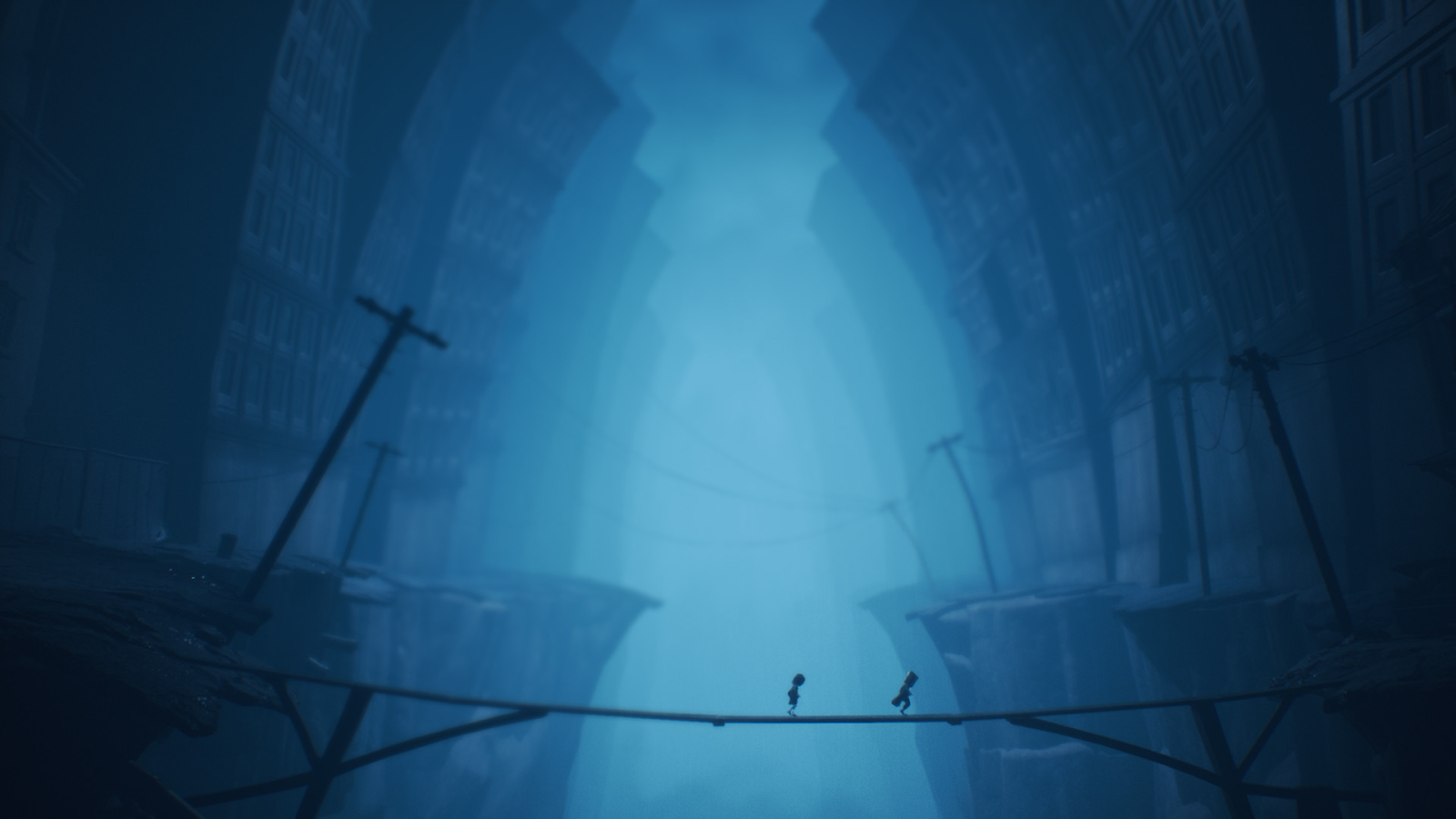
After escaping the Forest, Mono and the Girl cross a lake(?) using a giant door as a raft. Here we are properly introduced to the main setting of this game, a location that we will just call the City for the sake of simplicity. The City is for the most part abandoned, the only indication that people lived here are piles of discarded clothing. The buildings themselves seem to curve and look downward on our two protagonists, as if the City itself is watching their every move and judging them for it. And from this point on in the game, each main level is spaced out with a brief trip to the City streets until you head back indoors. Each trip to the City streets ends with Mono finding a working television set. Every time a TV turns on, Mono is drawn to them, like a moth to a flame. And interacting with said TVs allows Mono to catch a glimpse of that ominous door at the end of the hall that was teased at the start of the game. Before he can see what's on the other side, the Girl will pull him away from the TV as it shuts down once more. Again, all of this is important for later, so keep it in the back of your mind.

Image from https://adventuregamers.com/screenshots/view/38395/95962#images-61

The next level is the School, which is a level that I admittedly have mixed feelings on. First a little context. A feature that's new to Little Nightmares II is that Mono can pick up certain objects, such as wooden sticks and giant-sized utensils and use them as improvised weapons to attack minor enemies. The Forest doesn't really have any enemies besides the Hunter, who is clearly too big and strong to attack directly. So the School introduces the Bullies, the students of the School and the first enemy type that can be harmed with said weaponry. As such, if the Forest was an introduction to puzzle solving and Jolly Cooperation, then the School is the introduction to the combat system. The problem is that Mono's attack animation is rather slow, which makes sense since he is at best an adolescent human using tools meant for giants. But because of the slow attack animation, you basically have to time your attacks perfectly to defeat the Bullies, because if you swing your weapon too early or too late, they will kill Mono with one grab. The fact that Mono dies in one hit combined with his slow attack speed forces you to "git gud" as the saying goes, because this game's combat mechanics leave very little room for error. This is the only real criticism I have of the game, that the combat is just a little bit too unforgiving. What's worse is that (mild spoiler alert!) the enemies in the next level are nowhere near as aggressive as the Bullies, and if the Bullies' aggression was reduced slightly it would not be anywhere near as bad as it is currently. Like, I have beaten Little Nightmares II dozens of times. I've gotten every collectible possible and even tried my hand at just for fun speed running. But the School trips me up every playthrough precisely because of the unforgiving combat.

But on the subject of things I do like about the School, it has my favorite monster in the whole game, the Teacher. The Teacher is a female giant who, aside from her wrinkled "face" and stiff body movements, appears to be relatively normal. Then her neck starts stretching and slinking around the School like a demented serpent. The Teacher is the scariest monster in the game, because her design and abilities make you feel viscerally uncomfortable just from looking at her. And the Bullies, which devolve into rowdy degenerates when left to their own devices, shrivel up in fear when the Teacher is hosting a lesson. The whole School seems to fear the Teacher. Speaking of, while I dislike the combat sections with the Bullies, I do like the design and aesthetic of the School. Having such a mundane setting be twisted into a giant maze of bookshelves, desks and school supplies is peak Little Nightmares level design. And honestly, if it weren't for the combat sections with the Bullies, the School would have been my favorite level.

Anyway, early on in the level the Girl gets kidnapped by the Bullies, forcing Mono to fight his way through the School on his own. After spending almost the entire Forest level together, this is the first time our protagonists have been separated. As such, you do feel a little handicapped in your options, on top of the worry you feel for the Girl's well being. You get her back towards the end of the level, which leads to one of my favorite scenes from the whole game. So imagine. Mono and the Girl have been reunited, they're sneaking through a School corridor, and there is a lone Bully absentmindedly scribbling on the floor. There's a sledgehammer that you can grab. So your first instinct is to grab the sledgehammer and bonk the Bully before they can notice you. That's how you dealt with the Bullies before. But before you even have a chance to pick it up, the Girl runs over to the Bully and grabs them in a stranglehold. And then she breaks the Bully's head open with just her bare hands. If it wasn't for the Bully's head being made of porcelain instead of flesh and bone, this kill would have earned the game an M for Mature rating. It is genuinely one of the most disturbing sights in the game. For newcomers, seeing a child do something so brutal is not only harrowing, it's a hint that there is more to this girl than meets the eye. For veterans of the first game, this is your first clue as to the Girl's identity, which I won't spoil just yet.

So Mono and the Girl escape from the School and return to the City streets. Curiously, the Teacher is the only giant in the game that never gets killed on screen. In fact, Mono and the Girl don't do anything that prevents the School from making more Bullies. So no matter what happens next, just remember that the Teacher is still out there. But more importantly, it's now raining in the City. Mono is unaffected, but the Girl is visibly shivering from the coldness of the rain. So while exploring the streets, the Girl finds a bright yellow raincoat, which she equips immediately. Newcomers won't get what the big deal with the raincoat is, but anyone who played the first game knows why. Basically, the Girl putting on the raincoat confirms once and for all that she is the protagonist from the first game, a human(?) girl named Six. Again, because of the wordless nature of the story, you wouldn't know Six's name unless you looked at promotional material. So from here onwards, I will refer to the Girl as Six. Anyway, the reveal that Six was the Girl you were traveling with the whole time would have been a pleasant surprise, if it weren't for the fact that it was really obvious who she was from the moment she first appeared. First of all, the music box at the beginning of the game is playing a song from the first game called Six's Lullaby. Second of all, there's the aforementioned scene where the Girl smashes a kid's head open, and anyone who played the first game will tell you that Six is incredibly ruthless and prone to acts of extreme violence. And third of all, the Girl has literally the exact same model as Six, just without a raincoat. And finally, Six (complete with raincoat) is literally on the box art of the game, standing front and center alongside Mono. None of this is a bad thing, of course. It's just mildly amusing that the game treats the raincoat reveal as some shocking twist despite how obvious the whole thing is.

Anyway, after getting the raincoat and heading indoors, Mono and Six find themselves at the next main level, the Hospital. And the Hospital is the level where the game proudly says "I'M NOT GONNA SUGERCOAT IT!" and stops going easy on the player. The puzzles here are more complicated and require visiting multiple rooms to solve. There are minor enemies in the form of the Living Hands, which are exactly what they sound like. Living, disembodied hands that crawl around like spiders. These can be squished with a well-timed weapon strike from Mono, and they are as previously mentioned, nowhere near as aggressive as the Bullies. Overall, I think the combat in this level is better than the School because even Mono still dies in one hit, the skittishness of the Living Hands makes them easier to deal with. It's still not perfect, but I'll take the Living Hands over the Bullies any day. There are also multiple giants in the form of the Patients. The Patients are mannequins made with a mixture of cloth, wood and flesh. They only move when in complete darkness, so long as the lights are on they are as still as a statue. This level introduces the flashlight, a tool Mono can use to freeze the mannequins. While I don't consider the Patients to be the scariest or even the best monster in the game, they are definitely the most stressful to deal with. And also the scene where Mono is running down a hall while hundreds of Patient hands erupt from the walls is iconic. On par with the Dinner Guest scene from the first game.

Image from https://adventuregamers.com/screenshots/view/38395/95962#images-35

The Hospital is probably the longest level in the whole game, with the first half being Mono and Six trying to power up a defunct elevator by installing new fuses in the generator, and needing to solve a series of puzzles to get those fuses in the first place. The second half of the level is spent working your way downwards to the Hospital's morgue, where you encounter the main giant of the level, the Doctor. Insert Doctor Who joke here. Anyway, the Doctor is an obese slug-like giant that crawls on the ceiling and navigates the morgue while upside down. The Doctor can be seen experimenting on the Patients, taking them apart and putting them back together as crude abominations. However, the most interesting thing about the Doctor is that you can see the masks worn by every other giant encountered so far in his office. He even has the masks of the giants from the first game on display. So now we know who is the one in charge of making the masks and handing them out to the rest of the giants. What purpose the masks serve is still unclear at this point. Anyway, the Doctor chases Mono and Six through the rest of the morgue, but he gets trapped inside a cremator. You can either spare the Doctor's life by leaving for the elevator immediately or you can kill him by turning the cremator on, burning the Doctor alive. This is the only time in the game where the player can choose whether a giant lives or dies. It doesn't really impact the rest of the game as the Doctor never returns regardless of your decision. As sadistic as it sounds I prefer turning the cremator on, if only because it plays an animation of Six warming herself up with the cremator's fire. It's a cute animation that is made hilariously morbid with context.

The fourth and penultimate level is the City itself. Just the entire rest of the City. Mono and Six platform their way across the rooftops and sneaking through abandoned apartments. And surviving at least one collapsing building. They also figure out what happened to the rest of the City's population. They all got turned into the next main enemy type, the Viewers. The Viewers are the giant citizens of the City who having seemingly turned completely feral, despite ironically looking the most human of all the giants encountered so far. The only thing keeping their animalistic impulses in check is their addiction to TV. To give you an idea how desperate the Viewers are for any kind of stimulation, they will literally throw themselves off cliffs just to get a better look at a working TV. They will drag the TVs they do have into the shower with them so they can continue watching while bathing. They are so addicted they will put themselves, and anyone caught in their path into very real danger. Now I don't want to get too political here, but I'm pretty sure the central theme of this level is that too much media consumption is bad for your health. Especially since the only thing that the Viewers seem to watch is static. They aren't watching funny children's cartoons, or compelling romantic dramas, or even simple game shows. The Viewers are being stimulated with nothing more than meaningless lights and the pointless drone of static. 

Now is the point where I am going to tell you to beware of spoilers. From this point on, things get so wild that it would be a shame to not experience the game for yourself. If you want to know my opinion on the rest of the game without spoiling it too much, I consider this level and the final level to be pinnacle of Little Nightmares' art and storytelling style. And as previously mentioned, Little Nightmares II is one of my favorite horror games ever. So if you have any interest in playing this game, you can pick it up on literally any modern gaming system. Steam, PS4, Xbox One, Nintendo Switch, etc. Without further ado, let's get into spoiler territory.

So you know how I said that every time Mono finds a working TV he is drawn to it, and how he always gets pulled away before the door at the end of the hall opens? Well, in the fourth and final visit to the City streets, he finally got to see what was on the other side of the door! It was the Thin Man, a sharply dressed giant with unnaturally long limbs. The Thin Man then reaches out of the TV and into the real world and grabs Six, leaving nothing behind but a shadowy specter. Much like the School, the rest of the City level has Mono completely alone. There are two main threats in this level, the Thin Man himself and the Viewers. 

The main gimmick of the City level is that Mono has learned to do his own version of the Thin Man's ability to travel into and out of television screens. And Mono has to use this new ability to escape from Viewer hordes and reach areas that would be otherwise inaccessible. It's a really clever and creative gimmick that makes up the majority of this level's puzzles. The Thin Man himself only appears sporadically throughout the level. You cannot really hide from him the same way you hide from other giants. You either run when you see him appear, or it's back to the checkpoint with you. One detail I like is that the closer the Thin Man gets to Mono, the slower the world around him moves. So if he's right behind Mono, the whole game goes into slow motion. It's an effect that makes him both more unsettling and more dangerous than the other giants. Anyway, after enduring several injuries and losing all of his tools, Mono finally removes the paper bag mask and confronts the Thin Man directly. Mono then somehow steals the Thin Man's magical powers and destroys him with his own magic. It's an awesome scene, and the music and frame adds a sinister edge to it. Especially when you remember the first game's ending, where Six stole the Lady's magic and used her new power to slaughter hundreds of giants at once. But now that the Thin Man is dead, there are only two things left to do. The first is rescue Six, obviously. The second is track down the source of the TV transmissions that the Viewers are addicted to and destroy the signal. 

The final level is the Signal Tower, inside of which is a freaky nightmare realm with looping halls and furniture floating around in zero gravity. Nothing about the Signal Tower's interior makes logical sense. Because it's a nightmare that operates on "nightmare logic" In fact, one might say that the Signal Tower is A LITTLE NIGHTMARE. Insert "bad-um ting!" sound here. And once again, spoiler alert! I mean it this time. If the City was a good enough level to deserve a spoiler warning, the Signal Tower deserves a super spoiler warning. Because not only does this section spoil the final level of the game, it also spoils some late game stuff from Little Nightmares I. Understood? Good! So Mono reunites with Six. But something is... off about her. Something... Distorted. She's now a giant, with long arms that stretch and bend at painful looking angles and mismatching legs that are grossly longer on one side than the other. And mirroring the beginning of the game, Six is sitting alone in a room, her only comfort being the music box. Mono has grown to care about Six during their time together, and possibly in a misguided attempt to help his friend, Mono breaks the music box. Which sends the distorted Six into a frenzy. This is the final boss. It's not an exciting confrontation with whatever villain designed such a horrid City. It's a young boy trying to save his friend from a fate worse than death. There's something beautifully tragic about it.

Image from https://adventuregamers.com/screenshots/view/38395/95962#images-79

So Mono trashes the music box completely, restoring Six to her original form. But the Signal Tower begins to collapse. There is one last chase scene, where Mono and Six run through the falling ruins of the Signal Tower itself. But no matter how well you play, Six will always outpace Mono, and Mono will always fail the last jump. The only reason he doesn't die is because Six turned around and caught his hand. Now, a little bit of context here. Throughout the game, about once per level is a "Leap of Faith" spot. These spots are gaps that Six can get across, but not Mono. In order to get past these spots, Mono would have to jump across and trust that Six will catch him. The whole game was building up to this exact moment. This was the final Leap of Faith spot. And well... You know that scene in The Lion King? The one where Mufasa is hanging on the ledge and Scar starts to pull him up, only to say "Long live the King!" and throw Mufasa down to his death? Yeah. Six just drops Mono down into the Signal Tower ruins. Why did she do this? There's a lot of theories. Maybe she was always planning on betraying Mono once he outlived his usefulness to her, maybe it was an act of petty revenge. After all, Six has been beaten, chased, tied up and hanged upside down, shot at, and had a building collapse right on top of her since she first met Mono. Perhaps she blamed Mono for all the bad parts of their adventure. But if she did, why did she stick around for so long? She could have left Mono the moment they reached the City, but chose to stay anyway. Maybe her hand slipped and dropping Mono was a genuine accident. But if it was an accident, while did Six act so calmly about it? Either way, Mono falls into the ruins while Six returns to the City to do as she pleases. The final scene of the game is Mono growing old and transforming into the Thin Man before locking himself away behind the door at the end of the hall shown at the start of the game. 

One thing I neglected to mention earlier. There are two kinds of optional collectibles hidden in each level. The first are hats, which allow you to customize Mono somewhat. Most of these hats are goofy jokes, like a teddy bear hat and a bucket helmet. But the other collectible are Shadow Children. Shadow Children are spooky ghosts that disappear when interacted with. If you grab every Shadow Child in the game, the ending is altered to show one additional scene. In this new ending, we see Six experiencing one of her infamous hunger pains, just like in the original game. She then looks over an advert for a submarine-based restaurant called the Maw. Which is the location from the first game. And the place where Six will succumb to hunger-induced madness and become a cannibalistic sorceress. Which means there is a very good chance that this game is a prequel. Actually, I suppose the fact that Six went the whole game without using her sorceress abilities is a bigger piece of evidence for this game being a prequel, since she only gains those powers in the first game's ending. But this ending does solve one mystery from the first game, which was why was Six in the Maw in the first place. Before, it was safe to assume she was a captive or perhaps she was born there. But this ending implies she went to the Maw of her own volition with the express goal of finding something to devour. So there's that mystery solved.

So what does this ending mean? Lots of things. Firstly, the fact that Six is still experiencing her hunger pains (or perhaps, this is the origin of said hunger pains) means even if Six saved Mono at the end and the two lived happily ever after, Mono would eventually be attacked by Six once her hunger drives her to cannibalistic madness. In such a scenario, Mono would be forced to kill Six in self defense, or else Six would devour her only real friend. Therefore, Mono's days were numbered the moment he freed Six from the Hunter's basement. This isn't to demonize Mono. Not at all. I believe he was doing what he felt was the right thing. But more importantly, Mono became the Thin Man. Which means a few things. Most obviously, that "normal" humans can transform into giants, meaning all the monsters encountered in the Little Nightmares universe could have been innocent people who were twisted and contorted into monstrous parodies of their former selves. Secondly, it means that Mono is probably trapped in a Groundhog Day style time loop. Starting quite possibly as early as the Forest, freeing Six, narrowing escaping the giants, killing his future self, and being betrayed at the last minute. Only to be released by his younger self and doing everything again in a loop. Either that, or Mono was just yet another victim in a long line of different Thin Men. Each doomed to wait in a lonely room at the end of a hallway that only seems to exist in TV signals until some other poor fool repeats their mistakes and sets them free.

And there you go! A review of all five levels in Little Nightmares II. Spoilers are over, by the way. As for presentation, this is a game that rides that fine line between being hauntingly beautiful and deliberately disgusting. The closest thing I can compare it to would be something like The Nightmare Before Christmas or The Corpse Bride. In fact, the art style is reminiscent of Tim Burton movies in general. The camera is fixed at a single angle for the whole game, which gives the vibe that the player is peering into a deranged dollhouse or a sinister stage. And again, most of the locations are relatively mundane places in theory, like a school or hospital, but the gigantic and warped proportions of the buildings and furniture makes everything look uncanny. And the monsters are all excellently designed and animated. I especially like the detail they put into their "idle" animations. When the giants aren't attacking the kids, they can be seen doing normal everyday tasks around their respective facilities. The Hunter can be seen cleaning and stuffing a recent victim, the Teacher plays piano in between lessons, and the Doctor washes his hands before and after every experiment. It gives them all a little bit more personality outside of being angry murder monsters. This was something that was true of the first game's giants as well. I played the Nintendo Switch version of the game, and while I can't speak for other systems, I never encountered any kind of glitches or frame rate drops whatsoever. The whole game runs smoothly from start to finish.

The OST was composed by Tobias Lilja. And as far as this game's music goes, it bears repeating that Little Nightmares II rides that line between beautiful and disgusting.  Some songs in the OST, like Six's Lullaby or Togetherness are peaceful piano melodies, while other songs like Boots through the Undergrowth or Captive Audience sound less like music that you would willingly listen to for leisurely purposes and more like an alarm going off to warn you of incoming danger. This is not a bad thing, in fact it the "stressful" songs add to the experience. Nomes in the Attic is probably one of my favorite songs from the OST because it sounds eccentric and whimsical. Fun Fact! The music that plays when Mono fights the Bullies in the School is called Crackheads. I am not making that up. Whoever came up with the OST song names needs to be given a raise for that pun.

Now, sound effects! You already know what I am going to say. Fine line between beautiful and disgusting. The sounds of things like footsteps and Mono hitting something with a weapon are clean and crisp. The sounds the giants make come in varying flavors of uncanny. Like the sound of the Teacher's skin straining as her neck stretches is yet another disturbing element of her design. The sound of the Hunter's gunshots do a good job conveying just how much force and power he packs into his weapon. And one thing that I appreciate, which is both an audio thing and a visual thing, is that there are no actual jump scares at all in Little Nightmares II. It has enough confidence that its surreal and grotesque world and monsters are scary in and of themselves that it never resorts to cheap surprises to catch you unaware. In fact, the giants are well, giant, and as such you always see and hear them coming from miles away. But this doesn't detract from their ability to frighten, but it instead enhances it. Every scene with the giants is a tense game of cat-and-mouse. You are the "mouse." in this analogy. And you will be filled with dread as you hope that the "cats" don't notice you while you're sneaking around right under their noses. And when the "cats" finally notice you, that feeling of dread is transformed into adrenaline as you run for your life.

Overall, Little Nightmares II is a masterclass of horror. Its world is macabre, its denizens monstrous, and the whole experience is magnificent. I cannot recommend this game enough. If you like horror games, or want to dip your toes in the genre without diving headfirst into something more explicitly gruesome, then Little Nightmares II is a great place to start. I give it an easy 5 stars out of 5.

Little Nightmares II is owned by Bandai Namco and developed by Tarsier (who are no longer working with Bandai Namco at the time of writing). None of the screenshots used belong to me. Please support the official release.

Friday, September 15, 2023

Subnautica, finding beauty and terror in the deep blue sea. A review

 You may not know this, but I like horror games. Five Nights at Freddy's, Little Nightmares and Bendy & The Ink Machine were my first real exposure to the horror genre, and I've enjoyed the thrill of these kinds of games ever since. But you want to know the scariest game I have ever played? The one that gives me overwhelming dread and terror every time I play through it? That game is called Subnautica. Which is funny, because that isn't even a real horror game. At least, not in the conventional sense. So let's talk about it!

image from Wikipedia.org and Giant Bomb

Developed and published by Unknown Worlds Entertainment, Subnautica is a charming survival adventure game released back in 2018. The game sold 5.3 million copies and is often considered a must play for survival game fans. Basically, think Minecraft or Terraria but underwater and with a smoother art style. Anyway, you play as a space traveler named Ryley Robinson. Ryley was a crewman of The Aurora, an enormous Star Trek style space cruiser that has sadly crash landed on an alien planet. This planet, given the rather clerical name of 4546-B, has a surface comprised of  90% water. In other words, almost the entire planet is one big ocean. You are then dumped into Riley's shoes and told to find a way to escape, while also looking for any survivors of the crash. Your only companion for most of the game is the PDA. The PDA (Personal Digital Assistant) is an AI Program designed to keep you alive in this foreign, presumably hostile environment for as long as possible. It also doubles as the in-game tutorial, teaching you basics of exploration, crafting, and building management. The story is admittedly a simple tale of one man trying his best to survive an alien environment, but the fact that this game even has a story at all is a big deal. Most survival games don't even have a story, or named characters, or an explicitly stated goal to work towards. Normally they just dump you in a metaphorical sandbox and tell you that you need to "make your own fun!" For having a story, and a competently written one at that, Subnautica already gets points for originality.

The bulk of your time is spent swimming around in an alien ocean, collecting resources and finding new technology blue prints to build with. Most creatures in the game are not truly hostile to you, though some like the Stalker and Crash Fish will attack if you provoke them first. They are, after all, just regular animals, at least by this planet's standards. The only exception to this rule are the Leviathans, but they deserve their own section of the review. When you first start the game, you have nothing to your name except for some protein bars and a bottle of drinking water. Everything you want, you have to make yourself. Want to swim faster? You got to make yourself a pair of fins to boost your swim speed. Want to stay underwater for longer? You got to build an oxygen tank so you don't drown. Want a place to store your belongings and admire the oceanic views in piece? You need to build a habitat. While some items can be crafted as soon as the game starts (assuming you have enough resources) most items require you to find the associated blue print for that item beforehand. Blue prints can be found either in abandoned bases left by the other survivors or by scanning debris from the Aurora with the scanner tool.

Image from trueachievements.com

All of these things cost resources, which you collect simply while exploring the ocean. And some resources can be turned into other resources. For example, kelp can be made into fibers, and copper ore can be made into either batteries or wires. And unlike every other survival game in existence, Subnautica does NOT have procedural world generation. What this means is that instead of letting an automatic generator create the world from a randomly chosen number, the world has been handcrafted by the developers themselves. And honestly, the ocean is wonderfully designed. Every biome, every bit of coral and every branch of kelp was placed deliberately for the best possible experience. You always start in the Safe Shallows biome, which true to its name, is the safest and shallowest area in the game. It's the only place in the game where you can reliably build above sea level, and the wildlife here is mostly docile.

But I know what you are thinking. "Spencer, this doesn't sound that scary! This game sounds pretty chill, actually!" That's because of how Subnautica is balanced. You need to leave the Safe Shallows eventually, either because you ran out of resources to work with or because you want to progress the story. And the further away from the Safe Shallows you go, the more danger you will find. The animals get more territorial and aggressive. The water pressure makes swimming without specialized submarines impractical. Even the sunlight itself darkens to pitch black if you dive deep enough. While the Safe Shallows are a good safety net, it is impossible to beat the game without taking that plunge into the dark, unknown abyss. And the biomes get progressively creepier as you descend.

And sooner or later, you will face a Leviathan. Leviathans are the game's main mascot monster. There are a few variations of these enormous life forms, some being more peaceful than others. The Reef Back Leviathan is a giant whale-like creature that is completely docile, even letting you mine ores off its back. The Ghost Leviathan is a blue serpent that only appears if you somehow go outside the ocean's borders, and it attempts to scare you back in. And then there's the Reaper Leviathan. The Reaper is an apex predator that will hunt you down to the ends of the ocean if it catches your scent. It can destroy entire submarines with just one or two attacks, patrols several areas that are critical for story progression, and announces its presence with an unsettling roar. The threat of Reaper Leviathans is so great that whenever I head to any area they frequent, I try to speed-run my way past them, because the less time you deal with Reapers, the better.

Image from ausgamers.com

But the Reapers by themselves aren't the main reason I consider this game to be scary. They are the most dangerous fish in the entire game, that much is true. But the reason Subnautica is scary is because of the ocean itself. It grows darker and darker as you descend, it hides its treasures in caves and tunnels hundreds of miles below the surface. You have no clue what is down there, and you have no idea what might be looking back at you. So imagine, going so deep underwater that you can't see the sunlight anymore. You have no idea what time of day it is. You go into a cramped underwater cave. You get mixed up in the cave system, and can't find your way out. Your equipment is low on battery charge. You start to panic as your oxygen depletes. You know if you don't get out now, you will drown. You frantically kick around, trying to find an exit point. You find a hole in the ceiling. Hope fills your heart as breathable air leaves your lungs. "I can make it!" you think. You swim as fast as you can, and as you make it out of the cave, you hear it. A blood curdling roar in the distance. Where is it coming from? You can't tell. Your only concern is getting some air in your lungs. As you kick and struggle against the watery abyss, you realize as your oxygen runs out completely and the Reaper approaches from the pitch-black abyss... You never stood a chance. Even if you made it back to the surface, you couldn't outrun the Reaper. Or vice versa.

That is why Subnautica is scary. It is a game that perfectly captures that feeling of terror and desperation that comes with the danger of underseas exploration. It is a known fact that humanity has explored more of outer space than our own oceans. You know why? Because the deep blue sea is an environment completely alien to the human experience. We as a species do not belong that deep underwater, either because the water pressure would destroy us, or we would encounter a sea creature that exists far beyond human comprehension. Something within us knows that fact deep down, even if we would never admit it. And Subnautica manages to recreate these feelings using a fictional, alien ocean and fictional alien fish. In that regard, Unknown Worlds has my respect.

This isn't to say that Subnautica is always scary all the time. This is just a specific scenario after all, and the majority of a playthrough is spent just taking in the wonder and majesty of this strange, but beautiful underwater world. In fact, the game has a surprising amount of humor, mostly delivered through the PDA and collectible logs you can read for lore. I think my favorite joke is that the PDA reminds you that any resources you collect are legally the property of the Alterra Corporation (the company Ryley works for), and that anything he crafts he owes back to the company. There's also another joke about how one of the survivors managed to kill themselves accidentally by waving a distress flare around an exposed gasoline leak, thus triggering a deadly explosion. That sounds horrible, but the context makes it clear this was more of a moment of avoidable stupidity than anything truly tragic.

On the subject of difficulty, Subnautica offers three main difficulty options. Freedom Mode is the easiest, Survival Mode is moderate, and Hardcore Mode is as hard as it sounds. In Freedom Mode, the hunger and water gauges are disabled, meaning you no longer have to worry about collecting food or drinking water to survive. In Survival Mode, you do have to worry about hunger and thirst, and you will drop a random assortment of items upon death. Hardcore Mode is exactly the same as Survival Mode, but with a caveat. If you die in Hardcore Mode, your save file is automatically deleted, forcing you to restart the entire game from Day One. There's also a variant of Freedom Mode called Creative Mode. Creative Mode turns you completely invincible, and free to build whatever you want with a infinite supply of resources. In other words, it's exactly like Minecraft's Creative Mode. The difficulty is sadly locked into the save file, which means if you want to adjust the difficulty you do need to play the game again from scratch. I personally played through the game on Survival Mode, since the sales pitch is "survive in an alien ocean" and I wanted the full survival experience. But I'm also not good enough at the game to beat it in one go, so Hardcore Mode is a pass for me. 

There's also base building. That's what the habitats are for. They allow you to store all of your belongings, and can be outfitted with specialized rooms for additional utility. Say you need to find a specific resource for your next project. Scanner rooms (which are like giant versions of the scanner tool) can highlight that specific resource within a 50 meter radius so you can find it more easily. If you need a reliable source of food, indoor planter boxes let you grow edible plants as long as you have enough room for them. If you have a submarine with a low battery charge, The Moonpool can automatically recharge your sub as long as as the habitat has power. Speaking of power, there are two main things to keep in mind when building your habitat. The first is power, and the second is structural integrity. Let's talk power first. You need electricity to keep things running. But where does one get electricity? There are a lot of ways, though their effiency is dependent on the location you built the habitat in. Solar panels generate power from sunlight, obviously. But if your habitat is so deep underwater that you can't even see the sun, solar panels stop working entirely. Thermal Plants generate power as long as you build near a large source of heat, such as a geyser or undersea volcano. In colder regions they are pretty much useless, but in warmer waters they surpass all other options. Bio Reactors convert dead fish and kelp into power and can function just fine in any location, but Bio Reactors can burn through your surplus supplies if you're not careful. Nuclear Reactors are far stronger than the other three options combined and works just about anywhere. The problem is that Nuclear Reactors produce nuclear waste, which is both useless and potentially dangerous. Use whichever form of power is best for the kind of habitat you want to build.

Now let's talk structural integrity, the second main thing you need to worry about for base building. Basically, every time you add an additional room to a habitat, the structural integrity will lower. If it reaches below a certain threshold, your habitat will break apart and start flooding. This is bad, for obvious reasons. While you can repair any damage done to your habitat with the appropriate tool, it is better to prevent this from happening altogether. You can do this by raising a habitat's structural integrity with foundations, reinforced walls, and bulkhead doors. All of these solutions are fairly expensive in terms of resources. So it is generally better to build small to medium sized habitats with reinforcements here and there than to try and make a massive mega base. That said, if you are dead set on making one big mega-base with multiple floors and dozens of rooms, you can do that as long as you use enough reinforcements to keep it from collapsing. Habitat building requires you to have enough planning and foresight to both keep the base powered as well as making it structurally sound, while being flexible enough to make something that looks aesthetically pleasing. It's a simple, but engaging base building system.

You know how I said that Subnautica is one of the few survival games to have a story? Throughout the game, you find audio logs from the other survivors of the crash. And even some logs from the crew of an entirely different spaceship that crashed on this same planet several years before you did. Through these logs you learn that the planet is under quarantine. There is a water-bound bacteria that infects all living matter with a deadly virus. This virus wiped out the intelligent life forms on 4546-B, leaving only the fish who developed a natural resistance to it. And this was why the Aurora crashed; it was shot down by an automated anti-air cannon to prevent the virus from spreading to the rest of the galaxy. Your new goal from now on is to find a way to cure the virus and disable the quarantine system, because even if you manage to build a one-man spaceship to get back to human civilization, you will just be shot down again if you don't cure the virus before launching. One thing I really like about this storyline is how you learn you were infected by the virus. At the beginning of the game you are given the option to scan yourself with the scanner tool. The first time you do this, Ryley's vitals come back normal. But after a few days, if you choose to scan yourself again, you'll hear an alert about a bacterial infection in Ryley's body. Let a few more days pass, and the next time you look at your bare hands, and you might see grotesque tumors forming on your skin. There's no fancy cutscene for this reveal. You could easily miss these details if you aren't looking for them. But I appreciate when devs try to tell story through game mechanics instead of traditional cinematics. Of course, this game pulls a Batman: Arkham City when it comes to the idea of the protagonist being infected with a virus. No matter how long you take to beat the game, the virus will never kill you because the rate at which it spreads in Ryley's body is tied directly to story advancement. Ryley will always survive "just" long enough to cure himself, even if the virus has been eating at him for in-game months or years. This might be immersion breaking, but I view as a quality of life thing. After all, it would really suck if your Hardcore run was stopped because you took too long to find the cure.

In terms of presentation, Subnautica is definitely a good looking game. It has a clean, almost cartoony aesthetic. Most of the technology in this setting is smooth and pristine, when it's not being ravaged by wildlife. The creature designs are also excellent. Even though they are fictional alien fish, most of the animals here have enough biological consistency that they could believably exist in real life. They move like believable animals and they act like believable animals. Like, I could totally see National Geographic doing a nature documentary on these creatures. And the biomes are all distinct from each other, using wildly varied colors and lightings to make each one stand out. And because of that, you can reliably guess where in the world you are just by the colors. Just to give a few examples, the Safe Shallows is a coral reef so close to the surface that parts of it jut out above the water, and it uses a lot of blues and greens to look safe and inviting. The Jelly Shroom Cave is an unground cave system filled with bioluminescent mushrooms, and it uses pinks and purples to convey a sense of wonder and mystery. And The Crash Zone is a dead, barren wasteland consisting entirely of sickly yellows and browns. Every other biome follows this pattern of being tied to one or two distinct colors that immediately showcases the "vibe" of the biome in question.

There are only two bad things I have to say is that this game, one of which is a problem that almost every survival game experiences; if you move too quickly through the world, the game starts having a hard time loading in terrain and associated textures in time with your movement. Basically, if you move too fast, the sea floor might disappear for a brief moment until the game can load it back in. And with the sole exception of Terraria, every survival game I have ever played has a problem similar to this. Heck, even Minecraft, a game that was hailed as one of the best survival games ever made, has this problem. I played the game on PS4, and I do not know if this a console problem or a problem with the game itself. But this is not really a deal-breaker, because again, every survival game has this issue. It just breaks immersion a little if it happens to you. The second main issue with Subnautica is that the controls for walking on dry land are a little bit clunky and awkward. Which also isn't a deal breaker because you spend so much of your time underwater, and it is clear that the devs prioritized getting the aquatic movement right over the land movement.

The game's sound design is impeccable. Its music, composed by Simon Chylinski, is ethereal and mysterious. The music invites you deeper into the ocean while simultaneously making you feel trapped by it. The simplest way to describe Subnautica music is that it is the soundtrack equivalent of a siren's song. Fitting for a game about undersea exploration. The only exception to this rule is Abandon Ship!, a song in the OST that only plays when your submarine is critically damaged. This song can best be described as an intensely urgent techno rave. It's not bad, in fact it's one of the best songs in the whole OST. But again, it only plays when your sub is critically damaged. And it blows my mind that the best song is played during a situation the player would rather avoid. On an unrelated note, the sound effects are also great. The Reaper's roar is intimidating, the soft hum of the submarine's engines give a sense of power, and the voice acting is actually really good. Which, again, is surprising for a survival game, since these games typically don't have voice acting at all. The PDA speaks in a comically monotone voice that feels accidentally sarcastic. The Sea Emperor (who holds the cure for the virus) sounds equal parts majestic and regal, but also ancient and tired. Which fits for a creature that predates the virus that killed all the land-dwellers in the first place. And the audio logs you can collect do a good job showcasing the stress and despair the other survivors felt in their final moments.

Overall, Subnautica is a beloved icon of survival games for a reason. It manages to be just as, possibly even more scary than actual horror games while being a fun underwater exploration experience. I consider this game, Minecraft and Terraria to be the "Holy Trinity" of survival games, for these three games set the standard for which all other survival games should be judged against. So if you like Minecraft or Terraria, you will probably like Subnautica. Even if you haven't played a survival game before, Subnautica is a great place to start. For these reasons, I give Subnautica a perfect rank of Five Stars out of Five.

Subnautica is available on PS4, PS5, PC, Nintendo Switch, Xbox One, and Xbox Series S/X. Subnautica is the property of Unknown Worlds Entertainment and their parent company, Krafton. Please support the official release.

Thursday, August 17, 2023

An extremely late review of the hardest game I've ever played: Sekiro

Hey there. Long time no see. I haven't posted anything in over a year and that's no good. Why was I gone for so long? To make a long story short, I lost motivation to work on the blog. For a very long time. So this blog kind of became a zombie blog. No new content but somehow still getting views. In the meantime I started writing my own original stories, but none of them are at a state where I feel comfortable sharing them on the Internet. So until my original work is complete, I am going to try and revive the blog. And I am going to attempt to stick to a monthly/bi-monthly schedule, so something like this doesn't happen again. With that spiel out of the way, I want to introduce you to one of, if not the single most difficult game I ever played... Sekiro: Shadows Die Twice.

Image from Wikipedia.org

Sekiro was developed by From Software and published by Activision (before they were bought out by Microsoft), and was released in 2019. To say From Software is a one trick pony is to do them a disservice. They are more like a one trick unicorn. They only really make one kind of game (that being Gothic Horror adventure games with deliberately steep learning curves and mysterious storylines that the player has to figure out themselves), but they have gotten so good at that one style of game that they have refined that one style to near perfection. Of course, the problem with this is that if you don't like From Software's style, you're probably going to find their entire catalogue off putting. And no game embodies the "one trick unicorn" mindset better than Sekiro: Shadows Die Twice. Now, I love the From Software games. They are true artists, with a clear passion for their work. And indeed, I consider Sekiro to one of their finest works. It's not their best game, but it's definitely in the top three. But explaining why I like this game is complicated. Hence, the purpose of this review. Quick content warning, though. This game is rated M for Mature by the ESRB, meaning it is intended for audiences 17 years old or older. The review itself will keep things (somewhat) family friendly, but this is not the kind of game you want to give Little Timmy to keep him distracted for five minutes. Not unless you want a broken controller. Or nightmares about undead monkeys.

So what exactly is Sekiro: Shadows Die Twice? Sekiro is an action-adventure game created and directed by gaming legend Hidetaka Miyazaki, who is most well known for his work on the Dark Souls trilogy. This game is technically considered a part of the Souls Borne series, but it is often regarded as the black sheep of the series. This is due to its more straightforward narrative and lack of series standard features, such as multiplayer or character customization. Despite its status as the "black sheep" of From Software's catalogue, Sekiro was their first game to win the Game of the Year Award, cementing the developers' status as legitimate titans in the video game industry and not just a niche studio. 

Taking place in Sengoku Era Japan, you play the role of a Shinobi known only as the Wolf. In case you're unfamiliar with Japanese history, the Sengoku period was regarded as the darkest and bloodiest time in the country's history. It was almost a hundred years of nonstop civil warfare, bloodshed and violence. But while this war wages on, the Wolf is tasked with protecting a small child named Kuro. And protecting Kuro is important because he possesses the power to grant immortality to anyone of his choosing. In other words, Kuro is a walking Fountain of Youth. Despite taking place in a real historical setting, Sekiro has a lot of fantasy elements, so don't expect the game to be historically accurate.

Anyway, Kuro and Sekiro planned to flee the country to keep the power of immortality out of the wrong hands. Unfortunately, a samurai named Genichiro blocked their escape route. The player is then dropped into a scripted boss fight that a first time player has no chance of actually winning. And this is done to teach the player one valuable lesson: You are going to fail in this game. A lot. And that's okay. Sekiro is a game that has earned a reputation, rightfully so, as one of the most challenging video games ever made. But with enough time and practice, you can defeat people like Genichiro without breaking a sweat. But back on topic. Genichiro chops off the Wolf's left arm and kidnaps Kuro. The Wolf did not die, for Kuro's immortality blessing was protecting him. But he was now missing an arm. So a mysterious elder called the Sculptor gives the Wolf a wooden prosthetic that can be customized with a wide array of gadgets. The game starts for real here.

The plot for the first half of the game is surprisingly simple. The Wolf is honor bound to rescue Kuro by any means necessary. But he is free to explore the world however he wishes as long as he works towards that goal. And one of the biggest departures from From Software's usual storytelling style is that the Wolf is an actual character. Normally, Souls Borne protagonists are mute but customizable heroes, serving as self-inserts for the player. But the Wolf is a predetermined protagonist, with his own personality and motivations. And your enjoyment of Sekiro is going to come down to whether you are okay with playing as an established character instead of a self-insert. I personally really like the Wolf. He's very serious and uptight, only speaks when spoken to first and even then, he keeps conversations brief and to the point. The Wolf has lived an extremely hard life, being an orphan adopted by Japan's most dangerous assassins, and the only thing keeping him sane is his determination and loyalty to Kuro. And for From Software's first attempt at a predesigned hero, the Wolf works well. He fits the gloomy, Gothic Horror inspired worlds that From Software are known for while having a journey that feels more personal because he has a very clear goal to work towards and a very clear villain to stop.

Speaking of villains, the main villain of this game is Genichiro, the samurai from the start of the game. Genichiro is a man with a surprisingly sympathetic motive. He was adopted into a family of samurai warriors called the Ashina Clan. Genichiro genuinely loves the clan like the family he never had. And he will commit any atrocity he can to save his family from the war. This is why Genichiro kidnapped Kuro in the first place. He wants Kuro to bless his army with immortality so they can outlast their enemies in a battle of attrition. Kuro refuses to cooperate because every time someone is blessed with immortality, a random person in the world is infected with a deadly disease called Dragon-Rot. So blessing an army would cause a plague. Genichiro knows this, and doesn't care. He is so desperate to win the war he is willing to cause a global pandemic. 

You fight Genichiro multiple times throughout the story, and I'm going to be honest, Genichiro was the boss that got me to like this game. Up until the second duel with Genichiro, I had very mixed feelings on Sekiro. Sure, I liked the samurai aesthetic and the combat against regular enemies, but the first few bosses were frustrating to deal with, and I had to take multiple breaks to calm down in between each attempt. I pushed as far into the campaign as I did more out of stubbornness than actual enjoyment or fun. But Genichiro redeemed the game in my eyes. He was the best showcase of Sekiro's combat up until that point, and I didn't even mind losing to him because he had a perfectly polished duel. Utilizing swordsmanship and archery in equal measure to keep you on your toes. He's fast, but predictable. His attacks have a good rhythm that makes learning how to deflect easier the longer the fight goes on. But most importantly, fighting him was actually fun! And the bosses that came after Genichiro's second duel were even better! The only reason why I consider Elden Ring (another Souls-Borne that won Game of the Year) to be a better game than Sekiro is because the bosses before the Genichiro rematch are too annoying and frustrating for their own good. If Sekiro had a better early game experience it would surpass Elden Ring in my eyes. That isn't to say that Sekiro is a bad game. Both of these games are excellent showcases of From Software's talent and passion. I just feel Elden Ring is a slightly better experience overall because of its more beginner friendly early game.

The game's story takes a weird turn when you finally reunite with Kuro. You see, Kuro has grown to resent his immortality powers. So he starts cooking up a plan to erase the very concept of immortality from reality. At this point the Wolf's goal changes from simply rescuing Kuro to helping him complete a ritual known as Immortal Severance. From here, the story can branch off into one of four endings, based on which version of the ritual you perform. These endings play out in the typical fashion for Miyazaki stories. Here's a mild spoiler warning for the remainder of this section of the review. There's a bittersweet ending where your journey's end mirrors the beginning in a cyclical manner, a more positive ending where the hero sacrifices themselves to give the future generations a better future, and a weird ending hidden behind an elaborate puzzle. There's also a bad ending choice that can be made halfway through the game, which ends the story early and locks you out of the entire second half of the game. Personally I liked most of these endings, though I feel that the "heroic sacrifice" ending is the one that stays truest to the Wolf's characterization. But I did get the weird ending on my first playthrough simply because this game's weird ending is called the Dragon's Homecoming, which is the coolest sounding name for anything in any video game ever. Like, I saw the names of the different endings (which are vague enough to not spoil their contents) while looking at the PS4 Trophy requirements, saw "Dragon's Homecoming" and decided I would go for that ending simply because that sounds cooler than all the other options combined.

Image from sekirothegame.com

But that's enough for the story. What about gameplay? If I had to describe Sekiro in one word, it would be "speed." This game is fast. Very fast. The Wolf moves remarkably faster than any other Souls-Borne character, at least so far. But almost every enemy in the game can match that speed or even surpass it. So how do you defend yourself against such foes? Deflecting. Now, a quick history lesson for anyone unfamiliar with From Software. All of their Souls-Borne games had a deflect ability. And in every game besides Sekiro, it was (in my opinion) too risky to use because it was impossible to tell what could be deflected and what could not unless you looked up that information ahead of time. Sekiro solves this problem with two very simple solutions. First, almost every attack can be deflected. And second, the few attacks in the game that can't be deflected have a clear visual and audio telegraph warning you ahead of time. These are known as Perilous Attacks. If you hear a violin shriek or see a red Japanese symbol floating above your head, that is your cue to get out of the way. But aside from Perilous Attacks, everything in the game can be deflected. Regardless of size, speed or power. You can deflect a charging bull, throwing knives from other Shinobi, body slams from a King Kong sized ape, and everything in between so long as it not a Perilous Attack.

And you want to be deflecting as much as possible. Every time you deflect an enemy's attack, you deal damage to the enemy's Posture. Think of it as a second health bar for enemies. If an enemy's Posture is completely broken, the Wolf can perform a one hit KO move called a Shinobi Deathblow. Generally speaking, it is often both faster and safer to break enemy Posture with deflections and finish them off with a Deathblow than it is to defeat the enemy with normal attacks. Especially since some enemies don't give you any time to attack directly, meaning you have no choice but to use deflections to break through their Posture. And when you are deflecting a seemingly endless barrage of blows and finally pull off that Deathblow at the end, you feel like a master swordsman. In that regard, Sekiro might have the best sword duels in video game history. Just keep in mind that the Wolf also has Posture of his own, and yes, if the Wolf's Posture is completely broken then he too becomes susceptible to a Deathblow. There's also a stealth system that lets you sneak past enemies or slay them quietly, though it is a very simple system and said enemies will lose track of you just mere minutes after spotting you. One cheeky thing you can do is use stealth to sneak up on certain bosses and perform a free Deathblow on them, which skips over the entire first half of the boss battle. This sadly doesn't work on every boss. But when it does work, it feels cathartic. 

One of the biggest points of contention among From Software fans is that the Wolf cannot be customized. The rest of the Souls-Borne series have a huge selection of weapons, armor and magic spells that let you handcraft your character's fighting style to your exact liking. Sekiro doesn't offer any of these options. You start the game with a katana and you end the game with that same katana. There is some customization in the form of the Shinobi Tools and Combat Arts, but these are supplements to the main fighting style, not replacements or alternatives. Shinobi Tools are gadgets that can be attached to the Wolf's prosthetic arm, and you equip up to three of them at one time. Each one is custom-tailored for specific threats. For example, The Loaded Axe can break through enemy shields while the Flame Vent can be used to set foes on fire. All Tools use a limited ammo source called Spirit Emblems, which make it so you cannot use the Tools recklessly. The only exception to this rule is the Grappling Hook, which not only has infinite uses, but is always equipped to the Prosthetic no matter what. This sounds overpowered, but the Grappling Hook is used almost exclusively for traversal, so it balances itself out. Combat Arts are special attacks that can be performed by pressing the attack and deflect buttons at the same time. These are special attacks have some additional utility on top of doing damage. For example, "Double Ichimonji" restores the Wolf's Posture with every use, while "High Monk" can be used to jump over certain Perilous Attacks. You can only have one Combat Art equipped at a time. 

Image from sekirothegame.com

But there is one thing I have to address in this review. The difficulty. Sekiro is a hard game. There is no easy mode, or any equivalent thereof. And unlike the rest of the Souls-Borne series, there is no co-op mode that lets you team up with other players if you get stuck. And to add insult to injury, if you die multiple times in a row, a random friendly character or merchant will get infected with Dragon Rot, pausing any storyline or business that character is involved in until you find a cure. Combine all this with the limited customization, you get what is often considered the hardest game From Software has ever made. The biggest flaw with this game is that its difficulty feels very frontloaded. You start the game with only one healing potion instead of the series standard three potions, and the items needed to upgraded the Wolf's health and defenses are locked behind some deceptively tough bosses. The first three or so areas feel much harder than the rest of the game for these reasons, but if you can push past those grueling first areas and get some upgrades, the rest of the playthrough becomes much more manageable. 

Fun fact! I rewrote this section more than any other part of the review, because every time I try and explain my thoughts on the difficulty in a concise manner it always devolves into me complaining about the Chained Ogre and Blazing Bull bosses. I'm pretty sure those two bosses killed me more times than the actual final boss. But with the benefit of hindsight, the Blazing Bull wasn't that bad. You just have to turn off the "logical" part of your brain when you deflect it, because the Wolf deflecting a charge from a giant bull covered in fire does not look like it should be physically possible. But it isn't considered a Perilous Attack, so despite all logic and reason, you can deflect the Blazing Bull's charges. The Chained Ogre has the opposite problem. Almost everything it does is considered a Perilous Attack. And the Ogre is fought early enough in the game that a new player might come to the conclusion that dodging is more important than deflecting, when the opposite is true. If they toned down the number of Perilous Attacks the Chained Ogre has, or maybe moved it further into the campaign when Perilous Attacks become more frequent, then it wouldn't be that bad. But if anyone quit the game because of Chained Ogre or Blazing Bull, I wouldn't blame them.

But on the subject of bosses I actually like, The Great Shinobi Owl is a personal favorite of mine. He is the Wolf's father, and as such he fights with all the same Shinobi Tools and Combat Arts that the Wolf uses. Shuriken, firecrackers and poison bombs are just a few examples of the stuff he can pull out at a moment's notice. He is a cunning and manipulative trickster, and at one point he even feigns surrender just to get some cheap hits in. Owl is as close as the Wolf gets to fighting a clone of himself, which makes this fight even more brilliant. And his theme music is so good I was literally stunned in real life by how good it was. And thanks to what can best be described as time travel shenanigans, the Wolf can challenge Owl to a rematch in the distant past, and a good fight got only better because this Owl is in his prime. As such, he moves faster, he has new combos and weapons to deal with, and he can even summon ghostly owls to assist him. And his theme music somehow got even better!

And of course, you can't talk about Sekiro without talking about the Sword Saint. Most discussion of this game online is about the Sword Saint. Spoilers again, since the Sword Saint is literally the final boss. The Sword Saint is Isshin Ashina, Genichiro's surrogate grandfather and the greatest swordsman who ever lived. Earlier in the game Isshin winds up dying of a terminal illness. Genichiro gets his hands on a magic sword called the Mortal Blade, which can bring one deceased person back to life as an immortal being, at the cost of the user's soul. So Genichiro uses the Mortal Blade to revive his grandfather, sacrificing his own life to do so. Isshin agrees to fight the Wolf, not because he wants to, but to honor his grandson's dying wish to protect the Ashina Clan and win the war. And you get a glorious, one on one duel between two immortal swordsmen, throwing everything they got to put the other down. The Sword Saint is one of the best boss battles I've ever seen in any video game ever, right up there with Nightmare King Grimm from Team Cherry's Hollow Knight. He tests your skill with every aspect of the game's combat. He has fast katana strikes that need to be deflected, and wide reaching Perilous attacks from a giant spear to test your dodging skills. He has a flintlock pistol that he can use to take potshots at you from a distance. He'll even use heretical magic to supercharge his weapons with electricity, requiring to perform deflections in midair to avoid getting zapped. And you fight him in the same open meadow at the start of the game, where you first fought Genichiro. And when you land that final Deathblow on him, Isshin's reaction isn't rage or despair, it's respect. His last words to the Wolf are congratulating him for being a splendid warrior, with no hard feelings for everything that happened. Everything about the Sword Saint, from the spectacle to the music to the actual fight, is a perfect climax to end your journey. 

Image from sekirothegame.com

On the subject of presentation, Sekiro is definitely one of the best-looking games in From Software's catalogue. While it does have traces of the Gothic Horror flair that the developers are known for, it's mixed in with this Feudal Samurai aesthetic that lets the game stand out among its peers. Some areas, like the Senpou Temple, are simply gorgeous to look at with bright colors and an almost serene atmosphere. Other areas, like Mibu Village, are decrepit shells of their former glory. And a personal favorite area of mine is the Hirata Estate, a once prestigious palace engulfed in flames. One thing I noticed is that their is a stronger focus on verticality in Sekiro compared to previous From Software games, with lots of multi-story buildings and steep cliffs. This is partly to give you places where you can reliably use the grappling hook, and partly to induce a sense of grandness and overwhelming scale. The enemy designs are also some of the best in From Software's catalogue. Surprisingly, there's not a lot of incomprehensibly twisted monstrosities, like a normal Souls-Borne game. Instead, most of the enemies are humanoid, and their designs are generally cleaner to look at. Considering the strong emphasis on sword duels, the enemies had to have these cleaner designs so you could actually tell what they are about to do and respond accordingly.

One of my favorite bosses in terms of spectacle is the Guardian Ape due to the transition between its first and second forms. Mild spoilers, but when you defeat the Guardian Ape for the first time, the Wolf decapitates it. You get the "Shinobi Execution!" message that marks the end of a boss battle. But the gate to the next area is still closed. And the Ape's body stands back up, grabs its severed head, and keeps on fighting like nothing happened. It's a good scare that lures you into a false sense of security, especially because the "Shinobi Execution!" message makes the fake out feel more authentic. And the way the Ape's undead form moves around like a puppet being guided by invisible strings is not only unnerving, but its a hint to the Ape's true nature as a victim of one of the Senpou Temple parasites.

There is only one critique I have with the game's presentation, and that is the frame rate. Now, Sekiro has a frame rate of 60 frames per second on PS4 (the system I played it on). This is a fine framerate for an action game. But one area in the game, Ashina Castle, causes problems. Ashina Castle is by far the biggest area in the game, being a massive, well, castle that must be climbed from bottom to top and back again. Because of how big this area is, and all of the moving enemies within the castle and around its perimeter, this area causes the frame rate to slow down. The framerate does correct itself after a few seconds, but the framerate dips happened often enough in this one area that I couldn't ignore it. What's weird is that this the only area with framerate problems, the rest of the game runs just fine. This is most notable during the third and final visit to the Castle, where Central Ministry forces are added on top of the Ashina Clan enemies already in the Castle. While it is cool to see the two villain factions duking it out, the chaos they cause together is what really brings down the game's framerate. All of this is of course, not a deal breaker, just something to be aware of.

The sound design is excellent. The sound effects for the clashing of steel is clean and crisp, especially if you deflect multiple attacks in a row. The mechanical whirs and clicks of the Shinobi Prosthetic add a satisfying flair whenever you use a Shinobi Tool. But the highlight of the sound design is the sound effect for Perilous Attacks. It is a shrill violin shriek that immediately grabs your attention and alerts you to incoming danger far sooner than the red symbol that accompanies it. Whatever From Software's next Souls Borne game is, I sincerely hope they bring back Perilous Attacks just so they can add a sound effect just as iconic as that violin shriek. 

I played through the game with the Japanese voices, despite there being an official English dub. The reason I did this was because the Japanese voices were enabled by default. I'm not a "Subs over Dubs" kind of guy, but after looking up clips of the English voice acting, I can say the Japanese voices sound a lot better. Except for Gyoubu Oniwa, the first named boss you fight. His introductory speech in English is much more entertaining than it is in Japanese. In Japanese he sounds like a stern but refined soldier just trying to do his job. In English he sounds like a bloodthirsty demon screaming loud enough to wake up the dead. And because of that, the English version of Gyoubu's speech became an overnight meme back when the game first released. But the weird thing is, this is the only character I feel sounds better in English. No knock against the Japanese voice actor, for they did a splendid job. But the two takes are so wildly different that they make the same character have a completely different vibe.

Sekiro also boasts an impressive soundtrack, composed by Yuka Kitamura. Most of the music is done with traditional Japanese instruments, such as Taiko drums and Shamisen. As previously mentioned, Great Shinobi Owl's theme music is by far the best song in the game. It starts off with a slow yet intense melody, like a showdown between two skilled assassins. And then when Owl feigns surrender and hits you a cheap blow, the song speeds up and becomes more chaotic, almost as if even the orchestra itself is shocked at Owl's underhanded tactics. Another great song is the music for the Corrupted Monk boss. For the first stage of the boss the music is a fast paced flute solo, but as the fight progresses, more instruments get added in and the song grows more theatrical and menacing. And of course, the Sword Saint's theme music is a triumphant choir mixed with Taiko Drums and (what I think are) flutes, the perfect send off to your journey.

In conclusion, Sekiro: Shadows Die Twice is a great game, though it is admittedly not for everyone. The game is legendarily hard and the early bosses leave a bad first impression, but if you stick with it, Sekiro has some of the best sword combat in the history of action games. Honestly, if you combined this game's deflections and speed with the weapon variety and exploration of Elden Ring you would have the perfect From Software game. But it still stands on its own as a really good ninja game, as long as you are willing to sit down and practice. And even if you have no desire to even touch this game, the Sekiro speed-runs are pretty cool to watch. I give Sekiro 4 out of 5 stars.

Sekiro: Shadows Die Twice is owned by Hidetaka Miyazaki and From Software. All of the screenshots featured here do not belong to me. Please support the official release.