Spencer's Day

Total Pageviews

Showing posts with label halloween. Show all posts

Tuesday, October 22, 2024

Another Halloween Special: a very scary Resident Evil 4 Remake review

 It's the spooky month again. And you know what that means! Trick-or-Treating, costume parties, candy and me writing a review of a horror game. And today we are reviewing Resident Evil 4. Specifically the remake version that was released on PS5, Xbox Series X and Steam, because that's the only version of the game that I have played for myself. A quick content warning before we continue. Resident Evil is a horror franchise and as such every game in the series is rated M for Mature by the ESRB. Because of violence, swearing, disturbingly detailed zombies, body horror and cheesy one liners. Reader discretion is advised.

Image found on Wikipedia.org

But what exactly is Resident Evil 4? Released back in 2005 by Capcom as a Nintendo GameCube exclusive, Resident Evil 4 (often shortened to RE4 for the sake of brevity) is the fourth main title in the Resident Evil franchise. Resident Evil is, along side its rival series Silent Hill, the grandfather of the horror game genre. Without Resident Evil and Silent Hill, there most likely wouldn't be horror games at all. Or at least, the genre would look very different without their influences. RE4 won the Game of the Year award in that same year and to this day is considered a beloved classic that anyone with even a passing interest in horror should play. What's more interesting is the fact that the game's director, Shinji Mikami, had the video game equivalent of writer's block while working on RE4. So he and his crew made four different video game demos, labeled them all RE4, released them to the public as part of a limited time event and whichever demo was most popular would become the basis for the "real" RE4. Capcom didn't want to waste the other demos, so after they figured out which demo to turn into a full Resident Evil game, the others were renamed and reused for other projects. And that's how we got Devil May Cry.

Resident Evil 4 Remake is well, a remake of the original RE4. Released in 2023, the remake was made because Capcom's current big project is to bring Resident Evil 1-6 up to the graphical standards established by Resident Evil 7: Biohazard, as well as to expand on the story and gameplay. They've already released remakes for the first three games, and while longtime fans may have their gripes with the third remake, the general consensus is that they are at least as good as their original counterparts. While Shinji Mikami did not work on RE4 Remake (the role of director instead went to Yasuhiro Anpo and Kazunori Kaboi), he did state on his personal Twitter/X account that he "enjoyed it very much." An important disclaimer for this review. I never played the original RE4 myself. My only personal experience is with the remake. That being said, I did some research beforehand and will mention any major differences between the original and the remake when necessary.

In Resident Evil 4, you play as Leon S. Kennedy. Leon was one of the main protagonists of RE2 and RE4 serves as a direct continuation of Leon's story. While you don't need to play RE1 or RE3 to understand this game's story, doing a little research on the events of RE2 would help. Anyway, Leon was a police officer stationed in a fictional USA town called Raccoon City. In 1998, Raccoon City had the bad luck of being infected with the T-Virus, a rabies-like affliction that basically turns people into zombies. This virus was created by the Umbrella Corporation, who released it deliberately along with a bunch of other bio-weapons as part of an eugenics experiment. The CEO of Umbrella, Albert Wesker, believes it is his destiny to breed a generation of perfect superhumans that can survive in a post-zombified world, and is more than happy to throw away the lives of millions of people in the name of that destiny. Because of the T-Virus, 90% of Raccoon City's population was transformed into hideous monsters and the remaining 10% were forced to fight for their lives. Leon was one of the few survivors of the T-Virus incident. And the worst part about all of this is that everything I just described happened on Leon's first day in the service. That has to be like, the worst luck ever. Imagine getting a job and showing up to your first day of work only for your city to get overrun with zombies. Anyway, Leon managed to escape Raccoon City, which was then blasted with hydrogen bombs to keep the Virus from spreading to the rest of the country.

Fast forward 6 years later, and Leon Kennedy is now a secret agent working directly for the US President himself. During those 6 years Leon received training in marksmanship and hand-to-hand combat from a military veteran known as Major Krauser. Despite his newfound skills, Leon is still haunted by the events of his previous adventure. But Leon doesn't mope around and whine about his trauma, he just pours himself even deeper into his work as a coping mechanism. Speaking of Leon's new job, The President's daughter, Ashley Graham, is kidnapped by a Spanish cult called Los Illuminados. This cult somehow found a bunch of parasites that let's them make monsters of their own, and they plan to put a parasite in Ashley's body. It's up to Leon to track down the cult, stop their schemes and save Ashley. Complicating this mission is a run in with Ada Wong and Luis Serra. Ada is a femme fatale spy who Leon once had feelings for. They kind of have a Batman/Catwoman thing going on. But why is Ada in Spain? For reasons I won't spoil. Luis meanwhile is a former Umbrella employee who was studying the parasites that Los Illuminados use. That said, Luis seems to regret his involvement with Umbrella and promises to assist Leon on his mission as a means of atonement.

Resident Evil 4's story campaign takes place in three main locations; the Village, the Castle and the Island. Leon always starts in the Village and cannot access the other two locations until he makes significant progress in the story. But in the meantime, Leon has to deal with all sorts of monsters and villains. RE4 is heavily combat focused. And this is an important distinction because how much combat a horror game even has tends to vary on a case-by-case basis. Generally speaking, horror games can fit on a sliding scale of combat focus. Games like Resident Evil and Dead Space are the extreme end of extensive combat in a horror setting. Games like Five Nights at Freddy's and Outlast are at the extreme end of no combat at all in a horror setting. Every other horror game exists between those two extremes. Which style is better is a matter of opinion. Combat-heavy horror games can have enjoyment outside of the scares, and allowing the player to defend themselves against weaker monsters makes the *main* monsters scarier by comparison when their weapons suddenly stop working on the main threat. That being said, letting the player fight back might reduce the tension that the horror game is trying to build up. Combat-less horror is scarier on a first impression, since not being able to defend yourself at all is inherently scary. However, once the player knows where all the scares are the game becomes a glorified haunted house. It might be spooky, but predictable.

Image found on Playstationtrophies.org

Leon starts the game armed with a custom handgun called the SG-09 R and a combat knife, but he can find more exotic weapons throughout his adventure. These can include shotguns, sniper rifles, grenades, SMGs, and even a rocket launcher. In fact, there are so many different weapons to use that you could play the game three different times, each time using different guns, and have a wildly different experience each time. Because of the weapon variety, RE4 has a lot more replay value than other horror games. Heck, you could do a playthrough with just the SG-09 R and have a great time, because unlike every other video game in existence, the starter pistol is a genuinely good weapon that will serve you well from the start of the game all the way to the end of it. But every gun has some kind of unique benefit to it. The Punisher handgun does less damage than the SG-09 R but its bullets can pierce through shields and damage multiple enemies with one shot, provide they are standing in a row. The Red 9 handgun is basically a pistol sized shotgun, with tremendous firepower at close range but horrific recoil and below-average accuracy. But some guns, like the Red 9, can be enhanced by attaching additional parts to them. In the case of the Red 9, you can attach a stock to it to reduce the recoil.

Another important aspect of RE4's combat is knowing where to shoot enemies specifically. Headshots do more damage than body shots, obviously. But shooting an enemy in the knees will immobilize them, allowing you to finish them off with a melee attack. This attack will be either a roundhouse kick if performed in front of the immobilized enemy, or a literal suplex when performed from behind. This is actually the most cost effective method of fighting enemies. Ammo is limited, and the less ammo you waste the better. In my experience, shooting the knees and following up with a melee attack is the method that uses the least amount of ammo. It's also debatably the most stylish method of combat. Of course, this does not apply to bosses, or four-legged enemies, or to Regeneradors (more on them later.) Also, the knee shot method works best with handguns and SMGs. Shotguns and (most) rifles are so powerful that they can blow limbs completely off an enemy's body, which the game counts as an outright kill.

New to the remake is Leon's combat knife. Well, sort of. He had a knife in the original, but it was reworked to make melee combat more engaging. The knife gives Leon two different melee attacks, a sweeping slash and forward lunge. But more importantly, it allows Leon to parry enemy attacks and break free from enemy grapples. Some enemies like to grab Leon in an attempt to strangle him. Under normal circumstances, the player would need to mash the X button (or the equivalent thereof) to break free. But if Leon has a knife, he can skip this whole process and get a free stab on whoever just grabbed him. The reworked knife is the biggest difference between the original game and the remake. In fact, the knife is so important that there is literally an entire boss battle dedicated to knife-fighting. The only downside of the knife is that it has limited durability and will break if used too frequently. However, if Leon is carrying an extra knife, he will automatically switch to that knife when his main one breaks. Additionally, Leon's main knife can be repaired by a mysterious stranger called the Merchant in exchange for Pesetas, the main currency of this game. 

Image found on Playstationtrophies.org

The Merchant can be found in (almost) every safe room. Think of safe rooms as checkpoints. You can save your progress in them, and most enemies cannot enter them. They are the only places that are truly safe. The Merchant will sell you all sorts of items. From crafting materials to new weapons. The Merchant can also upgrade the weapons you already have by improving the power of each shot, the ammo capacity, the reload speed or the rate of fire. Obviously some guns are going to be better at different things, but the upgrades can really close the distance in effectiveness. For example, the Blacktail handgun normally does a lot less damage than the Red 9. But fully upgraded in power, it becomes the second most powerful handgun in the game in addition to having superior accuracy, fire rate and reload speed. At that point the only advantage the Red 9 has over the Blacktail is that it can kill enemies using one less bullet.

The most important thing you need to remember is that Leon's inventory is limited. He has an attaché case that he can store everything in. Guns, ammo, healing items, crafting ingredients, even those additional weapon parts. Because of this, weapons with additional parts might be more powerful than average, but are balanced by taking up a lot more space in the case, thus preventing you from carrying additional items. You can rearrange the positioning of these items to make room for more in a process similar to playing Tetris. But if you can't make room for an item in the attaché case, you cannot carry it at all. You can combine two or more items together to make new items entirely, which also has the side effect of taking up less space than the sum of the item's parts. This is actually how you get most of your ammo. While you can find ammo lying around in barrels and crates, most of the time the only bullets you have are the ones you craft yourself. Each weapon also only takes ammo for its associated category. Handguns can only use handgun ammo, shotguns can only use shotgun shells, rifles can only use rifle ammo, et cetera. The one exception to this rule is the rocket launcher, on account that it's a one use only weapon. The rocket launcher is the strongest weapon in the game and can kill anything with one shot, up to and including the final boss. The downside is that not only does the rocket launcher take up more than half of Leon's inventory, it only has one shot. Once you fire the rocket launcher, that's it. You're not getting another shot with it for the rest of the game.

Resident Evil 4 sports a nice variety in enemy monster designs. You start off with basic villagers armed with torches and pitchforks, and then the monsters get gradually crazier as you progress. Just to give a few examples, Leon can encounter rabid dogs with tentacles erupting from their backs, chainsaw-wielding maniacs, cultists with man-eating worms for heads, literal zombified giants and the Regeneradors. The Regeneradors are my "favorite" enemy because their design is incredibly nightmarish and watching them slither around like a demented snake makes my skin crawl. Also, they can rapidly heal from any injury up to and including decapitation, with the only way to kill them being to destroy 3-5 hidden parasites in their torso. Regeneradors are scary because not only do they fall in the uncanny valley (looking almost human but not quite perfect), they are by far the most dangerous standard enemy type. Be thankful that game waits until you reach the Island before throwing these blubbery menaces at you.

You know how I said that Leon's main goal is to rescue Ashley? Well, he accomplishes that goal. Surprisingly early. So early in fact that this plot point isn't even considered a spoiler. But there's just one problem. Leaving the territory of Los Illuminados is far, far more difficult than entering it. Which means that until Leon and Ashley can find an escape route, you the player have to make sure both of them stay alive. Ashley is sometimes playable for brief solo adventures, but most of the time she is a non-playable companion who will follow Leon automatically. She has no weapons or combat skills to speak of. If she gets hit by any enemy, she will be incapacitated until Leon helps her back on her feet. If she gets hit while incapacitated, she will die and you will get a Game Over. Additionally, some enemies will try and grab Ashley to carry her away. If she gets carried too far away from Leon, she will be recaptured and you will get another Game Over. The other biggest change from original to remake is that Ashley has also been reworked. In the original game, she had a limited health pool that could only be refilled by "sacrificing" some of your own healing items to her. Now, her health refills by itself as long as she isn't incapacitated or being carried away. This change was made with the intention of making the "escort Ashley" sections easier. After all, the less healing items you use on Ashley, the more you have to heal up Leon.

In both the original and the remake, you can give Ashley simple commands. Things like "Stay Here" "Hide" or "Run Away." In the remake specifically, you can tell Ashley to follow Leon in either a "tight" formation or a "loose" formation. The former makes so that Ashley will try her best to stay right behind Leon's back at all times. The latter makes her keep her distance from Leon, but she will still stay close enough to have a line of sight to him. The tight formation is good for running through dangerous areas or through enemy hordes you don't have the resources to fight properly. The loose formation is good for giving Leon the breathing room he needs to actually fight off said enemies. You can also give Ashley context-sensitive commands like "hold this button down" or "hide in this specific locker." Every time the game lets you put Ashley in a locker (which is a wild thing to say without context) it usually means  there's about to be a fight against a strong enemy, like one of the aforementioned chainsaw maniacs, or even worse, a Regenerador.
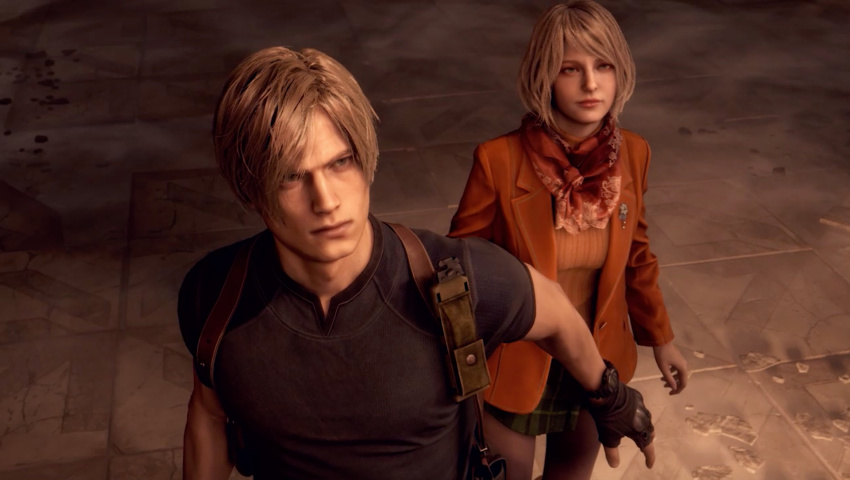
Image found on Playstationtrophies.org

But now I want to talk about Leon Kennedy himself, because he is very much the star of the show. In the original game, Leon became infamous for spouting cheesy, 80's action hero style one liners like "No thanks, BRO!" and "Where's everybody going? Bingo?" Most of said one-liners have since become memes in the Resident Evil fan community.  And to be fair, the original Resident Evil were meant to be campy, since the franchise started out as a love letter to 70's and 80's era horror movies. The remakes take themselves more seriously in comparison. Don't get me wrong, though. Leon still says funny one-liners and does outrageous action hero stunts like back flips and suplexes on literal zombies. But in the remake, his cheesy action hero vibes are contrasted against the nightmarish horrors he encounters. And you know what? It works. Especially if you buy in to the idea that Leon's antics are a coping mechanism for all the stuff he went through back in Resident Evil 2. But one thing I adore about Remake-Leon's personality is that he acts more annoyed than scared by the aforementioned monstrosities. He does react with disgust at things like occult shrines and new enemy types, but every time after that initial surprise he's like "Oh great, it's these guys again." Which is honestly just as funny as the original's one liners.

Ashley on the other hand is scared out of her mind and reacts with appropriate levels of terror at every other monster. Which makes sense for her situation. She's been kidnapped by a cult, is trapped in a foreign country, has a dormant parasite in her body and her dad thought that sending only one guy to rescue her was enough. She is very lucky that the one guy that the President sent was Leon Kennedy. One of the few gripes I heard other people having with the original game was that Ashley's voice was annoying. Though perhaps it wasn't necessarily the voice and more the fact that in the original game she screams "LEON HELP!!!" every time an enemy so much as looks in her general direction. She still screams a lot (as a civilian in a horror franchise is wont to do) but I never found her to be annoying. This may be a Remake thing making the character more likable or it may be me not having any biases from experiencing the original game. I don't know.

One quick note before we continue talking about the story. Resident Evil 4 Remake has DLC. One DLC pack is free, the other is a paid expansion. The free DLC is titled The Mercenaries and is a non-canon minigame where you try to kill as many enemies as possible within a time limit. The game actually gives you a spoiler warning the first time you boot up the minigame, both because it features end-game locations as arenas and because it spoils the identity of one of the main villains. But this game mode is neat because it lets you play as other characters besides Leon such as Ada, Major Krauser, Luis and even Albert Wesker. There's also HUNK, a masked soldier that is not encountered in the main story in any capacity, but he's the closest thing the RE franchise has to a mascot, which is why he's here. Each character comes with a different set of weapons meant to encourage a specific fighting style. For example, Leon and Ada are both generalists who don't excel in anything but aren't particularly bad at anything either. They both have a pistol and a shotgun. Leon gets a semi automatic rifle unique to him in this game mode, while Ada gets a crossbow and a grappling hook, the latter of which lets her perform long range melee attacks by pulling herself towards stunned enemies. Major Krauser goes all in on melee combat, sporting a custom knife that's pretty much unbreakable as well as explosive arrows and an SMG to deal with big groups. Luis meanwhile is meant to be a sniper, with a bolt-action rifle and a Red 9 handgun giving him very good damage per shot at the expense of speed and mobility. HUNK gets an SMG and a pocket knife as his only weapons, but he can perform a neck snap on any stunned or immobilized enemy to kill them instantly. Albert Wesker is a master of parries. In fact, he's so good at parrying enemy attacks that he doesn't need a knife to do so, and every time he does parry an enemy attack he automatically performs a one-hit kill move. He has both a pistol and a magnum to deal with the few threats can can't be parried. 

The last main mechanic of The Mercenaries is Mayhem Mode. This is a temporary super move that is unique to each character. Leon and Ada's Mayhem Mode just improves their damage and movement speed. Luis' lets him plant dynamite to blow up a large group of enemies at once. Krauser's is a spoiler-filled transformation that supercharges his already impressive melee attacks. HUNK's Mayhem Mode gives his SMG infinite ammo, thus letting him literally melt anyone standing in his way. And finally, Albert Wesker gains the ability to literally teleport right to any enemy in his field of vision and unleash a barrage of punches and kicks. It looks like something pulled straight out of an anime. While there is a time limit in The Mercenaries, you can extend it by either collecting green orbs hidden in each arena, killing enemies with headshots or with melee attacks. However, the game mode is NOT endless. After 150 kills, the game ends automatically and you are given the highest score possible for your troubles.

Image found on Playstationtrophies.com

The second DLC, Separate Ways, is a (probably) canon side story where you get to play as Ada Wong, with her adventure happening alongside Leon's. Unfortunately, I haven't had a chance to play Separate Ways yet, so I cannot speak of its quality in good faith. I might write a mini-review for Separate Ways in the future. But here's as good a place as any to reveal why Ada is in the Los Illuminados compound. Ada is working for Albert Wesker. Yes, the same guy who doomed Raccoon City. Wesker wants an item called the Amber, which contains the dormant egg of one of the cult's parasites. He wants to combine the parasite with his zombie viruses to create undead superhumans. But Ada does eventually change her mind about working for a man who casually brags about how his plan will cause the deaths of not just millions of people, but billions. So she does agree to help Leon stop the cult and eventually disposes of the Amber so that it will never be used for evil ever again.

Okay, now we get into the realm of spoilers, because I want to talk about the villains. Los Illuminados is led by a cult leader named Osmund Saddler. Saddler was infected with the original parasite, and with it he can effectively mind control anyone who has another parasite in their body. There doesn't seem to be a limit to the range of his possession, in fact the entire cult is infected with parasites, implying that every enemy you face is being mind controlled all at the same time. His entire evil plan is to infect Ashley, use her as a sleeper agent to infect the President with another parasite, and then rule the United States from the shadows by mind-controlling the U.S. leadership. Funnily enough, in the original game, Saddler himself explains his plan in a stereotypical villainous monologue. In the remake, It's Luis who tells Leon why Saddler wants to put parasites in people.

Speaking of Luis, I like him. He's this smooth talking, kind of sleazy but still charming scoundrel who despite being "just" an Umbrella researcher, can keep up with Leon. In fact, there's a boss battle against two zombified giants (called El Gigante) where Leon and Luis have to work together to bring the giants down. He reminds me of Han Solo from Star Wars, just with a Spanish accent. Luis is a scoundrel who provides much of the humor and comic relief for the game. But honestly speaking, Luis is the true unsung hero of RE4. He alone was able to figure out how to remove the parasites without killing the victim. Meaning that without Luis' help, even if Leon and Ashley escaped Los Illuminados, Ashley would be doomed to mutate into some kind of freaky monster and bring about the apocalypse. Unfortunately, spoilers for this next section, but Luis does not live to see the fruits of his labor. He is sadly killed off by one of the main villains, though with his dying breath he gives Leon the key to his lab so he can remove the parasite inside Ashley safely. How Luis dies changes depending on whether it's the original or the remake. In the original game, Luis is killed by Saddler. In the remake, Luis is killed by Major Krauser. It's a minor change in the grand scheme of things, but the main reason the change was made was to introduce Krauser as a villain a lot earlier than the original did.

What's the deal with Major Krauser, you ask? The answer is that he was a double agent working for Los Illuminados the whole time, and that he was the one who kidnapped Ashley in the first place. Krauser did all of this because several years ago, Krauser and his men were sent to South America for a top secret mission called Operation Javier. What Operation Javier was is never explained, outside the fact that it was a complete disaster and the US Military left Krauser's squad to die. Krauser was really mad about how the government treated his crew, and while it's possible that he sought out Los Illuminados because he wanted revenge for his fallen comrades, he currently only cares about power. And he has the exact same skills that Leon has, because he was the one who taught Leon how to fight in the first place. And if I had a nickel for every time a Capcom game had a rival character with the same skillset as the protagonist who forsakes their humanity in the name of getting more powerful, I'd have two nickels. Which isn't a lot, but it's still weird that both Resident Evil 4 and Devil May Cry had this exact character archetype. But then again, if Devil May Cry started life as a RE4 demo, I'd suppose you would see similarities between the two.

Image found on Playstationtrophies.com

The game has a few bosses to fight, and here I need to mention a "quirk" of the Resident Evil franchise. The bosses have what Capcom calls Adaptive Difficulty, where the amount of health a boss has is proportionate to the amount of ammo and healing items you have in your inventory at the start of the battle. Regular enemies have the same amount of health no matter what. Adaptive Difficulty also effects how much ammo and money you can find in barrels and crates, with ammo appearing more frequently if you're running low and money appearing more frequently when you have a surplus. The purpose of this system is meant to encourage a "use it or lose it" mentality in the player, where you gain ammo just as quickly as you use it up. Because of this, it can take anywhere between 5-6 shots to kill a boss, or up to 50-60. Overall, I like the bosses. Major Krauser is my personal favorite. You fight him three separate times, with the first time being a standard knife fight with no guns from neither Krauser nor Leon. The second time is a gun fight where Leon is forced to navigate a booby-trapped maze while Krauser harasses him with SMG fire and explosive arrows. The third time, Krauser uses a parasite to mutate his arms into a sword and shield made of bones and meat for one last duel. And the whole time they're fighting, Leon and Krauser engage in gloriously cheesy trash talk. But no matter which version of Krauser you're fighting, you have to learn how to do the parry correctly. That's just non-negotiable. Unless you use your one and only rocket launcher shot on Krauser.

On the subject of the final boss, Osmund Saddler himself, I did not do the fight legitimately. I used my one and only rocket launcher shot on Saddler, completely skipping the final battle entirely. His monster form looks cool though. Like a giant demonic crab covered in eyeballs. One boss I do enjoy is Ramon Salazar. Salazar is an arrogant noblemen who is a fanatic follower of Saddler's cult. He mutates into what can best be described as a cross between a rose and an octopus. Salazar acts as the main villain of the Castle area, and he spends the whole time being an over-dramatic nerd. The funniest thing about Salazar is that you can completely trivialize his boss fight by throwing a golden chicken egg (an item that normally is only good for selling to the Merchant) at him. This somehow removes 75% of his health and stuns him instantly. Meaning if you're quick enough, you can just blitz Salazar with shotgun blasts and rifle shots before he can even finish his villainous monologue at the start of the fight. Which is both hilarious and good for speed running!

Speaking of speed running, Resident Evil 4 gives the player a rank at the end of each playthrough based on how well they did. This considers things like number of enemies defeated, number of Game Overs, and how quickly it took the beat the game. When I first finished the game, it took me around 33 hours to complete it. But you can very easily beat this game in 8 hours or less. The current record (at the time of writing) is roughly 1 hour and 35 minutes on Standard difficulty. Oh yeah, I should mention the different difficulty settings. In addition to Adaptive Difficulty, RE4 has four traditional difficulty options. Assisted, Standard, Hardcore and Professional. Assisted is the easiest and recommended for people unfamiliar with horror games. Standard mode is intermediate and recommended for horror game fans who have not played the original game from 2005 (aka people like me). Hardcore mode is well, hard, and is recommended for people who have already played the original game. Professional mode is the same as Hardcore but with stricter parry timings and no autosaving your progress at all. It's also unavailable at first. You need to beat the game on one of the other difficulty options before it will let you even attempt Professional mode. What the difficulty options do is adjust the amount of health that regular enemies have (bosses are unaffected because of Adaptive Difficulty). It also affects how much damage they do per attack and how quickly they move around. The higher the difficulty, the faster and deadlier enemies become. Finally, the difficulty options change how much ammo you can craft and how expensive the Merchant's wares are. 

The last thing I want to mention before talking about the presentation is the extra content. By completing certain "challenges" within the game, you can unlock a special currency called Challenge Points. These can be exchanged for nice cosmetic things like concept art, 3D models of all the different characters and weapons, and even fun little costumes for Leon and Ashley. Some of the costumes have additional effects, but most are just for fun. Like there's a pair of cat ears you can put on Leon that gives all of his weapons infinite ammo. Said cat ears are unlocked by getting an S+ Rank (the highest rank possible) on Professional Mode. By that point you've perfected the art of playing this silly horror game, so I don't think you need infinite ammo that badly. There's also a Pinstripe Suit for Leon that makes him look like a 1940's era gangster. Ashley gets (among other things) a suit of medieval armor that makes her too heavy for most enemies to pick up. There are some unique weapons that can only be unlocked with Challenge Points, like the Hand Cannon and the Chicago Sweeper. Of course, those weapons can only be accessed by playing New Game Plus mode. New Game Plus allows Leon to start the game with all of his weapons and upgrades from a previous playthrough. Which means you can hypothetically blitz through the game with an overpowered Leon and enjoy some sweet catharsis on any part of the game that gave you trouble the first time around.

In terms of presentation, Resident Evil 4 is a very nice looking game. Like, the original game looks shockingly good despite being almost 20 years old (which in the video game industry might as well be 200 years), and the remake manages to be debatably better. It's objectively better in terms of facial expressions and texture quality, but then again, the entire reason the remake was made was to bring this game up to a new graphical standard. In that regard, the remake succeeded. There's also a ton of little details that most people probably won't notice, but the fact they were put in the game at all makes me appreciate the effort. Just to give a few examples, Ashley tip-toes around the bodies of dead enemies instead of stepping on them. Leon starts limping if his health gets too low. Leon occasionally checks the chamber of his currently equipped gun to make sure it's loaded. Leon practices exceptional trigger discipline, never putting his finger on the trigger until the player pushes the "shoot" button. Ashley covers her ears when Leon starts shooting at something. The only thing I could say bad about RE4 Remake is that it isn't as campy and over-the-top as the original game. Which isn't even that much of a bad thing because this game is still campy. Just a different flavor of camp.   

In terms of sound design and voice acting, both are good. The music consists mostly of ambient droning meant to put the player on edge (because this is still a horror game). That said, there is some peaceful music in the safe rooms meant to serve as a break from the harrowing nightmares outside. The sound of the guns firing is crisp. Leon still has his cheesy one-liners, which are delivered in the most deadpan way imaginable. And enemies bark out Spanish phrases while fighting you. I don't speak Spanish, and the subtitles don't translate the Spanish, but I have heard from Spanish speaking corners of the Internet that the Spanish voice acting is an improvement over the original. You know what's not an improvement over the original? Ada Wong's voice. I do not know why Ada Wong's voice in the remake bothers me. Like, it's not as good as the voice acting for everyone else but it's also not bad enough to where I can call it bad acting in good faith. I think the problem is that she sounds oddly stiff. I'm not sure if it's the actor herself, or if the problem lies with the voice direction, or if the game just used a bad take. I remember seeing some people on the Internet say that her voice acting sounds better in Separate Ways, but again, I haven't played that DLC yet. It's unfortunate, because the rest of the game's audio presentation is so good that this one thing sticks out even more.

Image found on Playstationtrophies.org

Overall, I'd say that Resident Evil 4 is a splendid horror game. Both the 2005 original and 2023 remake. But which is better? As cliché as it sounds, both are good. The original is a classic for a reason. But the remake is a great game in and of itself. Personally, it comes down to preference. The original is campier and places a greater emphasis on spectacle. The remake, while still campy, takes itself more seriously and puts greater focus on the horror elements. But like I said at the start of the post, if you have any passing interest in the horror genre, this is a great place to start. I give Resident Evil 4 Remake 5 stars out of five.

Resident Evil is the property of Capcom. None of the images used were created by me. Please support the original creators.

Tuesday, October 31, 2023

The Halloween Special: A very spooky review of Little Nightmares II

Halloween and horror games. A truly iconic duo. There's just something special about playing a spooky game during a spooky holiday during a spooky month. And I was planning on doing a review of Five Nights at Freddy's since that's a very popular horror franchise that just released a theatrical film. But I also never did a review of Little Nightmares II, which is one of my favorite horror games ever. And I feel like Little Nightmares is more fun to talk about because it is such a strange and surreal experience unlike anything else in the genre. Don't worry, I'll cover FN@F eventually. But today we're doing Little Nightmares II.

Image from https://www.behance.net/gallery/88698867/Little-Nightmares-II

So what is Little Nightmares II? Developed by Tarsier Studios and published by Bandai Namco, Little Nightmares is a horror game franchise focusing on a world of giants. And when I say "giants" I mean everything is bigger than the humans(?) you play as. Heck, even something as simple as a wooden stool is so big that your character can barely climb up on top of it. The games focus on using platforming skills to navigate environments that would be considered mundane, were not for the literally gigantic proportions of both the furniture and the monsters living in said environments. Released in 2021, Little Nightmares II is a direct sequel to the 2017 original. I personally considered Little Nightmares I to be an excellent game, it being such a surreal and unique experience both as a horror game and as a platformer. Though in my review of the first game, I made the argument that it doesn't "count" as horror due to a lack of traditional jump scares. I now regret making that claim, since the notion that a game is only "horror" if it has jump scares was ignorant of me. After all, any work of art that seeks to disturb and unsettle is horror, even if the means to cause that reaction differ from the "standard" methods used by similar works.

Little Nightmares is unique among horror games for two main reasons. The first reason is the game is played in a third-person perspective, meaning you can actually see your character moving around. Most horror games are played in first-person, making you see directly through the eyes of the protagonist. But the third-person perspective calls attention to the characters you play as, which considering the "true nature" of one character in particular, is rather fitting. The second reason is that, with the exception of some tie-in comics and a debatably canon series of audio plays that Bandai Namco released on their YouTube channel, the Little Nightmares series tells its story without so much as a single word of dialogue, instead letting body language and environmental details do all the narrative work. As such, Little Nightmares is a story that is as mysterious as it is open to speculation. But it's not mysterious in the same way that Five Nights at Freddy's is. That franchise is mysterious because it hides story-relevant information from the player in increasingly elaborate ways, but the information itself is fairly simple. Little Nightmares doesn't hide information, it just gives you information that only makes sense with the benefit of hindsight. Basically, you don't have to go digging through three different lore novels or solve a riddle hidden in the source code of the creator's website to the understand what's going on. The only information that is not (to my knowledge) in the game itself are the names of the two main characters, Mono and Six. But the story still works even without knowing their names, you would just get used to calling them the Boy and the Girl respectively.

So do you need to play the first Little Nightmares to understand the sequel? Well, yes and no. Some scenes don't hit as hard narratively without experiencing the original. After all, what significance can a newcomer expect to gain from the scene where a little girl dons a bright yellow rain coat? But considering the wordless story and overall mysterious vibe that the series is going for, knowing what happened in the first game is not required. That, and it's entirely possible that Little Nightmares II takes place before the first game. Maybe. Because of the ambiguity of this title, I will be judging it primarily on its own merits and only bring up comparisons to the original game when it is relevant to do so. One little warning before I explain the game any further. While Little Nightmares II is rated T for Teen by the ESRB (thus it is intended for ages 13 years or older), it is still very much a horror game and as such there might be disturbing imagery and subject matter too intense or macabre for more sensitive audiences. Continue reading at your own discretion.

Now, Little Nightmares II is a rather short game. You could beat this game in about 10 hours or less. This is both a blessing and a curse. The blessing is that the short length is good for a "bite-sized" experience, or if you want to try speed running, then this is a good game to start speed running for. The curse is that if you really like the game, you might finish it earlier than you were expecting and are left feeling mildly disappointed at the short length. Because of the game's short length, as well as its level structure (the protagonists go to giant-sized version of a seemingly normal place, they encounter the giant living in said place and either destroy it or escape from it), I will going over the broad strokes of all five main levels, as well as some fun facts here and there. I won't discuss every single thing, like every puzzle or every chase scene, but I will give the general vibe of the level.

Our story begins with a vision of a hallway with an ominous looking door at the far end. This hallway is important for later, so keep it in the back of your mind. Once the vision ends, our protagonist wakes up in a forest filled with broken television screens. The main character of Little Nightmares II is a young boy wearing a paper bag mask that Tarsier named Mono in promotional material, but given the wordless nature of this game's storytelling, you would have no way of knowing Mono's name otherwise. Anyway, Mono moves through the forest by solving physics based puzzles, like pushing boxes around to form a makeshift staircase or swinging on a rope to cross a gap that's too wide for him to jump over. Even before we meet the main monster for this level, we encounter human(?) sized beartraps and hunting nets filled with rotting carcasses. There is something in these woods that appears to be hunting humans (and possibly other giants) for some purpose. Maybe for sport? Or for satiating a depraved appetite? It wouldn't be the first time Little Nightmares tackled the theme of a monstrous hunger driving people to committing acts of extreme debauchery.

Image from https://adventuregamers.com/screenshots/view/38395/95962#images-88

Mono comes across a cabin in the woods, clearly built with a giant in mind. In there he finds a young human(?) girl trapped in the basement, with several tally marks implying that the girl has been stuck down there for at least 55 days. The Girl's only comfort being a music box playing a haunting melody pulled straight from the original Little Nightmares. So Mono frees her by grabbing a nearby human-sized hatchet and breaking down the door The Shining style. While this girl is reluctant to cooperate with Mono at first, the two of them soon find a series of obstacles that are impossible to overcome by themselves, and so they decide to work together for the foreseeable future. This is the main "gimmick" of Little Nightmares II. From this point onward the player with have a companion that will automatically assist with certain puzzles, such as helping to push heavy objects around or giving them a boost to jump up to an otherwise out-of-reach ledge. There's also a dedicated "hold hands" button that allows you to manually control both Mono and the Girl at the same time, by making them hold hands together. Which is surprisingly cute and wholesome for a game filled to the brim with ghoulish horrors. 

Fun fact! Tarsier originally intended for the whole game to have a two-player co-op mode, with player one being Mono and player two being the Girl. Unfortunately, The co-op mode was sadly scrapped early on in development because Tarsier couldn't figure out how to get it to work properly. And this is an interesting tidbit because Bandai Namco recently announced Little Nightmares III, and that game's main gimmick is that it has an actual, genuine two-player co-op mode like the one that this game was originally planned to have. So even though Little Nightmares III is being developed by Supermassive Games instead of Tarsier, it's nice to see one of Tarsier's unused ideas get (hopefully) fleshed out in a future project.

Mono and the Girl escape the cabin and head into a nearby workshop where we are introduced to our first enemy, the Hunter. The Hunter is a giant responsible for setting up those traps seen earlier in the Forest. The Hunter covers his face with a primitive mask made from a burlap sack with a single hole for him to see through. A common theme across the Little Nightmares franchise is that almost everyone living in this world hides their real faces with masks and other pieces of headwear. Even Mono and Six cover their faces, the former with a paper bag and the latter with a raincoat hood. So the idea of hiding one's face behind a mask is clearly important. But the other giants' masks looked "better quality" for lack of a better term. Either being a stretched out faux-skin material or a ceramic Kabuki mask like the ones used in Japanese theater. But the Hunter's mask looks homemade, which means he either can't afford a real mask or he has rejected giant society by making his own. He also has an uncanny interest in taxidermy, since his cabin is filled with stuffed humans(?) posed to look like they are having a "normal" family dinner.

The rest of the Forest level is spent either running from the Hunter in exhilarating chase scenes or sneaking around him in tense stealth sections. Funnily enough, the Hunter is the least supernatural monster in the whole series. Every other monster has stretching limbs, heightened senses or straight up reality warping magic. But the Hunter is just a big guy armed with nothing more than a double-barreled shotgun, a handful of beartraps and a lamp. There's some beautiful simplicity in that. Anyway, because of his shotgun he is the only monster capable of attacking Mono and the Girl from a distance. So if they are being chased, they need to duck behind cover to avoid getting blasted, then they must run to the next piece of cover while the Hunter is reloading.  The level ends with Mono and the Girl reaching a shed at the edge of the forest, and using the spare giant-sized hunting rifle inside to kill the Hunter with a point-blank shot. Overall, the Forest level is an excellent first level that introduces all the core game mechanics that the rest of the game builds upon. Running and jumping, pushing and pulling objects around, climbing up certain walls and swinging on ropes. This level also serves as an introduction on how the Girl works as a companion. Additionally, the Forest sets the vibe of the whole game. You know you are in for a wild ride when you find a net full of rotting carcasses (that may or may not be human) hanging from a tree within thirty minutes of starting the game. It establishes that this is a bleak, uncaring world where monsters will kill humans by the dozens if they are given the chance to do so.

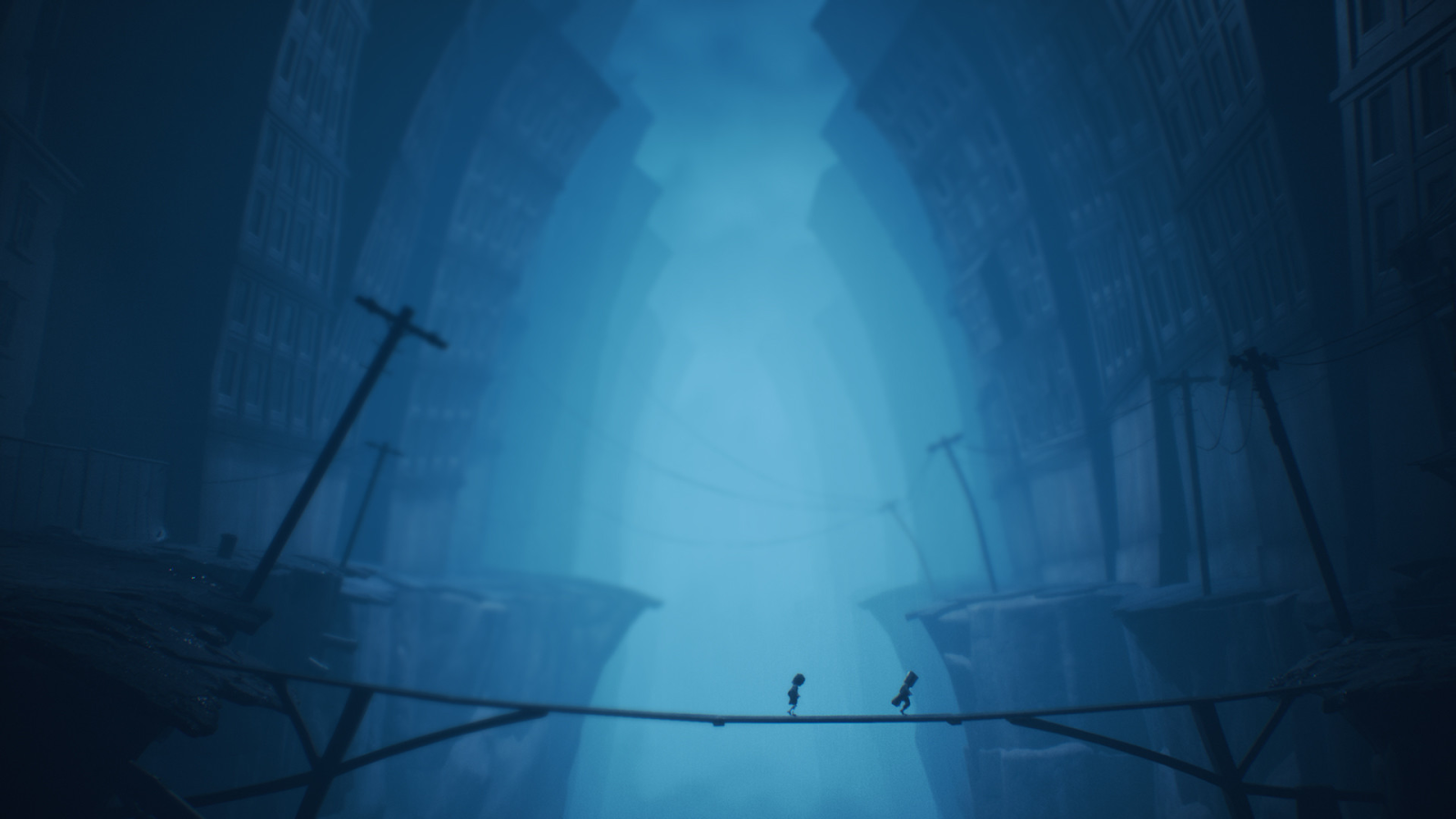
After escaping the Forest, Mono and the Girl cross a lake(?) using a giant door as a raft. Here we are properly introduced to the main setting of this game, a location that we will just call the City for the sake of simplicity. The City is for the most part abandoned, the only indication that people lived here are piles of discarded clothing. The buildings themselves seem to curve and look downward on our two protagonists, as if the City itself is watching their every move and judging them for it. And from this point on in the game, each main level is spaced out with a brief trip to the City streets until you head back indoors. Each trip to the City streets ends with Mono finding a working television set. Every time a TV turns on, Mono is drawn to them, like a moth to a flame. And interacting with said TVs allows Mono to catch a glimpse of that ominous door at the end of the hall that was teased at the start of the game. Before he can see what's on the other side, the Girl will pull him away from the TV as it shuts down once more. Again, all of this is important for later, so keep it in the back of your mind.

Image from https://adventuregamers.com/screenshots/view/38395/95962#images-61

The next level is the School, which is a level that I admittedly have mixed feelings on. First a little context. A feature that's new to Little Nightmares II is that Mono can pick up certain objects, such as wooden sticks and giant-sized utensils and use them as improvised weapons to attack minor enemies. The Forest doesn't really have any enemies besides the Hunter, who is clearly too big and strong to attack directly. So the School introduces the Bullies, the students of the School and the first enemy type that can be harmed with said weaponry. As such, if the Forest was an introduction to puzzle solving and Jolly Cooperation, then the School is the introduction to the combat system. The problem is that Mono's attack animation is rather slow, which makes sense since he is at best an adolescent human using tools meant for giants. But because of the slow attack animation, you basically have to time your attacks perfectly to defeat the Bullies, because if you swing your weapon too early or too late, they will kill Mono with one grab. The fact that Mono dies in one hit combined with his slow attack speed forces you to "git gud" as the saying goes, because this game's combat mechanics leave very little room for error. This is the only real criticism I have of the game, that the combat is just a little bit too unforgiving. What's worse is that (mild spoiler alert!) the enemies in the next level are nowhere near as aggressive as the Bullies, and if the Bullies' aggression was reduced slightly it would not be anywhere near as bad as it is currently. Like, I have beaten Little Nightmares II dozens of times. I've gotten every collectible possible and even tried my hand at just for fun speed running. But the School trips me up every playthrough precisely because of the unforgiving combat.

But on the subject of things I do like about the School, it has my favorite monster in the whole game, the Teacher. The Teacher is a female giant who, aside from her wrinkled "face" and stiff body movements, appears to be relatively normal. Then her neck starts stretching and slinking around the School like a demented serpent. The Teacher is the scariest monster in the game, because her design and abilities make you feel viscerally uncomfortable just from looking at her. And the Bullies, which devolve into rowdy degenerates when left to their own devices, shrivel up in fear when the Teacher is hosting a lesson. The whole School seems to fear the Teacher. Speaking of, while I dislike the combat sections with the Bullies, I do like the design and aesthetic of the School. Having such a mundane setting be twisted into a giant maze of bookshelves, desks and school supplies is peak Little Nightmares level design. And honestly, if it weren't for the combat sections with the Bullies, the School would have been my favorite level.

Anyway, early on in the level the Girl gets kidnapped by the Bullies, forcing Mono to fight his way through the School on his own. After spending almost the entire Forest level together, this is the first time our protagonists have been separated. As such, you do feel a little handicapped in your options, on top of the worry you feel for the Girl's well being. You get her back towards the end of the level, which leads to one of my favorite scenes from the whole game. So imagine. Mono and the Girl have been reunited, they're sneaking through a School corridor, and there is a lone Bully absentmindedly scribbling on the floor. There's a sledgehammer that you can grab. So your first instinct is to grab the sledgehammer and bonk the Bully before they can notice you. That's how you dealt with the Bullies before. But before you even have a chance to pick it up, the Girl runs over to the Bully and grabs them in a stranglehold. And then she breaks the Bully's head open with just her bare hands. If it wasn't for the Bully's head being made of porcelain instead of flesh and bone, this kill would have earned the game an M for Mature rating. It is genuinely one of the most disturbing sights in the game. For newcomers, seeing a child do something so brutal is not only harrowing, it's a hint that there is more to this girl than meets the eye. For veterans of the first game, this is your first clue as to the Girl's identity, which I won't spoil just yet.

So Mono and the Girl escape from the School and return to the City streets. Curiously, the Teacher is the only giant in the game that never gets killed on screen. In fact, Mono and the Girl don't do anything that prevents the School from making more Bullies. So no matter what happens next, just remember that the Teacher is still out there. But more importantly, it's now raining in the City. Mono is unaffected, but the Girl is visibly shivering from the coldness of the rain. So while exploring the streets, the Girl finds a bright yellow raincoat, which she equips immediately. Newcomers won't get what the big deal with the raincoat is, but anyone who played the first game knows why. Basically, the Girl putting on the raincoat confirms once and for all that she is the protagonist from the first game, a human(?) girl named Six. Again, because of the wordless nature of the story, you wouldn't know Six's name unless you looked at promotional material. So from here onwards, I will refer to the Girl as Six. Anyway, the reveal that Six was the Girl you were traveling with the whole time would have been a pleasant surprise, if it weren't for the fact that it was really obvious who she was from the moment she first appeared. First of all, the music box at the beginning of the game is playing a song from the first game called Six's Lullaby. Second of all, there's the aforementioned scene where the Girl smashes a kid's head open, and anyone who played the first game will tell you that Six is incredibly ruthless and prone to acts of extreme violence. And third of all, the Girl has literally the exact same model as Six, just without a raincoat. And finally, Six (complete with raincoat) is literally on the box art of the game, standing front and center alongside Mono. None of this is a bad thing, of course. It's just mildly amusing that the game treats the raincoat reveal as some shocking twist despite how obvious the whole thing is.

Anyway, after getting the raincoat and heading indoors, Mono and Six find themselves at the next main level, the Hospital. And the Hospital is the level where the game proudly says "I'M NOT GONNA SUGERCOAT IT!" and stops going easy on the player. The puzzles here are more complicated and require visiting multiple rooms to solve. There are minor enemies in the form of the Living Hands, which are exactly what they sound like. Living, disembodied hands that crawl around like spiders. These can be squished with a well-timed weapon strike from Mono, and they are as previously mentioned, nowhere near as aggressive as the Bullies. Overall, I think the combat in this level is better than the School because even Mono still dies in one hit, the skittishness of the Living Hands makes them easier to deal with. It's still not perfect, but I'll take the Living Hands over the Bullies any day. There are also multiple giants in the form of the Patients. The Patients are mannequins made with a mixture of cloth, wood and flesh. They only move when in complete darkness, so long as the lights are on they are as still as a statue. This level introduces the flashlight, a tool Mono can use to freeze the mannequins. While I don't consider the Patients to be the scariest or even the best monster in the game, they are definitely the most stressful to deal with. And also the scene where Mono is running down a hall while hundreds of Patient hands erupt from the walls is iconic. On par with the Dinner Guest scene from the first game.

Image from https://adventuregamers.com/screenshots/view/38395/95962#images-35

The Hospital is probably the longest level in the whole game, with the first half being Mono and Six trying to power up a defunct elevator by installing new fuses in the generator, and needing to solve a series of puzzles to get those fuses in the first place. The second half of the level is spent working your way downwards to the Hospital's morgue, where you encounter the main giant of the level, the Doctor. Insert Doctor Who joke here. Anyway, the Doctor is an obese slug-like giant that crawls on the ceiling and navigates the morgue while upside down. The Doctor can be seen experimenting on the Patients, taking them apart and putting them back together as crude abominations. However, the most interesting thing about the Doctor is that you can see the masks worn by every other giant encountered so far in his office. He even has the masks of the giants from the first game on display. So now we know who is the one in charge of making the masks and handing them out to the rest of the giants. What purpose the masks serve is still unclear at this point. Anyway, the Doctor chases Mono and Six through the rest of the morgue, but he gets trapped inside a cremator. You can either spare the Doctor's life by leaving for the elevator immediately or you can kill him by turning the cremator on, burning the Doctor alive. This is the only time in the game where the player can choose whether a giant lives or dies. It doesn't really impact the rest of the game as the Doctor never returns regardless of your decision. As sadistic as it sounds I prefer turning the cremator on, if only because it plays an animation of Six warming herself up with the cremator's fire. It's a cute animation that is made hilariously morbid with context.

The fourth and penultimate level is the City itself. Just the entire rest of the City. Mono and Six platform their way across the rooftops and sneaking through abandoned apartments. And surviving at least one collapsing building. They also figure out what happened to the rest of the City's population. They all got turned into the next main enemy type, the Viewers. The Viewers are the giant citizens of the City who having seemingly turned completely feral, despite ironically looking the most human of all the giants encountered so far. The only thing keeping their animalistic impulses in check is their addiction to TV. To give you an idea how desperate the Viewers are for any kind of stimulation, they will literally throw themselves off cliffs just to get a better look at a working TV. They will drag the TVs they do have into the shower with them so they can continue watching while bathing. They are so addicted they will put themselves, and anyone caught in their path into very real danger. Now I don't want to get too political here, but I'm pretty sure the central theme of this level is that too much media consumption is bad for your health. Especially since the only thing that the Viewers seem to watch is static. They aren't watching funny children's cartoons, or compelling romantic dramas, or even simple game shows. The Viewers are being stimulated with nothing more than meaningless lights and the pointless drone of static. 

Now is the point where I am going to tell you to beware of spoilers. From this point on, things get so wild that it would be a shame to not experience the game for yourself. If you want to know my opinion on the rest of the game without spoiling it too much, I consider this level and the final level to be pinnacle of Little Nightmares' art and storytelling style. And as previously mentioned, Little Nightmares II is one of my favorite horror games ever. So if you have any interest in playing this game, you can pick it up on literally any modern gaming system. Steam, PS4, Xbox One, Nintendo Switch, etc. Without further ado, let's get into spoiler territory.

So you know how I said that every time Mono finds a working TV he is drawn to it, and how he always gets pulled away before the door at the end of the hall opens? Well, in the fourth and final visit to the City streets, he finally got to see what was on the other side of the door! It was the Thin Man, a sharply dressed giant with unnaturally long limbs. The Thin Man then reaches out of the TV and into the real world and grabs Six, leaving nothing behind but a shadowy specter. Much like the School, the rest of the City level has Mono completely alone. There are two main threats in this level, the Thin Man himself and the Viewers. 

The main gimmick of the City level is that Mono has learned to do his own version of the Thin Man's ability to travel into and out of television screens. And Mono has to use this new ability to escape from Viewer hordes and reach areas that would be otherwise inaccessible. It's a really clever and creative gimmick that makes up the majority of this level's puzzles. The Thin Man himself only appears sporadically throughout the level. You cannot really hide from him the same way you hide from other giants. You either run when you see him appear, or it's back to the checkpoint with you. One detail I like is that the closer the Thin Man gets to Mono, the slower the world around him moves. So if he's right behind Mono, the whole game goes into slow motion. It's an effect that makes him both more unsettling and more dangerous than the other giants. Anyway, after enduring several injuries and losing all of his tools, Mono finally removes the paper bag mask and confronts the Thin Man directly. Mono then somehow steals the Thin Man's magical powers and destroys him with his own magic. It's an awesome scene, and the music and frame adds a sinister edge to it. Especially when you remember the first game's ending, where Six stole the Lady's magic and used her new power to slaughter hundreds of giants at once. But now that the Thin Man is dead, there are only two things left to do. The first is rescue Six, obviously. The second is track down the source of the TV transmissions that the Viewers are addicted to and destroy the signal. 

The final level is the Signal Tower, inside of which is a freaky nightmare realm with looping halls and furniture floating around in zero gravity. Nothing about the Signal Tower's interior makes logical sense. Because it's a nightmare that operates on "nightmare logic" In fact, one might say that the Signal Tower is A LITTLE NIGHTMARE. Insert "bad-um ting!" sound here. And once again, spoiler alert! I mean it this time. If the City was a good enough level to deserve a spoiler warning, the Signal Tower deserves a super spoiler warning. Because not only does this section spoil the final level of the game, it also spoils some late game stuff from Little Nightmares I. Understood? Good! So Mono reunites with Six. But something is... off about her. Something... Distorted. She's now a giant, with long arms that stretch and bend at painful looking angles and mismatching legs that are grossly longer on one side than the other. And mirroring the beginning of the game, Six is sitting alone in a room, her only comfort being the music box. Mono has grown to care about Six during their time together, and possibly in a misguided attempt to help his friend, Mono breaks the music box. Which sends the distorted Six into a frenzy. This is the final boss. It's not an exciting confrontation with whatever villain designed such a horrid City. It's a young boy trying to save his friend from a fate worse than death. There's something beautifully tragic about it.

Image from https://adventuregamers.com/screenshots/view/38395/95962#images-79

So Mono trashes the music box completely, restoring Six to her original form. But the Signal Tower begins to collapse. There is one last chase scene, where Mono and Six run through the falling ruins of the Signal Tower itself. But no matter how well you play, Six will always outpace Mono, and Mono will always fail the last jump. The only reason he doesn't die is because Six turned around and caught his hand. Now, a little bit of context here. Throughout the game, about once per level is a "Leap of Faith" spot. These spots are gaps that Six can get across, but not Mono. In order to get past these spots, Mono would have to jump across and trust that Six will catch him. The whole game was building up to this exact moment. This was the final Leap of Faith spot. And well... You know that scene in The Lion King? The one where Mufasa is hanging on the ledge and Scar starts to pull him up, only to say "Long live the King!" and throw Mufasa down to his death? Yeah. Six just drops Mono down into the Signal Tower ruins. Why did she do this? There's a lot of theories. Maybe she was always planning on betraying Mono once he outlived his usefulness to her, maybe it was an act of petty revenge. After all, Six has been beaten, chased, tied up and hanged upside down, shot at, and had a building collapse right on top of her since she first met Mono. Perhaps she blamed Mono for all the bad parts of their adventure. But if she did, why did she stick around for so long? She could have left Mono the moment they reached the City, but chose to stay anyway. Maybe her hand slipped and dropping Mono was a genuine accident. But if it was an accident, while did Six act so calmly about it? Either way, Mono falls into the ruins while Six returns to the City to do as she pleases. The final scene of the game is Mono growing old and transforming into the Thin Man before locking himself away behind the door at the end of the hall shown at the start of the game. 

One thing I neglected to mention earlier. There are two kinds of optional collectibles hidden in each level. The first are hats, which allow you to customize Mono somewhat. Most of these hats are goofy jokes, like a teddy bear hat and a bucket helmet. But the other collectible are Shadow Children. Shadow Children are spooky ghosts that disappear when interacted with. If you grab every Shadow Child in the game, the ending is altered to show one additional scene. In this new ending, we see Six experiencing one of her infamous hunger pains, just like in the original game. She then looks over an advert for a submarine-based restaurant called the Maw. Which is the location from the first game. And the place where Six will succumb to hunger-induced madness and become a cannibalistic sorceress. Which means there is a very good chance that this game is a prequel. Actually, I suppose the fact that Six went the whole game without using her sorceress abilities is a bigger piece of evidence for this game being a prequel, since she only gains those powers in the first game's ending. But this ending does solve one mystery from the first game, which was why was Six in the Maw in the first place. Before, it was safe to assume she was a captive or perhaps she was born there. But this ending implies she went to the Maw of her own volition with the express goal of finding something to devour. So there's that mystery solved.

So what does this ending mean? Lots of things. Firstly, the fact that Six is still experiencing her hunger pains (or perhaps, this is the origin of said hunger pains) means even if Six saved Mono at the end and the two lived happily ever after, Mono would eventually be attacked by Six once her hunger drives her to cannibalistic madness. In such a scenario, Mono would be forced to kill Six in self defense, or else Six would devour her only real friend. Therefore, Mono's days were numbered the moment he freed Six from the Hunter's basement. This isn't to demonize Mono. Not at all. I believe he was doing what he felt was the right thing. But more importantly, Mono became the Thin Man. Which means a few things. Most obviously, that "normal" humans can transform into giants, meaning all the monsters encountered in the Little Nightmares universe could have been innocent people who were twisted and contorted into monstrous parodies of their former selves. Secondly, it means that Mono is probably trapped in a Groundhog Day style time loop. Starting quite possibly as early as the Forest, freeing Six, narrowing escaping the giants, killing his future self, and being betrayed at the last minute. Only to be released by his younger self and doing everything again in a loop. Either that, or Mono was just yet another victim in a long line of different Thin Men. Each doomed to wait in a lonely room at the end of a hallway that only seems to exist in TV signals until some other poor fool repeats their mistakes and sets them free.

And there you go! A review of all five levels in Little Nightmares II. Spoilers are over, by the way. As for presentation, this is a game that rides that fine line between being hauntingly beautiful and deliberately disgusting. The closest thing I can compare it to would be something like The Nightmare Before Christmas or The Corpse Bride. In fact, the art style is reminiscent of Tim Burton movies in general. The camera is fixed at a single angle for the whole game, which gives the vibe that the player is peering into a deranged dollhouse or a sinister stage. And again, most of the locations are relatively mundane places in theory, like a school or hospital, but the gigantic and warped proportions of the buildings and furniture makes everything look uncanny. And the monsters are all excellently designed and animated. I especially like the detail they put into their "idle" animations. When the giants aren't attacking the kids, they can be seen doing normal everyday tasks around their respective facilities. The Hunter can be seen cleaning and stuffing a recent victim, the Teacher plays piano in between lessons, and the Doctor washes his hands before and after every experiment. It gives them all a little bit more personality outside of being angry murder monsters. This was something that was true of the first game's giants as well. I played the Nintendo Switch version of the game, and while I can't speak for other systems, I never encountered any kind of glitches or frame rate drops whatsoever. The whole game runs smoothly from start to finish.

The OST was composed by Tobias Lilja. And as far as this game's music goes, it bears repeating that Little Nightmares II rides that line between beautiful and disgusting.  Some songs in the OST, like Six's Lullaby or Togetherness are peaceful piano melodies, while other songs like Boots through the Undergrowth or Captive Audience sound less like music that you would willingly listen to for leisurely purposes and more like an alarm going off to warn you of incoming danger. This is not a bad thing, in fact it the "stressful" songs add to the experience. Nomes in the Attic is probably one of my favorite songs from the OST because it sounds eccentric and whimsical. Fun Fact! The music that plays when Mono fights the Bullies in the School is called Crackheads. I am not making that up. Whoever came up with the OST song names needs to be given a raise for that pun.

Now, sound effects! You already know what I am going to say. Fine line between beautiful and disgusting. The sounds of things like footsteps and Mono hitting something with a weapon are clean and crisp. The sounds the giants make come in varying flavors of uncanny. Like the sound of the Teacher's skin straining as her neck stretches is yet another disturbing element of her design. The sound of the Hunter's gunshots do a good job conveying just how much force and power he packs into his weapon. And one thing that I appreciate, which is both an audio thing and a visual thing, is that there are no actual jump scares at all in Little Nightmares II. It has enough confidence that its surreal and grotesque world and monsters are scary in and of themselves that it never resorts to cheap surprises to catch you unaware. In fact, the giants are well, giant, and as such you always see and hear them coming from miles away. But this doesn't detract from their ability to frighten, but it instead enhances it. Every scene with the giants is a tense game of cat-and-mouse. You are the "mouse." in this analogy. And you will be filled with dread as you hope that the "cats" don't notice you while you're sneaking around right under their noses. And when the "cats" finally notice you, that feeling of dread is transformed into adrenaline as you run for your life.

Overall, Little Nightmares II is a masterclass of horror. Its world is macabre, its denizens monstrous, and the whole experience is magnificent. I cannot recommend this game enough. If you like horror games, or want to dip your toes in the genre without diving headfirst into something more explicitly gruesome, then Little Nightmares II is a great place to start. I give it an easy 5 stars out of 5.

Little Nightmares II is owned by Bandai Namco and developed by Tarsier (who are no longer working with Bandai Namco at the time of writing). None of the screenshots used belong to me. Please support the official release.