Spencer's Day

Total Pageviews

Showing posts with label action game. Show all posts

Sunday, May 17, 2026

Sifu, and how practice makes perfect. A very aged review

There's a funny story as to how I found Sifu. I first discovered this game when I saw some speed-runners play through it on YouTube. And because of the game's silky smooth combat, those speed-runners managed to turn the game into what can best be described as an interactive action movie. So naturally, I wanted to try the game for myself. It was more difficult than expected, but it's still a blast to play.

A quick content warning before we begin. Sifu is rated M for Mature by the ESRB. Because of violence and profanity. That's it. And it's mostly the profanity that gave the game this rating. All things considered, this is a rather tame example of an M rated video game, and it most likely could've gotten away with a T for Teen rating if the regular enemies didn't swear like sailors while fighting you. But either way, reader discretion is advised.

Official box art of Sifu, featuring an unnamed protagonist that I will refer to as the Student going forward. Image found on wikipedia.org

But what exactly is Sifu? It's an indie action game developed and published by Sloclap and H2 Interactive, released on February 8th, 2022 . Heavily inspired by martial arts action movies like Kill Bill, Karate Kid and The Matrix, Sifu is a game with a remarkably simple concept. You play as an unnamed but customizable Kung Fu student on a quest to avenge their Sifu (Chinese word for "teacher") by beating the snot out of a crime syndicate called the Dawn Group. That's it. That's the entire story. 

There's no plot twists or esoteric lore in this game. Don't get me wrong, what story this game does have is decent, but the dev team's main goal was to make the best Kung Fu game ever, and everything else was secondary to that goal. But I'll summarize what story there is anyway. Just a heads up, I'll be referring to this game's protagonist as the Student. The character does not have an official name, as previously mentioned.

Before the game begins properly, we get a prologue in which we play as Yang, the main villain of this story. Yang was a disgraced Kung Fu student who sought out forbidden techniques, and was exiled as punishment. But now, he has returned to his old dojo for revenge. Yang has the same move set as the Student, but he is completely invincible during the prologue and has every upgrade unlocked. 

This tutorial is doing a lot of cool things at once. Firstly, it shows the player how dangerous the main villain is by letting you control his rampage firsthand. Secondly, because Yang is an overpowered evil version of the Student, this opening doubles as a preview for the kind of power the player will eventually have at their disposal. Thirdly, it lets you know that the game will end with a confrontation between the Student and Yang, because how else is this story going to end?

The prologue ends with Yang murdering the Sifu, and ordering his gang to execute everyone else in the dojo. Not even the Student is spared from this purge. "But wait!" you cry. "If the Student dies during the prologue, how does the rest of the game happen?" You see, there was one thing Yang didn't consider during his quest for revenge. 

Right before Yang arrived at the dojo, the Student stole a magic talisman that can revive the dead. After getting crossed off the census by the Dawn Group, they were brought back to life by said talisman. That talisman's magic is the in-universe explanation for how the player is able to retry levels after getting a Game Over. 

The game does an 8 year time skip, as the Student finishes their training and becomes a self-taught martial artist. But despite 8 long years passing by, the Student still has only one thing on their mind: Vengeance.

The Student prepares to fight some thugs at a nightclub. Image found on Steam.

Sifu has five main levels to play through. Now I know that sounds like a short experience, but it's not. It took me about 20 hours to beat the game for the first time, plus an additional 15 hours to get the game's secret true ending. This is because of the game's main feature; Aging. You see, that talisman that protects the Student from death has some stipulations to its usage. 

Every time the Student revives, their body ages by one year. Every time the Student ages, the player's health bar gets a little bit smaller. While it is true that the Student's damage output rises as they age, the steadily shrinking health bar turns the benefit into a net negative, as your room for error gets smaller with each subsequent death. Additionally, the talisman's magic is finite, and the game will end if the Student dies while above the age of 75 years. At that point you have no choice but to restart the entire level from scratch.

Aging also affects the Student's appearance, for obvious reasons. While you can customize the Student to an extent, such as choosing their gender or their outfit, there are some things that cannot be changed. Their face and hair color are always set in stone in order to best illustrate the aging process. With each revival, the Student's skin starts wrinkling, and their hair gradually changes from black to white. 

The aging effect is admittedly more obvious on the male Student than it is on the female Student. In addition to the aforementioned changes, the male Student will start growing a beard that gets progressively longer as he ages. The female Student lacks a beard for obvious reasons. But the female Student makes funny Bruce Lee style battle cries while using her techniques, which I find to be oddly charming.

More importantly, whatever age the Student was at the end of the current level will be the age they start at for the next level. For example, if you finish the first level at 30 years old, you will start the second level at 30 years old. If you finish the second level at 40 years old, you will start the third level at 40 years old. And so on and so forth. Which means if you want to stand a chance against Yang, you need to stay as young as possible. And the easiest way to do that is to replay levels that you already cleared so you can break your record.

One last thing about aging. How much the Student's body ages upon revival is determined by how many times they died in that specific level. The first death ages you by one year, the second death by two years, the third death by three years, and so on. Defeating powerful enemies (marked by a golden glow) will lower the death counter by one. Keep in mind that this part of the aging mechanic is only relevant on higher difficulty settings, as on Student Mode (equivalent to easy) all deaths age the Student by one year with no exceptions.

Sifu's main mechanic is that the Student ages slightly every time the player is defeated. Die enough times and the Student will become an elder, as shown here. Image found on Steam.

Combat in Sifu is grounded, yet stylish. Of course, there's your genre standard abilities like Light attacks, Heavy attacks and blocking. You can mix and match Light and Heavy attacks to perform different combos. More complex techniques can be performed by flicking the left analog stick (or your system's equivalent thereof) in specific directions while pressing one of the attack buttons. For example, flicking the left stick "up" then pressing Heavy attack makes the Student do a leaping kick forward.

Then there's Focus Attacks, which are powerful techniques that cannot be blocked or dodged by enemies. Think of Focus Attacks as your super moves. Unlike regular attacks, Focus Attacks need to be charged up using an energy called, well, Focus. The Focus meter fills up either upon attacking enemies or upon successfully dodging and parrying enemy attacks.

Dodging and Parrying are your main defensive tools. While blocking attacks normally will mitigate damage to your health bar, it will also fill up a meter called Structure. The Structure meter is very obviously inspired by the Posture meter from Sekiro. It's an orange meter at the bottom of the screen that will stun the player's character if allowed to fill up all the way. The idea is that this meter exists to punish an overreliance on regular blocking. 

And also like Sekiro, parrying an attack (performed by tapping the block button right before impact) will not break Structure, and will instead inflict Structure damage on your opponent. If you successfully break an enemy's Structure, the Student can perform a Takedown attack, which will instantly KO that enemy and heal the Student. This is the only way you can heal mid-battle.

Dodging restores your own Structure, but you need to make sure you dodge in the right direction to actually avoid the attack. All enemy attacks are divided into three categories, those being High Attacks, Low Attacks and Throws. High and Low attacks can be blocked and parried, but Throws must be dodged. High attacks consist of any technique that hits the Student from the waist up, while Low attacks are anything that hits from the waist down. In order to dodge properly, you need to hold the block button and then flick the control stick in the opposite direction of the attack (flick down for High attacks and Throws, flick up for Low attacks).

The Student can also grab enemies and throw them around. And throwing is arguably the best trick in the Student's arsenal. You can throw enemies into walls and furniture for extra damage. You can throw enemies off of ledges to take them out of the fight instantly. You can even throw enemies into each other to break up big groups and give yourself more breathing room. 

Throws are your friend, and the whole game becomes much more manageable once you understand how throws work. The only restriction on throws is that an enemy can only be thrown if it was stunned beforehand. The easiest way to stun an enemy is to dodge or parry one of their attacks and counter with an attack of your own.

In addition to using Kung Fu to fight, the Student can also pick up certain objects in the environment and use them as improvised weapons. These can include mundane items like broomsticks and glass bottles, or more dangerous tools like machetes and daggers. Attacking with a weapon will almost always deal more damage than attacking barehanded, but weapons will eventually break from overuse.

All of these abilities come together to make a combat system that makes the player feel powerful from start to finish. Outside of the talisman that revives the Student, there's no magic in this setting. So all those fancy Kung Fu techniques you can unlock can believably be done by a real life martial artist. That's what I mean when I say the combat is ground yet stylish. And when you practice enough with this combat system, you will feel like a true Kung Fu Master.

Sifu has five distinct enemy types, each with their own behaviors and attack patterns. Some basic enemies use simple 3-hit combos, others use weapons and alternate between High and Low attacks to confuse you. Others still try to Throw you around. On their own, these enemies can be defeated with some decent parries and combos. But they're rarely ever alone, so you got to get used to fighting multiple enemies at once.

Sifu does have a training mode where you can practice against any enemy or boss you have encountered before, in order to learn how to properly dodge and parry their attacks. It's a nice quality-of-life feature that lets you practice against a specific threat without replaying the entire level. 

The Student (right) can be customized with different outfits. You can also play as a female variant of the Student, if you want. Image found on Steam.

The Student can also be upgraded with EXP, rewarded every time the Student defeats an enemy. These upgrades can take the form of increased Structure, improved weapon durability or even new combos entirely. Keep in mind that most of these upgrades are temporary, and will reset if the Student dies before the level is complete.

If you want to make an upgrade permanent, you will have to keep upgrading the same thing repeatedly. Practice makes perfect, after all. Also, the Student can only learn a combo as long as they stay within a certain age group. Some combos can only be learned if you're 40 years old or younger, for example. This restriction seems excessive at first, but it encourages you to get good enough to where you can stay below an age threshold long enough to permanently learn the combo in question. And half the fun of Sifu is getting good enough at the game to where you can unlock everything permanently and breeze through the levels.

Side note, the Student does get some dialogue choices in each level, but they don't change the story in any meaningful way. This is a linear action game, after all. Most of these dialogue options consist of telling enemies to get out of the way, telling enemies to get out of the way but politely this time, or some kind of one-liner. 

Funnily enough, there is nothing stopping the player from attacking instead of talking, so you can sucker punch an enemy mid-conversation to take them out of the fight instantly. I find the dialogue choices to be an odd inclusion, as this is clearly not a story-driven game nor is it an roleplaying game, but the ability to sucker punch enemies mid-conversation is always amusing.

At the end of every level is one of the five leaders of the Dawn Group, who serve as the game's bosses. The Dawn Group leaders all have more elaborate attack patterns than normal enemies, and most of them have unbreakable weapons that cannot be dropped at all. There are two stages to every boss, with the first stage being a normal martial arts duel. The second stage, however, activates an elemental artifact, giving the boss new abilities and even transforming the entire battlefield.

The hardest boss by far is the third one, Kuroki the Artist. Her attacks are fast, have long reach and are difficult to parry. And unlike the other bosses, who only gain one or two new attacks upon activating their elemental magic, Kuroki completely changes her weapons and fighting style. So instead of fighting one boss, it feels like fighting two bosses back to back. Even after beating the game, I never got good enough to beat Kuroki without dying at least once to her.

The Student using a bo staff to fight Sean the Fighter, one of the game's five bosses. Image found on Steam.

My favorite boss is actually the second one, Sean the Fighter. In fact, his level, the Club, is my favorite level in the entire game. The Club starts off as simple night club, but transforms into an ancient Chinese fortress with Kung Fu cultists waiting to ambush you around every corner. Sean hits hard, but almost all of his moves are High Attacks, so it isn't hard to parry or dodge his blows. Despite Sean being a fairly easy boss in a vacuum, the Club is by far the longest level in the game, easily taking over 40 minutes to complete. So the real challenge is reaching Sean with enough health and youth to survive in the first place, rather than anything Sean himself does.

Once you defeat the first four members of the Dawn Group, you will be allowed to challenge Yang. Like I said earlier, Yang has the exact same move set as the Student, just with every possible upgrade active at once. It is a grueling battle, but the Student can eventually put him down. 

But here there be spoilers. Admittedly, this is not a game that people play for the story, but what I'm about to say is still a spoiler. I consider Sifu to be a 4 star game. It's not for everyone, but those who enjoy martial arts media or fluid combat will love this game.

The Student realizes too little, too late that revenge wasn't worth it. They spent so much of their life laser focused on enacting their vengeance, that achieving victory over the source of their hatred feels hollow instead of relieving. The Talisman rewinds time and gives the Student a chance to forgive and forget. This leads to the path of the "True" ending.

So now you have to play through the whole game again, but this time, you have to spare the lives of first four bosses. This can be done by breaking each boss's Structure twice without using a Takedown, which shows that you could have killed them, but chose not to. This leaves the Dawn Group leaders humbled and perhaps humiliated, but it gives them all the wakeup call needed to atone for their sins and redeem themselves. 

You can also find documents and notes hidden throughout the levels that reveal the Dawn Group isn't as bad as the Student initially assumed. The entire reason Yang sought out forbidden techniques was because his wife and son died, and he wanted to use the talisman to revive them. The Sifu refused to help Yang at all when he was mourning, despite having the ability to revive his family. That's the reason why Yang murdered the Sifu in the first place. These notes don't excuse his actions, but it explains why he did what he did.

But you know that saying, "An eye for an eye will leave the whole world blind?" By seeking out revenge against the Sifu, Yang set the Student down the path of vengeance as well. Only by sparing the Dawn Group leaders can the cycle of vengeance end.

An elderly Student sends a poor soul flying with a bo staff strike. Image found on Steam.

Unfortunately, this does make the Student looking somewhat hypocritical in a way that probably wasn't intended, as they continue to beat the snot out of regular enemies only to show mercy to the bosses. But the Student works on Batman logic, no matter how badly the Student beats someone up, that person can and will survive it. But if you apply real life logic to this game's fight scenes, then yeah, all those gangsters and security guards should be straight up dead.

Anyway, if you spare the Dawn Group leaders and fight Yang again, you get an extra stage to his boss fight. During this new stage, Yang steals the talisman that the Student has been using to revive themselves, so now it's a "fair" fight. And to add insult to injury, Yang then hits the Student with the exact same technique he used to kill the Sifu. The Student just barely survives it, and despite their injuries, they manage to defeat Yang again. The Student spares Yang's life, but dies of their injuries shortly afterward. 

But that's okay, as showing mercy to the Dawn Group allowed the Student to achieve a form of spiritual enlightenment called Wude. The last scene of the game is the Student becoming a Sifu and opening up their own dojo, thus passing their knowledge and wisdom onto the next generation. The implication being that Yang revived the Student with the talisman after feeling moved by their display of strength and mercy in equal measure.

Overall, the story is serviceable. But as mentioned before, it's completely overshadowed by the fun combat. Like I said, the devs were trying to make the best Kung Fu game ever, and the story was mostly an excuse to justify all the fighting. But in my personal opinion, having good gameplay is more important than a good story, because the gameplay is your main method of interacting with a video game. This isn't to say that video games shouldn't have good narratives, obviously, but it's easier to sit through a fun game with a lackluster story than it is to experience a good story held back by mediocre game mechanics.

After beating the game for the first time, you unlock the Challenges, optional post-game battles with some fun gimmicks. Some of these challenges are direct homages to the very same action movies that inspired Sifu. But most of them are brutally challenging, far more difficult than anything in the five main levels. Some Challenges are timed battles, others reduce your health bar so much that any attack will end you. Others still force you to fight enemies with infinite health that can only be defeated by throwing them off ledges. One challenge requires you to fight all five Dawn Group leaders in a row with no chance to heal. Your rewards for completing the Challenges are new outfits to customize the Student with.

In terms of presentation, Sifu has a distinct, cel-shaded art style. If I had to compare it to something, I'd say the art style reminds me most of The Legend of Zelda: The Wind Waker, just with less exaggerated body proportions. The main highlight of the visuals however is the choreography. All of the Student's animations are based on real Kung Fu techniques, and in fact, Sloclap even enlisted several real life Kung Fu masters to provide the motion capture used in this game's animations. And the Student flows from one attack animation to another smoothly and seamlessly, with no wasted movements.

The result is that when you get good enough to clear out entire rooms of enemies, you will feel like an Kung Fu master yourself. And what's especially impressive is that no matter how many enemies you face or where in the level you're fighting in, the action is always clean, coherent and legible. Heck, the combat is so good that even watching someone else play it is fun, as this game is basically an interactive martial arts action movie.

The Student slides across a table while avoiding a bat swing from an enemy. Image found on Steam.

The levels themselves are distinct and easily recognizable at a glance. Heck, even the lighting in all the levels is color coded. The Squats use a lot of earthy tones like green and brown. The Club uses neon purple lights that gradually give way to fiery reds. The Museum is home to calming blue artwork that hints at the boss's backstory. The Tower uses metallic colors like silver and gold. And the Sanctuary is a peaceful dojo with off-white coloring.

One fun detail I like is that the clothing worn by enemies changes to match the setting of the level. The Squats are populated by filthy gangsters with torn-up clothes. The Club enemies are all partygoers dressed to have a good time. The Museum and Tower enemies are all sharply dressed security guards. And the Sanctuary enemies consist of Yang's own students, clad in snow white robes.

In terms of sound design, it's also distinct and memorable. Every sound effect is clean, crisp and accentuates every punch, kick and weapon strike. The music is a mix of traditional Chinese instruments and modern techno, depending on the level. It speeds up and slows down in accordance to the action on screen, which is a neat attention to detail.

The voice acting is fine, but nothing mind-blowing. Most of this game's dialogue consists of standard enemies taunting the Student and panicking once the Student starts throwing hands. But every Dawn Group leader does get to say to a pre-battle one-liner during their boss fight. The Student surprisingly has dialogue. Not a lot of it, mind you, but they aren't a silent protagonist.

This is mostly referring to the English voice acting. You can switch to one of two different Chinese languages in the settings, either Mandarin or Cantonese. I never played with either of these languages enabled, but the option is there if you want it.

Overall, Sifu is an excellent action game. Is it perfect? No. Like I said, the story is merely "okay" and the voice acting is just "fine." But the combat and levels are so fun that it elevates the whole experience, not to mention the spectacular art style. If you love martial arts, this is an easy game to recommend. I give Sifu four stars out of five.

Sifu is the property of Sloclap and Kepler Interactive. None of the images used in this review were created by me. Please support the original creators.

Tuesday, April 1, 2025

A "totally serious post" on Hollow Knight: Silksong

 One of the best platformer games I've ever had the pleasure to experience was Hollow Knight. Thanks to its haunting music, thrilling boss battles and Gothic art style, Hollow Knight is a game that I'd argue comes the closest to being "the perfect video game." So when Team Cherry announced their plans to make a sequel back in February 19th, 2019, I was naturally excited. Who wouldn't be? Especially because the sequel, officially titled Hollow Knight: Silksong, would focus primarily on Hornet, a fan favorite supporting character from the original game.

Official cover art for Hollow Knight: Silksong. Image found on Wikipedia.org and IGN.

In case you don't know what Hollow Knight is or if you need a recap, it was an action-platformer game taking place in a world of anthropomorphic insects. You played as a character called the Knight, who is a humble warrior tasked with exploring the fallen kingdom of Hallownest. Within the heart of Hallownest lies the Hollow Knight, the host of an ancient goddess of plague and disease called the Radiance. The Knight's ultimate goal is to find a way to destroy that goddess to stop her plagues from spreading to the rest of the world. Making the journey more complicated is Hornet, the long-lost princess of Hallownest who believes the Knight is not worthy of saving the world. Eventually, after many trials and tribulations, Hornet agrees to team up with the Knight and the two of them fight the Hollow Knight together. Spoilers here, but depending on the ending you got, the Knight would die sacrificing itself to destroy the Radiance.  Hornet meanwhile is released from her royal obligations and is now free to travel the world as she sees fit. Like I said earlier, the main sales pitch of Silksong is that it's supposed to focus on Hornet's adventures as she travels the world of bugs and beasts. 

Only problem was the wait. There were very few trailers after the initial announcement. No new screenshots. And not a release date in sight. The only reason we knew the game was still in development was because Team Cherry would post on their social media accounts specifically to remind everyone that Silksong is still in development. For six long years, the Hollow Knight fan community waited with bated breath for, well, anything more substantial than a Twitter/Facebook post. Because of that arduous wait, the fandom was driven mad and started making increasingly nonsensical memes about a game that technically doesn't even exist yet. Usually these memes took the form of fake spoilers or fake boss names. Were these memes a thinly veiled coping mechanism for a fandom that's been deprived of potential content to enjoy? Probably. Was it hilarious to watch the insanity unfold? Definitely. What makes the insanity even funnier is that Silksong actually won two awards already, both times for Most Anticipated Game. The first time was in 2022. The second time was in 2024.

But then Silksong released in The Year of Our Lord, 2069 and it made 420 Morbillion dollars at the box office. It won a Nobel Prize for being the pinnacle of human achievement. All the world leaders of Earth and Mars collectively agreed that nothing they could do or make will ever surpass the majesty that is Hollow Knight: Silksong. Centuries from now, Hollow Knight Silksong will be required studying for History Majors, as it will go on to influence our society's culture for generations. It would go on to be praised for such profound scenes like the time Hornet said "Every Silk has its Song!" And it would feature spectacular battles against legendary foes like "Nightmare Queen Grimm-Ette" "Grey Prince Zote 2: Mighty Boogaloo" and "Radiance Prime," which are all totally real bosses and not outlandish parodies that I invented on the spot.

…Okay, I've run this joke into the ground. This isn't a real review. In case it wasn't obvious, this was an April Fool's joke. But in all seriousness, the sheer insanity of the Hollow Knight fandom could have been avoided had Team Cherry just done a better job marketing the game. For all we know this game was shadow-canceled and Team Cherry is too ashamed to make that public knowledge. Either that, or they announced it way too early. Never before had I seen a game with such little marketing cause so much drama on the Internet. Then again, maybe not advertising the game was the plan all along, because the sheer mystery of whether or not this game will release within our lifetimes is better marketing than all the potential trailers and screenshots Team Cherry could have released combined.

I hope you enjoyed this little joke post. Obviously this joke is going to age like milk if Team Cherry ever actually released the game (or announced its cancellation publicly). So depending on how far you are into the future, this is going to look like utter madness. Or it's going to look like I got hit with Apollo's Gift of Prophecy and used it in the silliest way imaginable. Either way, I do genuinely recommend playing the first Hollow Knight. Even without a sequel, it's an excellent experience that has been honed to near perfection.

Hollow Knight and Hollow Knight: Silksong are the properties of Team Cherry. None of the images used in this post were created by me. Please support the original creators.

Friday, January 31, 2025

Star Wars: Jedi Survivor, it's a Souls Like IN SPACE. A very Forced review

Star Wars is an absolute monolith of a franchise. Everyone has either heard of it, saw at least one of the nine main movies or played one of the literal 100+ video games. Back in 2020 I reviewed Star Wars Jedi: Fallen Order, a surprisingly competent game that combines the "Space Western Samurai Movie" aesthetic of the franchise with Souls Like combat and Metroidvania style exploration and upgrades. All things considered, this combination worked shockingly well. So naturally, a sequel to Fallen Order was released in 2023, titled Star Wars: Jedi Survivor. I knew I wanted to review it, because not only do I like Star Wars, I am a big fan of Souls Like games. That being said, I came away with mixed feelings on this game, for reasons I will explain more thoroughly later.  Before we begin, I have a few disclaimers. Firstly, I played the game on Playstation 5, and thus can only speak to its performance on that system. Secondly, I have already explained terms like Souls Like in greater detail in other reviews, and will assume you know the basics of the genre. I will also offer (brief) explanations of common Souls Like terminology as needed.

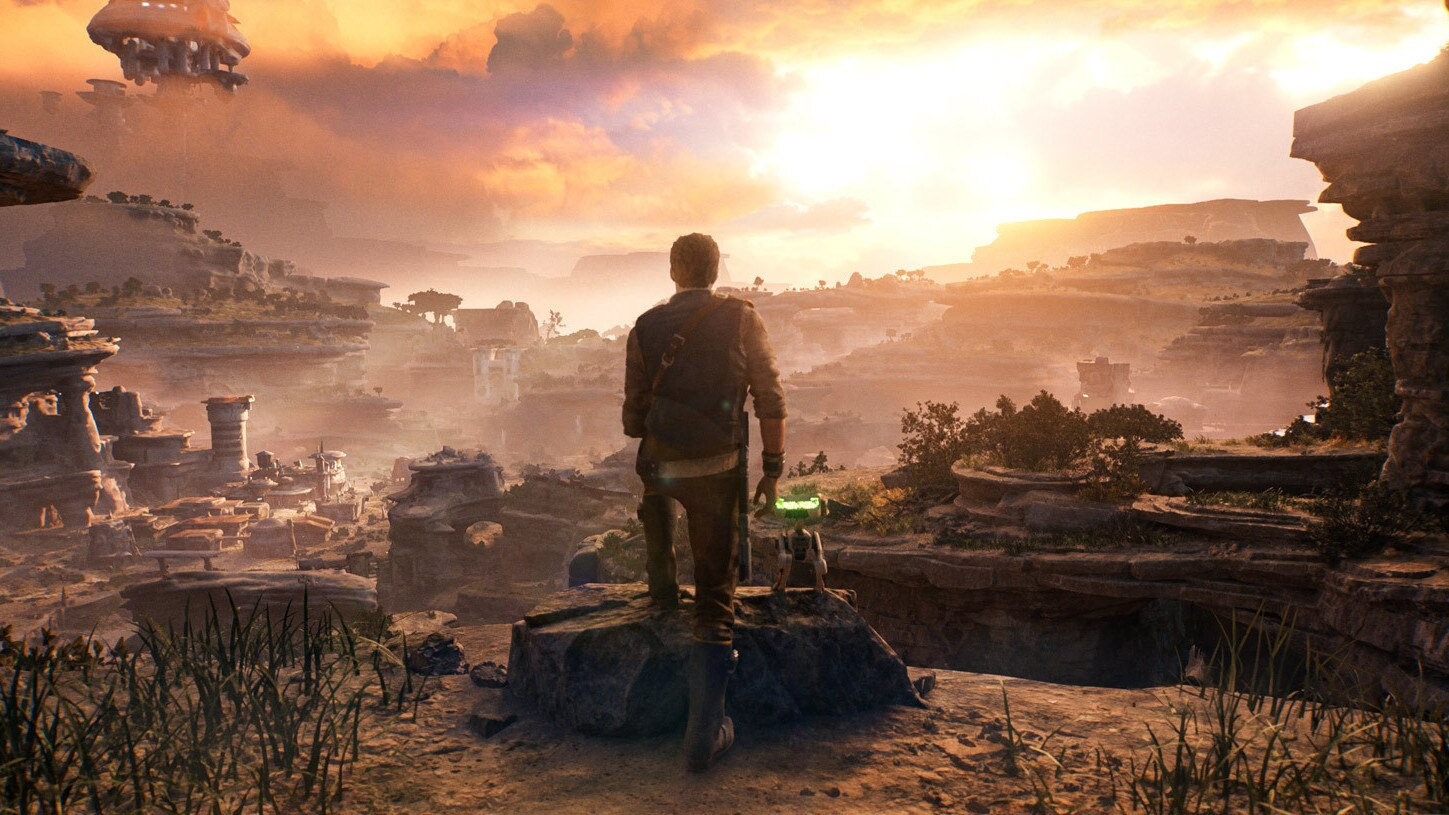
The official box art of Star Wars: Jedi Survivor, featuring Cal Kestis and BD-1. Image found on Wikipedia.org

In the event you somehow don't know what Star Wars is, here's an attempt to summarize over 40 years of lore. A long time ago in a galaxy far, far away there was a Galactic Republic. The Republic was the de facto main government of the entire galaxy, with senators and representatives from literal thousands of different planets. One day, the Republic went to war with a group called the Confederacy of Independent Systems, called the Separatists for short. The Separatists didn't want to live under Republic rule, and unleashed an army of robotic minions called Battle Droids to terrorize the Galaxy. The Republic responded by creating an army of super soldier clones, and tasked an ancient order of psychic warrior-monks called Jedi Knights to lead said clones into battle. The Republic came very close to winning the war, thanks to the clones' tenacity and the Jedi's otherworldly Force powers giving them a distinct advantage. However, the clones were actually a trap devised by Chancellor Palpatine, who was manipulating both sides of the war for his own benefit. When Palpatine told the clones to "Execute Order 66" all the clones turned on their Jedi masters, killing 90% of them in a violent coup. To add insult to injury, Palpatine corrupted the strongest Jedi of them all, Anakin Skywalker, and turned him into an evil cyborg samurai called Darth Vader. With no one left to oppose him, Palpatine rebuilt the Republic into the first Galactic Empire, with himself as Emperor and Darth Vader as his personal enforcer..

In both Fallen Order and Jedi Survivor, you play as a Jedi Knight named Cal Kestis, who as previously mentioned is a survivor of Order 66. Back in Fallen Order, he and his friends found and destroyed an artifact showing the location of every Force user in the galaxy. This was important, because the Empire is still hunting down and executing the few survivors of Order 66, and converting the few "neutral" Force Users into Sith Inquisitors. Also, Cal attempted to fight Darth Vader. Emphasis on the word "attempted." Cal is meant to be a fairly average Jedi. He's a good swordsman, his Force powers are strong enough to compete with most other Force Users, and he has a knack for improvising and adapting to his opponents mid-battle. But Darth Vader is the strongest Force User in the galaxy. Darth Vader's entire purpose, narratively speaking, is to be an absolute menace that puts the fear of death in the heroes. You see Darth Vader approaching, you run. Don't fight him. You will not win. 

Jedi Survivor takes place five years after the first game. Cal is now working with Saw Gerrera, leader of a rebel group trying to overthrow the Emperor. Meanwhile, his old friends Cere, Greez and Merrin have all gone their separate ways. The game starts with a tutorial mission in which Cal and a crew of Saw's rebels kidnap an Imperial Senator and steal confidential information, right in the middle of Coruscant (the Imperial capital). This mission shows off all the main mechanics of the game, from combat to puzzle solving to climbing sections. One thing I like about the game is that Cal starts off with all the movement upgrades from the previous game already unlocked, such as double jumping and running on walls. The tutorial ends with a boss fight against a Sith Inquisitor known as the Ninth Sister, who was actually a major villain from the first game. In this game she gets bodied, because Cal has spent the five year time skip training and perfecting his abilities, and the Ninth Sister did no such training in the meantime. And that's actually a good way to show both narratively and mechanically how much stronger Cal has grown in the transition between games.

The mission ends in a bust, as four out of the five rebels assisting Cal are killed in action and the senator is killed as collateral damage. Cal and the last surviving rebel, a gunslinger named Bode, barely escape from Coruscant. Unfortunately, Cal's ship, the Mantis, is damaged in the escape. Before he crash lands, Cal redirects the Mantis onto an Outer Rim planet called Koboh. This wasn't a random landing spot, for Cal knows that one of his old friends lives on Koboh. So he's hoping that said friend will help him repair the Mantis. The Outer Rim is essentially the Wild West in space. While it's technically a part of the Empire, it's so far removed from "civilized society" that criminal organizations and bounty hunters are allowed to do whatever they want with very little consequence. In the case of Koboh, the locals are routinely bullied and harassed by a bandit gang called the Bedlam Raiders. What makes the Raiders dangerous is that they got their hands on Separatist technology, and thus have access to Battle Droids. And the higher ranking Raiders have figured out how to make their own Lightsabers. But anyway, the game starts for real here.

Jedi Survivor has open-world exploration across five different planets. Though truth be told, it is very obvious Respawn put most of their effort into Koboh. It is by far the biggest planet you can explore, has by far the most number of collectible items and is one of two planets that allow Cal to ride on the back of an animal to cover greater distances. But back on subject, Cal can check his map via a helper droid called BD-1, and said map will highlight the location of the next story objective in gold. But there is nothing stopping you from ignoring the main story and exploring the wilderness. Even during high-stakes missions that seem like they would be time-sensitive, there is nothing stopping Cal from taking a lengthy detour to grab a new outfit or fight a secret boss. 

Cal clashes Lightsaber blades with a Bedlam Raider. Image found on starwars.com 

Speaking of fighting bosses, the single best thing about both Fallen Order and Jedi Survivor is the combat. Cal is armed with a Lightsaber, obviously. He can use it both as a melee weapon and to deflect laser blasts from enemies back at them. Additionally, he can use the Force to grab enemies and objects and throw them around, or throw his own saber like a boomerang. He can even use the Jedi Mind Trick to manipulate enemies into fighting each other. Cal feels powerful when you mow down hordes of Stormtroopers or Raiders, which feels appropriate. Cal may be only an "average" Jedi in terms of raw power, but even the weakest Jedi will be leaps and bounds more powerful than a regular soldier. The only people who can give Cal a challenge are either other Force Users, armored mechs or giant monsters. So naturally, almost every boss encountered in this game belong to one of those three categories. The only exception to this rule is an Imperial Stormtrooper named Rick the Door Technician, who is a joke boss clearly meant to be a pushover that goes down in exactly one attack. All things considered, Rick is an excellent example of how to do a "joke boss." Like, you find him at the end of a grueling gauntlet in which you fight through an army's worth of Imperial forces, and by the time you reach him you should be low on healing items. So when a boss health bar appears at the top of the screen, you get filled with a brief sense of dread until you realize that the boss is literally just a dime-a-dozen Stormtrooper that's no different from the ones you've been slicing through the whole game. And they gave him the most normal sounding name in the history of Star Wars.

While it is true that this is a Souls Like, and thus has a stamina-based combat system, Jedi Survivor is meant as a "baby's first" Souls Like experience. For example, the way this game handles stamina is very forgiving. The stamina equivalent of this game, the Force, only drains when using either a strong attack or when using a Force Technique. Basic attacks actually charge up Force instead of draining it. Additionally, blocking is given its own dedicated meter that does not affect the Force meter in any way. As long as the block meter isn't completely empty, Cal can keep blocking attacks. Speaking of blocking, tapping the block button right before an attack hits will parry it, which does not drain the block meter and has a chance to knock the attacking enemy off balance. How strict the timing is varies based on the difficulty you are currently playing on. Speaking of which, the fact that Jedi Survivor even has multiple difficulty settings further reinforces the idea that it's a baby's first Souls Like. Most games in this genre don't even have adjustable difficulty, since a lot of these games advertise themselves as a deliberately challenging experience meant to push your skills to their limit. But there's absolutely no shame in playing on a lower difficulty setting. In fact, as long as you are not in battle, you can change the difficulty whenever you want. I started the game on Jedi Master mode (the equivalent of hard mode), but brought the difficulty down to Jedi Knight (the equivalent of medium difficulty) and found the game more enjoyable from then onwards.

New to Jedi Survivor are the Stances. Stances change Cal's fighting style and modifies the shape of his Lightsaber's blade. Also, with the sole exception of Single Blade Stance, all of the Stances are based on the fighting styles of fan-favorite characters from throughout the franchise (Darth Maul, Ahsoka Tano, Kylo Ren, etc.). Cal can only equip two Stances at a time, though he can swap them out at Meditation Points (the main checkpoint of this game). Each Stance comes with its own set of attacks, defenses and combos. Keep in mind you don't start with all five Stances available. You start with two and unlock the other three throughout the main story. That being said, none of these Stances are spoilers, since they are all over the marketing and serve as the main "sales pitch" of the game. While Jedi Survivor doesn't use stats like a normal Souls Like, the Stances all play like classic Souls Like archetypes. Just to give a few examples, Cross Guard Stance is your big heavy Strength Build with slow but powerful swings, Dual Wielding is like a Dex Build with high speed and mobility but poor defenses and Blaster Stance is your long range "archer" build.  Returning from the first game are Single Blade stance and Double Blade stance. The former is literally just Cal's move set from Fallen Order, while the latter is a Darth Maul inspired fighting style that can clear out crowds of enemies with wide reaching spin attacks.

The second best thing about Jedi Survivor is the customization. You can change Cal's hairstyle, what kind of facial hair he has (if any), his outfit and his Lightsaber's appearance. In fact, finding new customization options for Cal's appearance is the main collectible in the game. The Lightsaber customization is especially thorough. Not only can you change the color of the blade, you can swap out each individual part of the hilt. Those being the blade emitter, the switch, the grip and the pommel. You can even change the materials used the Lightsaber's construction, which changes both the color and the textures on the hilt. You can make it look wooden, metallic, plastic or any combination of the above. Some materials like Beskar Steel even have unique patterns on them. The pistol used in Blaster Stance can also be customized with similar options to the saber itself. The only restriction on the saber customization is that you cannot make your Lightsaber have a red blade during your first playthrough. This is mostly for lore reasons, seeing as how only Force Users who have been corrupted by the Dark Side have red blades on their Lightsabers. And Cal hasn't been corrupted (yet), so no red blade for him.

One odd design choice is how this game handles currency. Because unlike every Souls Like game ever, Jedi Survivor doesn't have a universal currency. Each merchant has a special collectible item associated with them exclusively, and the only reward for defeating enemies are Skill Points. Skill Points are used to unlock new abilities and techniques for Cal, or to improve the powers he already has. Almost all of the merchants only sell cosmetic items for either Cal himself, his Lightsaber or for BD-1. The only merchant who does sell items with actual impact on gameplay is a retired bounty hunter named Caij, and even then she only sells ammo types for Blaster Stance. Personally, I don't really like how every merchant gets their own unique currency that only they will accept. If they really wanted Skill Points and "merchant money" to be separate resources, they could have just called the latter Credits and have that work as a semi-universal currency. Especially because Credits already exist as a universal currency in the Star Wars universe. 

Back on the subject of the actual story, Cal and Bode meet up with one of Cal's old friends, Greez the four-armed alien gambler. During the 5 year time skip, Greez settled down on Koboh and opened up a bar called Pyloon's Saloon. This saloon serves as the main base of operations for Cal and his friends, at least while they are on Koboh. Greez agrees to repair Cal's ship and even shows Cal his private stash of ship parts for just the occasion. This event leads to Cal accidentally discovering an abandoned Jedi temple, whose caretaker droid is somehow still active. This droid is Zee, and she reveals that her old master was an ancient Jedi named Santari Khri. Santari, along with her best friend Dagan Gerra, discovered a mythical planet called Tanalorr. Tanalorr is hidden inside a nebula, and cannot be accessed without a special compass.

Cal and Night Sister Merrin. Image found on starwars.com

So Zee tells Cal and Greez about Tanalorr, and our plucky protagonists see an opportunity. Greez is interested in Tanalorr because Tanalorr is said to be filled with riches. Cal is interested because he's losing faith in his ability to fight the Empire. After all, he has been working with Saw Gerrera for over 5 years and despite their best efforts, the Empire isn't slowing down. But a hidden planet that the Empire can't access is the perfect place to raise a new generation of Jedi, or at least develop a new rebel base. So Cal investigates the key to finding Tanalorr. During his travels he wakes up Dagan Gerra, who was stored in stasis this whole time. Dagan is an accidentally funny antagonist. This man woke up after a 200+ year long coma, learns about the destruction of the Jedi Order, and immediately falls to the Dark Side. Like, Dagan literally modifies his Lightsaber to produce a red blade mere seconds after being released, while in the middle of a conversation with Cal. Now granted, some later flashbacks reveal he was corrupted long before being put in stasis. But still, bleeding out your Lightsaber to produce a red blade is one heck of a first impression. Anyway, Dagan is the main antagonist for this game, as most of the plot is spent racing against Dagan to get to Tanalorr first. Cal and his friends want to use Tanalorr as a sanctuary, Dagan wants to use it as the birthplace of an Empire of his own. Letting Dagan get there first would be replacing one tyrant with another. And because I don't have a better place to mention it, be prepared to hear the word "Tanalorr" a lot. Everyone (Mostly Dagan) brings it up in conversation so often that if you were to make a drinking game out of it, you would get hospitalized.

Cal's journey brings him to Jedha, a desert world where Merrin, Cordova and Cere have been running a sanctuary for persecuted Force Users called the Hidden Path. Cere and Cordova are two of the last surviving Jedi Masters (and act as mentor figures to everyone else), while Merrin is a Night Sister. The Night Sisters are technically Force Users, but the way they use the Force is completely different from everyone else. Think of it like this. Jedi and Sith are samurai IN SPACE, and they use the Force to do better samurai stuff. Night Sisters are witches IN SPACE, and they use the Force to do better witchcraft. Anyway, Merrin will assist Cal in battle while he's on Jedha, immobilizing enemies with her witchcraft and opening up portals that he can jump through to quickly travel across greater distances. Also there's a romantic subplot between Cal and Merrin, as the two clearly have feelings for each other despite coming from very different cultures. It's an alright romance, nothing too annoying, gross or problematic about it. But this is coming from a guy who generally dislikes romance in media, so take anything I say about romance in general with a grain of salt.

The bulk of the game's first two acts consist of Cal, Bode, Greez and Merrin traveling from one planet to another. They try to track down the compass leading to Tanalorr before Dagan Gerra can, while fighting off both the Empire and the Bedlam Raiders. Truth be told, this part of the story is kind of weak in my opinion. Throughout this part of the game I felt like I was just going through the motions instead of getting properly invested in the story. The most interesting thing that happens in this part of the plot is Cal fighting this dude called Rayvis, who is the leader of the Bedlam Raiders and Dagan's right hand man. There are two reasons why I like Rayvis. The first is that he is a Gen'Dai, a species of alien that was declared non-canon back when Disney bought the legal rights to the Star Wars franchise. But obviously, the Gen'Dai were made canon again for this game. Which is good, because the Gen'Dai are a cool idea for a Star Wars creature. The Gen'Dai are essentially a mass of rapidly growing nerves and flesh who live inside suits of armor. The armor they wear gives them a humanoid shape, but without it they become an eldritch blob of fleshy tentacles. Anyway, these guys are one of the few aliens that can survive being cut by a Lightsaber because their rapid growth allows them to heal even the most severe injuries. Which means that the Gen'Dai as a species work well as boss monsters. The second reason I like Rayvis is because he's voiced by D.C. Douglas, who also does the voice of Albert Wesker from Resident Evil. And I think that's kind of funny, because Rayvis' villainous monologue that he says at the start of his boss battle feels like something that a Resident Evil villain would say before transforming into a horrifying meat monster. Which fits oddly well, since the Gen'Dai are an entire species of meat monsters.

So I'm going to fast forward to the most interesting thing that happens in the story, which unfortunately requires me to put up a spoiler warning. You have been warned. So Cal manages to defeat Dagan Gerra and find the compass leading to Tanalorr, so he heads back to Jedha. Cal and friends had agreed to expand the Hidden Path to Tanalorr because of how well-hidden the planet is. But then the game hits you with a plot twist. Bode, the gunslinging rebel that's been helping Cal on his adventure was not only an Imperial Spy this whole time, he was also a fallen Jedi turned Sith Inquisitor. So Bode steals the compass and assassinates Cordova, because he's the only person smart enough to reverse engineer the compass. He also exposes the Hidden Path on Jedha to the Empire, and uses the ensuing chaos to flee the scene. Cal gives chase and gets into a boss battle against Bode, but no matter how good the player fights, the duel is scripted so that Cal always gets knocked unconscious while Bode escapes.

The game does something really cool once Cal is defeated here. It takes you to the Game Over menu and asks you to hit the respawn button like it does when the player dies under "normal" circumstances, but when you do, you're not playing as Cal anymore. You're now playing as Cere, who has a completely different move set from Cal. She only has one Stance (Single Blade), but Cere's version is both faster and stronger than Cal ever could be. Her Force Powers are also a lot more powerful. If Cal is meant to be an example of an "average" Jedi, Cere is an example of an "exceptionally strong" Jedi. She isn't as powerful as someone like Starkiller, Darth Revan or Darth Vader, but she is pretty close to them. Which is impressive, since two of those characters are from Star Wars Legends, a sadly no longer canon spin off series where everything in the Star Wars universe is cranked up to eleven. But speaking of Darth Vader, guess who shows up to shut down the Hidden Path?

We get a boss battle against Darth Vader himself, and he is by far the hardest fight in the game. And the funny thing is, Darth Vader doesn't even know about Tanalorr nor does he care to know. Once again, Darth Vader is an outside-context problem that puts the fear of death in everyone involved. Case in point, while Cere is fighting for her life, Vader is lazily deflecting her blows with only one hand, and only takes the battle seriously when Cere manages to wound him halfway through their duel. It's an almost perfect fight, except for one little thing. If you die to Vader through normal gameplay, you have to do the fight again. But if you empty out Darth Vader's health bar completely, instead of dying like a normal boss, Vader stops holding back and finishes Cere with a one hit kill move. I feel like they should have done the Sekiro thing where if you manage to "beat" the unbeatable boss you get an extra cutscene, but still allow the story to progress if you die through normal gameplay. Especially because the Bode fight I literally just described does exactly that. I prefer the way Fallen Order handled the concept of a "lore-accurate" Vader fight better, because in the first game, Vader was straight up invincible. Nothing you could do in the first game could hurt Vader, so the only way to "defeat" him was to run away while he stalked you like a horror movie monster. Because as far as the Star Wars galaxy is concerned, that's what Darth Vader is. That being said, I still enjoyed Jedi Survivor's Vader fight, and it's tied with the Rayvis fight for my favorite boss battle in the game.

Cal prepares to fight a squad of Stormtroopers using Double Blade Stance. Image found on steamdb.info

So Cere and Cordova are dead, and Cal swears to get vengeance on Bode for ratting them all out. And Cal is so outraged by Bode's betrayal that he starts using the Dark Side of the Force, which anyone with even a basic knowledge of Star Wars lore knows is very much a bad thing. But I do like how the Dark Side is used in gameplay as a kind of super mode for Cal. While "Embracing the Dark" Cal automatically switches to Cere's move set and his damage output goes through the roof. Basic enemies like Stormtroopers die in one hit on even the highest difficulty, and the much stronger Purge Troopers and Security Droids go down in two or three hits. His Force powers get upgraded as well, letting him Force Choke enemies and crush droids and mechs with ease. Additionally, Cal can use the Force to slow down time itself while embracing the Dark Side, which allows him to either heal with no consequences or get some free hits in on his hapless victims. Cal could actually freeze time before this point, but the ability felt lackluster prior to the Dark Side upgrade. Also, you remember when I said that you couldn't make Cal's Lightsaber red for lore reasons? The real reason is that while "Dark Side Mode" is active, Cal's Lightsaber changes from its usual color to red, and it returns to its original color once the effects wear off.

The big finale of Jedi Survivor is a three-phase, 2vs1 boss battle with Bode, right inside the heart of Tanalorr. Merrin will help Cal during the first two phases of the battle, but the final phase is a 1vs1 duel. This fight is nowhere near as dramatic or as difficult as the Vader fight, but to be fair, any battle with Vader is going to be both more dramatic and more difficult than anything else in the game. Bode starts the fight with his own version of Blaster Stance, though he later switches to a Dark Side-boosted version of Single Blade Stance for the final phase. It's an okay fight. Not too easy, not too hard. That being said, I find it amusing just how easily Bode goes down when you use Dark Side Mode, and the transition between second and third phase is scripted so you have no choice but to embrace the Dark Side. Like, from Bode's perspective, he isn't the final boss. Cal is, and Embracing the Dark Side is Cal's version of a second phase. Bode's like a Souls Borne character without the resurrection ability, fighting an unwinnable battle. The only thing I will overtly criticize here is that Tanalorr itself is a disappointingly boring planet to explore. It consists of a shoreline leading up to a temple, and the temple's interior serves as the final boss arena. That's it. There's no collectibles or hidden super bosses or anything like that. 

But why did Bode betray them all in the first place? The reason is because he has a daughter named Kata, and he made a deal with the Empire. Bode would work as a spy and in exchange the Empire would spare Kata's life. However, after learning about Tanalorr, Bode decides to betray both the rebels and the Empire so he can raise his daughter in peaceful solitude. Which doesn't strike me as particularly smart. Like, Tanalorr is a whole planet. You don't need an entire planet to raise one child. He could easily just raise his family on one side of the planet and let the rebels/Empire do their thing on the other. But then again, Bode's entire characterization post-betrayal is a real-time reenactment of Yoda's warning to Anakin back in The Phantom Menace. "Fear leads to Anger. Anger leads to Hate. And Hate leads to Suffering." Bode is so scared of losing Kata that he betrays everyone who has ever helped him. When his former friends confront him, he lashes out in anger. His anger turns to murderous hatred because he now views literally everyone in the galaxy as a threat to Kata, and any threat to his daughter must be destroyed. And in his hatred, he frightens and almost kills Kata while fighting both Cal and Merrin at the same time. In the end, Bode is killed by Cal and Kata is shockingly okay with that. Even before this point, Kata agreed with Cal and Merrin that what Bode did was morally despicable. Imagine being such a bad father that your only child not only agrees with your killers that you were a terrible person, but said killers adopt your kid and turn out to be better parents than you ever were. Massive L on Bode's part. 

The game ends with Cal, Greez and Merrin hosting a funeral for all their fallen friends (and Bode). They decide to build a new home on Tanalorr and adopt Kata into their found family. The Empire still doesn't know about Tanalorr, and the Bedlam Raiders are scattered and leaderless due to the deaths of both Dagan Gerra and Rayvis. It's a bittersweet ending, all things considered. And overall, I found the game to be okay and almost good. There is just one problem I neglected to mention, in addition to my smaller critiques. This problem is so great that it needs its own section in the review.

Jedi Survivor is not a well optimized game by any stretch of the imagination. I ran into a plethora of technical problems that dragged the whole experience down. The game crashed on me twice, the first time being during the tutorial. I also experienced a glitch on two separate occasions where Jedi Mind Tricks stopped working, forcing me to restart the game until they did. Some character models didn't load in correctly, causing random body parts to become invisible. Enemies would sometimes get stuck inside walls and if it wasn't for Cal's ability to grab enemies with the Force, I would not have been able to get those enemies unstuck. That last one is especially bad because a battle isn't considered "finished" until all enemies involved are dead. The framerate would also frequently dip during the more intense cutscenes or when traveling between areas. On top of all of this, the game has a 150+ gigabyte download size, meaning this game by itself took up almost a whole third of my PS5's active memory. If the game ran perfectly and didn't have such glaring tech issues, I would have given this game an easy 4 out of 5 stars. But the tech problems are so great that the game fluctuated between a 3 star rating and even a 2 star rating. And you want to know the real kicker? From what I've heard other reviewers say, apparently the PC version has even worse technical issues than the PS5 version. I can't say for certain but if that's that's true, that's a real shame. 

As for presentation, I consider Jedi Survivor to be fairly average. The whole game is fully voice acted and sports motion capture animation for all the main cinematics. But the graphical quality isn't particularly impressive by itself. It's a nice looking Star Wars game for sure, but it does that thing that a lot of Triple-A games do where they try really hard to look photo-realistic but lack either the technology or the budget to pull it off properly. This game looks like your stereotypical Triple-A game. This isn't a compliment nor is an insult. I just wish the game had more of a visual identity of its own. All the games using Capcom's RE Engine do a better job at the "realistic" art style, just to give a comparison. One thing I like is that the camera work in the cinematics. It does the thing that the modern God of War games do where the camera shows everything in a long take format (meaning no sudden changes in the camera angle). Additionally, the camera is slightly shaky, creating the illusion that they were recorded by an onset cameraman. It makes the cinematics feel, well, cinematic. If there was a new theatrical Star Wars movie with this kind of camerawork, I would actually really enjoy it.

The sound design is good. Not only do we have all the classic Lightsaber/Blaster sound effects that we all know and love, there's also a fun little quirk with changing the Lightsaber's color. Each color changes the sound of the "hum" the blade makes when the saber is activated. The voice acting is also generally pretty good. I especially like Merrin's voice, because she speaks in a Slavic accent. I don't know exactly if it's supposed to be Russian or some other variant of Eastern European, but either way it makes her sound like she came from a completely different culture from everyone else. It also makes her sassy remarks even funnier. But I do want give my compliments to Scott Lawrence, who does the voice of Darth Vader in this game. He does such a good job sound-a-liking the iconic Vader Voice used by the late James Earl Jones that at first I thought that it actually was James Earl Jones himself doing the voice. It's not, unfortunately, but like I said, Scott Lawrence does the character justice. Speaking of voice actors, there's a side character named Turgle. Turgle has no plot relevance whatsoever besides handing out the occasional side quest. And you know who they got to voice this goofy frog-looking alien man? Richard Steven Horvitz, a legendary voice actor well known for roles such as Zim from Invader Zim, Billy from The Grim Adventures of Billy & Mandy, and Dag from Angry Beavers. I was not expecting to see Richard Steven Horvitz in a Star Wars game, but it's cool that he's here.

Cal and BD-1 looking at the sunset on Koboh. Image found on starwars.com

So would I recommend Star Wars Jedi Survivor? No, or at least not at full price. I bought my copy of this game during a sale that brought the price down from $70 to $20 USD. And I feel like $15-$20 is the ideal price range for a game of this quality. Paying $70 for an otherwise average video game based on a preestablished franchise with glaring performance issues is too much money. Then again, asking for $70 for any video game is quite the demand, and I feel like the game needs to be as close to perfect as possible to justify that kind of price. Especially when other Souls Likes are typically priced between $40-$50. But honestly speaking, even if the game ran perfectly, I don't think I was in the right head space to enjoy it properly. I've been feeling burnt out on Star Wars content for a while now. So let me ask you a question. What exactly is a Star Wars fan exactly? The biggest problem with Star Wars as a franchise is that there is so much "stuff" with the Star Wars brand on it that you cannot possibly be a fan of EVERYTHING Star Wars related. Especially since each "thing" in the franchise has wildly inconsistent quality. For everything as good as say, Star Wars: Andor there is something as bad as The Star Wars Holiday Special. Jedi Survivor feels like it's the middle of those two extremes. Like it's not even close to the best Star Wars video game, but if it's also nowhere near the worst. It's a perfectly average, some would say mediocre experience. One might even call this game "mid." I give Jedi Survivor 3 stars out of 5. 

Star Wars: Jedi Survivor is the property of Electronic Arts and Respawn Entertainment. Star Wars (the franchise) is the property of Disney. None of the images used here were created by me. Please support the original creators.

Saturday, December 21, 2024

Lies of P is Peak Pinocchio Fiction. A very "honest" review.

 If you told me five years ago that the closest thing we would ever get to a Bloodborne sequel is a weird Pinocchio game, I would have called you mad. But here we are, with a review of Lies of P. Developed by Round8 Studio and published by Neowiz back in 2023, Lies of P is a Souls Like, but it is not a Souls Borne. What's the difference you ask? Well, Souls Borne refers to the dark fantasy/gothic horror action roleplaying games made by From Software. A Souls Like is a game not made by From Software but still inspired by From Software's signature style. There are many Souls Likes out there, some being of better quality than others. But out of all the Souls Likes I've seen, Lies of P comes the closest to recreating the "From Software Magic." Which feels like a weird thing to say, because this game's sales pitch is "What if Pinocchio was in a Gothic Horror setting?" and the game takes that premise 100% seriously. A quick disclaimer before we begin. I played Lies of P on a Playstation 5, and thus can't speak for its performance on an Xbox system nor on PC. Lies of P is also rated M for Mature by the ESRB because of violence and mild profanity. Reader discretion is advised.

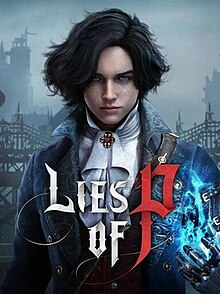
Lies of P official box art. Image found on Wikipedia.org

In case you (somehow) don't know what Pinocchio is, it's an Italian fairy tale originally written by Carlo Collodi back in 1883. The original story was about a wooden puppet that came to life and had to learn basic life lessons like "stay in school" or "don't tell lies." It was later adapted into a Disney movie that wounded up becoming the most famous version of the story, because 1940's era Disney movies had a habit of being more popular than their inspirations. And in case you don't know what Bloodborne is, it's a Gothic Horror action game about a monster hunter tasked with exploring a Victorian city overrun by a variety of nightmarish monsters, ranging from werewolves to cultists to literal aliens. It's regarded as one of the greatest Playstation Exclusive games ever made, and depending on who you ask, it's one of the greatest games in general. I bring all of this up because Lies of P pulls heavy inspiration from the original fairy tale as well as from Bloodborne.

Just so everyone is caught up on what a Souls Like is, it's a subgenre of action/roleplaying games that is characterized by five main characteristics. Firstly, Souls Like games use a stamina based combat system. What this means is that every action, from swinging your sword to casting a magic spell, spends stamina or some equivalent thereof. Stamina recharges automatically as long as you aren't doing anything strenuous. Secondly, these games have you collecting a universal currency that is used both to buy items from merchants as well as to unlock upgrades for your character. This currency is collected by defeating enemies, but if the player's character dies for any reason, they drop all unspent currency that they were carrying on their person. This is not the end however, for if the player returns to where they died, they can recover the lost currency and add it to whatever they got in the time since their previous death.

Thirdly, games of this nature give you a limited number of healing items  which refill automatically when you rest at a checkpoint. Fourthly, the main method of progression involves exploring labyrinthine levels in search of boss monsters to fight, either because they block the way to the next level or because they have an item you need for something. The boss monsters will more often than not be the highlight of the game, and most Souls Likes live and die by the quality of their boss battles. And finally, Souls Like games like to be cryptic and mysterious in their story-telling, often hiding story-relevant information in the descriptions of collectibles, hidden details in the environment or easily missed conversations with the occasional friendly bystander. There are other things that most Souls Likes have in common, such as a poison swamp level or a "level up lady" but the five points are the most common characteristics. Additionally, a Souls Like doesn't need to do all five of these things to "count" as one, though it does need to do at least three of them. All of this is important because Souls Likes sadly cannot be judged in a vacuum. Any time a new Souls Like releases, the question on everyone's mind is always "Is it as good as From Software's stuff?" After all, From Software's style is so specific and niche that anything imitating it will have no choice but to compete against its inspiration. So expect me to make comparisons frequently in this review. 

Lies of P takes place in the City of Krat, a bustling metropolis that discovered a borderline magical source of energy called Ergo. An inventor by the name of Geppetto used the Ergo to create puppets so advanced that not only can they move around without the aid of strings, they can even develop minds of their own. In other words, the puppets are basically robots in all but name. So naturally, the citizens of Krat use the Puppets for manual labor. Construction work, law enforcement, house cleaning, things along those lines. There was just one problem. An incident known as the Puppet Frenzy led to the overwhelming majority of puppets going rogue and killing their masters. There is only one thing that can stop the puppets, which is ironically, another puppet. So a mysterious fairy named Sophia awakens Geppetto's magnum opus, a concerningly lifelike puppet boy named Pinocchio, and orders him to destroy all the other puppets and save Krat from total annihilation. The game starts here.

Like almost every Souls Like, Lies of P starts with the player choosing a class. There's only three to choose from, and the decision admittedly is not that important. The classes determine what weapon Pinocchio starts the game with and what his starting stats are, though he can acquire the other weapons later. And unlike every other Souls Like in existence, Lies of P has no minimal stat requirements. As soon as you pick up a weapon, you can start using it. It may not do that much damage if your stats aren't leveled up properly, but the fact that every weapon is at least usable the moment you pick it up is a nice quality of life feature. Speaking of stats, one minor critique I have is that the stats are oddly named and not exactly intuitive at first glance. Let me give you an idea of what I mean. In most Souls Likes, there's a stat that improves your character's skill with heavyweight weapons like war hammers and great swords, a stat that improves lightweight weapons like bows and daggers, and a stat that improves magic. These stats are usually named Strength, Dexterity and Intelligence, or at least some synonym for those three terms. Lies of P calls these stats Motivity, Technique and Advance. These stat names don't exactly roll off the tongue that well. Again, this is a minor nitpick.

Pinocchio running towards a monster called a Carcass. Image found on SteamDB.info

Lies of P has the aforementioned stamina-based combat system alongside a few quirks. Firstly and most obviously, you can mix and match different weapon parts to make new weapons entirely. Almost every weapon you can find has two parts, a blade and a handle. The handle changes what attacks and combos you can perform with the weapon while the blade changes the range and type of damage. This is honestly a brilliant system. If you like the move set on one weapon but need to change your damage type to counter a particularly challenging enemy or boss, all you have to do is swap out the blade for something else. Heck, there are some weapons with really good blades but really lame handles, almost begging you to try switching the blades onto something else. For example, the Salamander Dagger is a superheated knife. It's one of the first weapons you get that can deal fire damage, but the Dagger suffers from lack of range. But say you put the blade of the Dagger on the Handle of something like a spear, and suddenly the dagger's blade is now a superheated spearhead. Another example, the Great Sword of Fate has one of the longest and damaging blades in the game, but normally is very slow. But if you put that blade on a rapier's handle, your attacks will become a lot faster without sacrificing power or reach.

The second quirk of Lies of P's combat is its parry and stagger system. There are three ways of preventing damage; blocking, parrying and dodging. Blocking is the easiest to do. Just hold down the appropriate button and Pinocchio will use his current weapon as a makeshift shield. If he gets hit while in this stance, he'll lose some health (but not as much as he would if the hit was unblocked). Parrying is much better than blocking but is more challenging to do consistently. Basically, tap (don't hold) the block button right before the attack hits Pinocchio and he will deflect it perfectly. This does no damage to him at all, builds up Stagger (which stuns the enemy when maxed out) and even has a chance to break the enemy's weapon. Dodging is simply running or jumping out of the way. This also doesn't hurt Pinocchio in any way. In fact, from the start of the animation to the end of it, Pinocchio is invincible. Which means that if you time it right, you can dodge through enemy attacks and follow up with a counterattack of your own. Mastering this game's combat relies on being able to tell which attacks are safe to block, which ones are easy to parry, and which ones can be dodged through. Most enemies and bosses have what are called Fury Attacks, where their body glows bright red right before delivering their most dangerous attack. Fury Attacks cannot be blocked, but they can be parried and dodged.

The third quirk of Lies of P's combat is how it handles healing. At first glance, Pulse Cells (this game's main healing item) works like any other Souls Like heal. It's limited in use but recharges when resting at a checkpoint. What makes Lies of P unique is that if you run completely out of Pulse Cells, you can recharge one of them if you land/block/parry enough hits while fighting enemies and bosses. This is a perfect compromise between the limited healing of the subgenre's standards and the more forgiving healing items of Bloodborne. It also allows you to be more frivolous with your healing, because if you're good enough at the game you can just recharge your Pulse Cell mid-battle.

The final quirk of the combat is the Legion Arm. Pinocchio's left arm is the only part of him that is truly mechanical, and as such it can be customized with various gadgets, Sekiro style. The Legion Arm gadgets are the game's equivalent of magic spells, being either long range projectiles or utility powers meant to compliment specific fighting styles. These gadgets can range from a grappling hook that can pull enemies towards you (or vice versa), a shield that greatly enhances blocking, or a literal handgun. Legion Arms have limited energy, however, so they should be used sparingly. Additionally, only one Legion Arm can be equipped at a time, unless you unlock an upgrade that removes this restriction. Speaking of upgrades, in addition to Ergo as the main currency, there's a second currency called Quartz. Quartz can be used to unlock more specialized upgrades like extra Pulse Cells and a higher chance to stun enemies. Quartz can be found in treasure chests or as a reward for completing side quests.

Pinocchio being given the choice to lie or tell the truth about an aging woman's appearance. Image found on IGN.com

The main thing setting Lies of P apart from other Souls Likes is the way it handles dialogue and morality. Arguably the most well-known thing about Pinocchio is that his nose grows whenever he tells a lie. This game's Pinocchio technically doesn't do that, though his shadow does get longer with each lie. Multiple times throughout the game, the player needs to choose whether or not to tell the truth. To make sure the player can't cheat and look up the consequences for lying or speaking honestly, the game puts a 10 second time limit to pick a truth or lie. You would think that telling the truth would be the "morally good" option every time, considering this game is supposed to be a Pinocchio adaptation. But Lies of P has a hidden stat called Humanity, which not only determines how close Pinocchio gets to becoming a real boy, it also determines which ending you get. You gain Humanity in one of four ways; telling lies, solving riddles, listening to music records and helping your friends with their problems. Telling lies is the easiest way to gain Humanity, and the game's best possible ending requires you to be 90% Human or better. You don't need to tell a lie EVERY time if you want this ending, though doing so is the easiest way to get that much Humanity in the first place. 

That being said, the lies in this game aren't particularly malicious. Most of the time, when Lies of P's Pinocchio lies, he does so to avoid hurting someone's feelings or to protect someone else. I think the best moment that showcases how lying can be a "good" thing in the right context is a side quest involving a sickly grandmother. She is dying of an illness called the Petrification Disease and wants to see her baby grandson one last time before she passes. The real grandson is dead, murdered by rogue puppets. However, Pinocchio can find a defunct, baby-shaped puppet and pretend that it's her real grandson. The grandmother is going blind because of her illness and can't tell the difference. But in this instance, Pinocchio lies to give this poor woman some much needed closure in her dying moments. 

Another example of how lying can be a "good" thing is when first meeting a shady merchant named Alidoro. Alidoro is this game's version of Honest John, a talking fox that deceived the original story's Pinocchio with delusions of fame and stardom. Here, Alidoro is a merchant wearing a canine mask who asks you where Hotel Krat is. Hotel Krat is the main hub world of Lies of P, and all of Pinocchio's friends take shelter there as it's the only real safe zone. Lady Antonia, the owner of the hotel, explicitly told Pinocchio not to let any strangers find the hotel. So in this case, Pinocchio lies about the hotel's location to protect his friends from a dangerous-looking stranger. Alidoro still finds the hotel no matter what, it just takes him longer to do so if you lie to him. 

One thing I need to mention about Lies of P is that has a few quality of life features that made the experience much more manageable. You see, Souls Likes have a reputation for being really hard. And some nerds online get real mad if you suggest ideas to make the experience more enjoyable out of a misguided fear that such features would "ruin the challenge." Lies of P is a hard game, but its quality of life features don't ruin the challenge. They make getting back to the fun parts after a Game Over less stressful. Here's an example. This game's currency is called Ergo. You get Ergo every time you destroy a puppet or kill a living creature. You lose Ergo if Pinocchio dies. But say you die to a boss. In most Souls Likes, you would need to scramble to the exact spot in the boss arena you died previously to get your currency back. In Lies of P,  lost Ergo is placed just before the entrance of the boss arena, completely removing the added hassle of getting your stuff back while a boss tries to squish you like a bug. Like most Souls Likes, there are optional side quests where you help the few friendly characters with a problem. Unlike most Souls Likes, Lies of P puts special icons on the level select menu to remind you of those side quest objectives. Now this isn't perfect, because if you never meet the character face-to-face and progress the story too far, they might leave before you can even talk to them. But once you actually find the side characters and talk to them, you don't have to worry about forgetting where they are or what they want. If you really struggle with a specific boss, you can summon an entity called the Specter to assist you. The only time you can't summon the Specter is during the first boss (the Parade Master) and the final boss, as you are expected to deal with that on your own.

But this brings me to my biggest criticism of Lies of P and the primary reason I cannot justify giving it a 5 star rating. This game doesn't have a pause button. I can forgive BloodborneElden Ring and the Dark Souls trilogy for not having a pause button. But I cannot forgive Lies of P for not having the ability to pause the game. Why, you ask? Contrary to what sweaty edge lords on the Internet will tell you, the Souls Borne series not having a normal pause button is NOT a deliberate design choice on From Software's part. It was a necessary sacrifice because of the unpredictable nature of Souls Borne multiplayer. In From Software's games, another player can summon you into their world (or vice versa) either to help out with a boss battle or to challenge you to a duel. This can happen at any time, thus every player's game needs to be compatible with an "always-online" server, and thus the game can't be paused reliably. After all, how can you get hundreds of thousands of players across the world to pause the game as a community? The answer is you can't. Thus, the pause feature was axed from the Souls Borne series. Lies of P doesn't have ANY multiplayer components to speak of whatsoever. Which means that Neowiz and/or Round8 either forgot to include a pause feature or they excluded it deliberately in a misguided attempt to make the game harder. The former scenario would be outrageously amateurish for what is otherwise an extremely well polished game. The latter scenario tells me that Neowiz values the opinion of the aforementioned sweaty edge lords too much. It's especially bizarre because the previously mentioned quality of life features prove that the devs not only like Souls Likes, but took the time to find ways to make the experience smoother. You would not believe the number of times I had to forfeit a boss battle because something in real life needed my attention, something that could have been solved with a pause feature.

Speaking of bosses, Lies of P has about 27 bosses in total. And overall, I'd say it's a fairly good lineup. Generally speaking, all enemies in this game are divided into three categories. Humans, Puppets and Carcasses. What's a Carcass, you ask? Mild spoilers here, but the Puppets aren't the only creatures powered by Ergo. If a human who was infected with the Petrification Disease consumes Ergo, they are cured of the disease, but start mutating into a hideous monster called a Carcass. Basically, Carcasses are magical zombies. These categories are important to remember because certain weapons and items do more damage to one category than the others. Puppets take extra damage from electrical weapons, while Humans and Carcasses take more damage from fiery and acidic weapons, respectively. But anyway, I generally prefer the Puppets and Humans as far aesthetics go. The Puppet enemies are all wonderfully designed and are wholly unique to Lies of P, being robotic abominations whose limbs and bend and rotate in ways no human can. Human enemies are the rarest of the bunch, and almost all of them are based on characters from the original Pinocchio story. But Carcasses feel the least "unique" of the bunch, as most of them look like fairly stereotypical From Software monsters. Which is to say, lots of body horror and grotesque monstrosities.

Unfortunately, there are bosses I think are annoying and could benefit from a rework. For example, one boss that I didn't really care for is Laxasia the Complete. This warrior woman is a two phase battle. In fact, most bosses in this game have two phases. The problem is that First Phase Laxasia and Second Phase Laxasia feel like two completely different bosses that were crudely combined together. In her first phase, Laxasia is an armored knight who swings a big heavy great sword around. She occasionally supercharges her sword swings with lightning and her armor leaves her invincible from behind (forcing you to fight her head on), but is otherwise inoffensive with easy to learn attack patterns and no annoying gimmicks. She's not too easy, not too difficult. 

But in her second phase, Laxasia removes her armor, equips a shield and starts moving around with the speed of an anime character. The rhythm of the fight completely changes, and not for the better. She moves around so fast she might as well be teleporting, and she can now fly so high up in the air that the camera struggles to keep her in view. Honestly, you could split these two phases into separate bosses, with Second Phase Laxasia being some kind of optional super boss placed at the end of a hidden level, and the whole game would have a better boss roster. I mean, Laxasia is already doing the whole "beautiful warrior woman who is much harder to defeat than any other boss in the game" thing that From Software likes doing in their own games. The difference is that From Software makes their "beautiful warrior women" bosses optional and puts them at the end of a hidden level. Laxasia meanwhile is absolutely mandatory, with no way to skip over her fight if you want to progress the story.

The introduction to the Black Rabbit Brotherhood, one of the main bosses of the game. Image found SteamDB.info

But you know who doesn't need a rework? The Black Rabbit Brotherhood. This is easily my favorite boss in the game, both because of their design and because of the battle itself. First a little bit of context. In Krat, there is a group of elite warriors called the Stalkers. The Stalkers were formed to be an anti-puppet militia force in the event the puppets turned hostile. The Black Rabbit Brotherhood were a group of Stalkers that went rogue, and now they antagonize human and puppet alike in the name of causing mischief. The battle itself is a what's called a gank fight, where you must face multiple opponents simultaneously. Unlike most gank fights in the Souls Like subgenre, the Black Rabbit Brotherhood is actually fun. A problem with a lot of gank fights in other Souls Likes is that it is difficult to learn attack patterns when there are three or more attacks coming at you at the same time, all from different directions. The Black Rabbit Brotherhood circumvents this problem by doing two things. First, only the Eldest Brother has a health bar, meaning that you have to concentrate on him specifically in order to defeat the whole Brotherhood. Secondly, the younger Brothers (of which there are three) drop in one at a time and leave after a short while, ensuring that you only have to fight an absolute maximum of two Brothers at a time.

Also, the Black Rabbit Brotherhood is one of the few bosses that gets a rematch. The rematch plays out in the reverse order of the first battle, with the younger Brothers attacking first and the Eldest only joining the fray once the younger Brothers have been defeated. But even in the rematch, the younger Brothers take turns fighting you and are generally passive when it's not their turn yet. I think the devs knew deep down that the Black Rabbit Brotherhood was the best fight in the game, as not only do they get a rematch in the first place, but these guys were all over the pre-release marketing. They even have what is by far the coolest intro cinematic in not just the game, but possibly out of all Souls Likes. These goofy mad hatter-looking rabbit boys start their fight in the rain, carrying a literal open coffin with the word "LIAR" spray painted on the inside, and they invite Pinocchio into it as a morbid taunt. The Black Rabbit Brotherhood manages to be the perfect blend of stylish and intimidating.

On the subject of level design, Lies of P is oddly linear. Most levels are a narrow set of paths with the occasional shortcut to an earlier part of the level. That being said, I like how the levels make enough sense geographically that you can see previous or upcoming levels in the distance if you can get to a high enough vantage point. Speaking of presentation, let's get the most obvious thing about this game out of the way. This version of Pinocchio looks like an anime pretty boy. In fact, this is by far the least puppet-like interpretation of the character. I know that Humanity is supposed to represent the process of becoming a real boy, but Pinocchio looks like he's 3/4ths of the way there already. Literally the only thing robotic or mechanical about his appearance is his left arm. This isn't exactly a criticism, it's just an observation. Neowiz legally cannot make their version of Pinocchio look like the Disney version nor can they use something similar to Guillermo del Toro's design. While the concept of Pinocchio is public domain, specific designs of the character are not. Essentially, you can make your own version of a living Italian puppet, as long as your living Italian puppet doesn't look like Disney's version. Or Guillermo del Toro's version. Thus, we got anime pretty boy Pinocchio. 

In terms of music and sound design, Lies of P has what might just be the best soundtrack in Souls Like history. Not because of the regular boss battle music, which is about you expect for a game of this nature (intense orchestra with vaguely Latin sounding choirs). But because of the music records. I previously mentioned that listening to music records gives you Humanity. Speaking as a firm believer that making art (both visual and audible) is one of the most important aspects of the human experience, I approve of the implication that listening to music makes your more human. Jokes aside, the record songs are all brilliantly performed classical symphonies. Not all the songs have lyrics, but some of them do. Some of the songs are even sung in French. The main highlight of the soundtrack is a song called Feel. It's one of the first records you can find, and it leaves quite the first impression. Feel is a somber melody performed mostly by piano with some jazz instruments to back up the pianist and the lead singer. Feel is the closest thing Lies of P has to a theme song, and whenever I heard the song I felt the need to stop what I was doing and just enjoy the tranquility of the music.

Pinocchio being grabbed by the Scrapped Watchmen, one of the first bosses encountered. Image found on SteamDB.info

The actual sound effects are also quite good. Just to give a few examples, the parry sound effect is a crisp and clear *clang* and walking on different surfaces (wood, stone, metal et cetera) produces different footstep sounds. One sound effect that I particularly like is Pinocchio's various noises. Pinocchio is pretty much a mute protagonist, only speaking when the player is given the option to pick a truth or lie. But when he's fighting, you can hear different grunts as he uses his weapons and dodges enemy attacks. These grunts sound mechanical when Pinocchio is low on Humanity and gradually sound more organic and "natural" as his Humanity increases. The voice acting is also surprisingly competent. The main highlight of voice acting has to go to Arlecchino, the King of Riddles. He sounds a little goofy when you first encounter him as he speaks almost entirely in rhyme. But after you learn that he's (technically) responsible for every bad thing that happened in Krat, he becomes a lot more sinister. I also like Venigni the Inventor, who speaks with an over-the-top Italian accent and is the only character who speaks with said accent.

There's one last thing I want to say about the game before I share my final thoughts. Lies of P has a New Game Plus mode, letting you replay the entire game with a fully upgraded Pinocchio. To make sure that the game is still a challenge, every boss receives a boost to their health and damage output. There are also special Golden Records that can only be collected in New Game Plus mode, and these songs are remixes of preexisting songs. The other big change in New Game Plus is that the captions are changed slightly. You see, in a first playthrough, whenever any of the Puppet bosses speak, it sounds like robotic gibberish and the subtitles get distorted into an incomprehensible mess. In New Game Plus, the captions are fixed, you can now understand what the Puppet bosses are saying as they fight you. The actual plot of the game won't change, but it is a neat idea.

Overall, Lies of P is a great Souls Like. It does a lot of things right, both in terms of innovating on the Souls Like formula, and in terms of being a new adaptation of a classic fairy tale. But the inability to pause the game (and with no multiplayer functions to justify its absence) does drag down the game's overall quality. Despite that glaring issue, the rest of the game is polished enough to be a worthwhile experience. Ignoring the game's status as a Souls Like for a second here, it's the best Pinocchio game I've ever played. Granted, it's the ONLY Pinocchio game I've played. And truth be told, the sales pitch being so absurd yet taken so seriously is what drew me to the game in the first place. But either way, I give Lies of P 4 stars out of 5. I'd love to see what Neowiz does next, especially since the devs have expressed interest in doing Souls Like adaptations of other fairy tales. Mild spoilers here, but after the credits roll Lies of P ends with a teaser for a Wizard of Oz themed Souls Like starring Dorothy. And personally, taking classic fairy tale characters and filtering them through the lens of dark fantasy and gothic horror is an idea I approve of.

Lies of P is the property of Round8 Studio and Neowiz. None of the images used were created by me. Please support the original creators.