Spencer's Day

Total Pageviews

Showing posts with label steampunk. Show all posts

Saturday, December 21, 2024

Lies of P is Peak Pinocchio Fiction. A very "honest" review.

 If you told me five years ago that the closest thing we would ever get to a Bloodborne sequel is a weird Pinocchio game, I would have called you mad. But here we are, with a review of Lies of P. Developed by Round8 Studio and published by Neowiz back in 2023, Lies of P is a Souls Like, but it is not a Souls Borne. What's the difference you ask? Well, Souls Borne refers to the dark fantasy/gothic horror action roleplaying games made by From Software. A Souls Like is a game not made by From Software but still inspired by From Software's signature style. There are many Souls Likes out there, some being of better quality than others. But out of all the Souls Likes I've seen, Lies of P comes the closest to recreating the "From Software Magic." Which feels like a weird thing to say, because this game's sales pitch is "What if Pinocchio was in a Gothic Horror setting?" and the game takes that premise 100% seriously. A quick disclaimer before we begin. I played Lies of P on a Playstation 5, and thus can't speak for its performance on an Xbox system nor on PC. Lies of P is also rated M for Mature by the ESRB because of violence and mild profanity. Reader discretion is advised.

Lies of P official box art. Image found on Wikipedia.org

In case you (somehow) don't know what Pinocchio is, it's an Italian fairy tale originally written by Carlo Collodi back in 1883. The original story was about a wooden puppet that came to life and had to learn basic life lessons like "stay in school" or "don't tell lies." It was later adapted into a Disney movie that wounded up becoming the most famous version of the story, because 1940's era Disney movies had a habit of being more popular than their inspirations. And in case you don't know what Bloodborne is, it's a Gothic Horror action game about a monster hunter tasked with exploring a Victorian city overrun by a variety of nightmarish monsters, ranging from werewolves to cultists to literal aliens. It's regarded as one of the greatest Playstation Exclusive games ever made, and depending on who you ask, it's one of the greatest games in general. I bring all of this up because Lies of P pulls heavy inspiration from the original fairy tale as well as from Bloodborne.

Just so everyone is caught up on what a Souls Like is, it's a subgenre of action/roleplaying games that is characterized by five main characteristics. Firstly, Souls Like games use a stamina based combat system. What this means is that every action, from swinging your sword to casting a magic spell, spends stamina or some equivalent thereof. Stamina recharges automatically as long as you aren't doing anything strenuous. Secondly, these games have you collecting a universal currency that is used both to buy items from merchants as well as to unlock upgrades for your character. This currency is collected by defeating enemies, but if the player's character dies for any reason, they drop all unspent currency that they were carrying on their person. This is not the end however, for if the player returns to where they died, they can recover the lost currency and add it to whatever they got in the time since their previous death.

Thirdly, games of this nature give you a limited number of healing items  which refill automatically when you rest at a checkpoint. Fourthly, the main method of progression involves exploring labyrinthine levels in search of boss monsters to fight, either because they block the way to the next level or because they have an item you need for something. The boss monsters will more often than not be the highlight of the game, and most Souls Likes live and die by the quality of their boss battles. And finally, Souls Like games like to be cryptic and mysterious in their story-telling, often hiding story-relevant information in the descriptions of collectibles, hidden details in the environment or easily missed conversations with the occasional friendly bystander. There are other things that most Souls Likes have in common, such as a poison swamp level or a "level up lady" but the five points are the most common characteristics. Additionally, a Souls Like doesn't need to do all five of these things to "count" as one, though it does need to do at least three of them. All of this is important because Souls Likes sadly cannot be judged in a vacuum. Any time a new Souls Like releases, the question on everyone's mind is always "Is it as good as From Software's stuff?" After all, From Software's style is so specific and niche that anything imitating it will have no choice but to compete against its inspiration. So expect me to make comparisons frequently in this review. 

Lies of P takes place in the City of Krat, a bustling metropolis that discovered a borderline magical source of energy called Ergo. An inventor by the name of Geppetto used the Ergo to create puppets so advanced that not only can they move around without the aid of strings, they can even develop minds of their own. In other words, the puppets are basically robots in all but name. So naturally, the citizens of Krat use the Puppets for manual labor. Construction work, law enforcement, house cleaning, things along those lines. There was just one problem. An incident known as the Puppet Frenzy led to the overwhelming majority of puppets going rogue and killing their masters. There is only one thing that can stop the puppets, which is ironically, another puppet. So a mysterious fairy named Sophia awakens Geppetto's magnum opus, a concerningly lifelike puppet boy named Pinocchio, and orders him to destroy all the other puppets and save Krat from total annihilation. The game starts here.

Like almost every Souls Like, Lies of P starts with the player choosing a class. There's only three to choose from, and the decision admittedly is not that important. The classes determine what weapon Pinocchio starts the game with and what his starting stats are, though he can acquire the other weapons later. And unlike every other Souls Like in existence, Lies of P has no minimal stat requirements. As soon as you pick up a weapon, you can start using it. It may not do that much damage if your stats aren't leveled up properly, but the fact that every weapon is at least usable the moment you pick it up is a nice quality of life feature. Speaking of stats, one minor critique I have is that the stats are oddly named and not exactly intuitive at first glance. Let me give you an idea of what I mean. In most Souls Likes, there's a stat that improves your character's skill with heavyweight weapons like war hammers and great swords, a stat that improves lightweight weapons like bows and daggers, and a stat that improves magic. These stats are usually named Strength, Dexterity and Intelligence, or at least some synonym for those three terms. Lies of P calls these stats Motivity, Technique and Advance. These stat names don't exactly roll off the tongue that well. Again, this is a minor nitpick.

Pinocchio running towards a monster called a Carcass. Image found on SteamDB.info

Lies of P has the aforementioned stamina-based combat system alongside a few quirks. Firstly and most obviously, you can mix and match different weapon parts to make new weapons entirely. Almost every weapon you can find has two parts, a blade and a handle. The handle changes what attacks and combos you can perform with the weapon while the blade changes the range and type of damage. This is honestly a brilliant system. If you like the move set on one weapon but need to change your damage type to counter a particularly challenging enemy or boss, all you have to do is swap out the blade for something else. Heck, there are some weapons with really good blades but really lame handles, almost begging you to try switching the blades onto something else. For example, the Salamander Dagger is a superheated knife. It's one of the first weapons you get that can deal fire damage, but the Dagger suffers from lack of range. But say you put the blade of the Dagger on the Handle of something like a spear, and suddenly the dagger's blade is now a superheated spearhead. Another example, the Great Sword of Fate has one of the longest and damaging blades in the game, but normally is very slow. But if you put that blade on a rapier's handle, your attacks will become a lot faster without sacrificing power or reach.

The second quirk of Lies of P's combat is its parry and stagger system. There are three ways of preventing damage; blocking, parrying and dodging. Blocking is the easiest to do. Just hold down the appropriate button and Pinocchio will use his current weapon as a makeshift shield. If he gets hit while in this stance, he'll lose some health (but not as much as he would if the hit was unblocked). Parrying is much better than blocking but is more challenging to do consistently. Basically, tap (don't hold) the block button right before the attack hits Pinocchio and he will deflect it perfectly. This does no damage to him at all, builds up Stagger (which stuns the enemy when maxed out) and even has a chance to break the enemy's weapon. Dodging is simply running or jumping out of the way. This also doesn't hurt Pinocchio in any way. In fact, from the start of the animation to the end of it, Pinocchio is invincible. Which means that if you time it right, you can dodge through enemy attacks and follow up with a counterattack of your own. Mastering this game's combat relies on being able to tell which attacks are safe to block, which ones are easy to parry, and which ones can be dodged through. Most enemies and bosses have what are called Fury Attacks, where their body glows bright red right before delivering their most dangerous attack. Fury Attacks cannot be blocked, but they can be parried and dodged.

The third quirk of Lies of P's combat is how it handles healing. At first glance, Pulse Cells (this game's main healing item) works like any other Souls Like heal. It's limited in use but recharges when resting at a checkpoint. What makes Lies of P unique is that if you run completely out of Pulse Cells, you can recharge one of them if you land/block/parry enough hits while fighting enemies and bosses. This is a perfect compromise between the limited healing of the subgenre's standards and the more forgiving healing items of Bloodborne. It also allows you to be more frivolous with your healing, because if you're good enough at the game you can just recharge your Pulse Cell mid-battle.

The final quirk of the combat is the Legion Arm. Pinocchio's left arm is the only part of him that is truly mechanical, and as such it can be customized with various gadgets, Sekiro style. The Legion Arm gadgets are the game's equivalent of magic spells, being either long range projectiles or utility powers meant to compliment specific fighting styles. These gadgets can range from a grappling hook that can pull enemies towards you (or vice versa), a shield that greatly enhances blocking, or a literal handgun. Legion Arms have limited energy, however, so they should be used sparingly. Additionally, only one Legion Arm can be equipped at a time, unless you unlock an upgrade that removes this restriction. Speaking of upgrades, in addition to Ergo as the main currency, there's a second currency called Quartz. Quartz can be used to unlock more specialized upgrades like extra Pulse Cells and a higher chance to stun enemies. Quartz can be found in treasure chests or as a reward for completing side quests.

Pinocchio being given the choice to lie or tell the truth about an aging woman's appearance. Image found on IGN.com

The main thing setting Lies of P apart from other Souls Likes is the way it handles dialogue and morality. Arguably the most well-known thing about Pinocchio is that his nose grows whenever he tells a lie. This game's Pinocchio technically doesn't do that, though his shadow does get longer with each lie. Multiple times throughout the game, the player needs to choose whether or not to tell the truth. To make sure the player can't cheat and look up the consequences for lying or speaking honestly, the game puts a 10 second time limit to pick a truth or lie. You would think that telling the truth would be the "morally good" option every time, considering this game is supposed to be a Pinocchio adaptation. But Lies of P has a hidden stat called Humanity, which not only determines how close Pinocchio gets to becoming a real boy, it also determines which ending you get. You gain Humanity in one of four ways; telling lies, solving riddles, listening to music records and helping your friends with their problems. Telling lies is the easiest way to gain Humanity, and the game's best possible ending requires you to be 90% Human or better. You don't need to tell a lie EVERY time if you want this ending, though doing so is the easiest way to get that much Humanity in the first place. 

That being said, the lies in this game aren't particularly malicious. Most of the time, when Lies of P's Pinocchio lies, he does so to avoid hurting someone's feelings or to protect someone else. I think the best moment that showcases how lying can be a "good" thing in the right context is a side quest involving a sickly grandmother. She is dying of an illness called the Petrification Disease and wants to see her baby grandson one last time before she passes. The real grandson is dead, murdered by rogue puppets. However, Pinocchio can find a defunct, baby-shaped puppet and pretend that it's her real grandson. The grandmother is going blind because of her illness and can't tell the difference. But in this instance, Pinocchio lies to give this poor woman some much needed closure in her dying moments. 

Another example of how lying can be a "good" thing is when first meeting a shady merchant named Alidoro. Alidoro is this game's version of Honest John, a talking fox that deceived the original story's Pinocchio with delusions of fame and stardom. Here, Alidoro is a merchant wearing a canine mask who asks you where Hotel Krat is. Hotel Krat is the main hub world of Lies of P, and all of Pinocchio's friends take shelter there as it's the only real safe zone. Lady Antonia, the owner of the hotel, explicitly told Pinocchio not to let any strangers find the hotel. So in this case, Pinocchio lies about the hotel's location to protect his friends from a dangerous-looking stranger. Alidoro still finds the hotel no matter what, it just takes him longer to do so if you lie to him. 

One thing I need to mention about Lies of P is that has a few quality of life features that made the experience much more manageable. You see, Souls Likes have a reputation for being really hard. And some nerds online get real mad if you suggest ideas to make the experience more enjoyable out of a misguided fear that such features would "ruin the challenge." Lies of P is a hard game, but its quality of life features don't ruin the challenge. They make getting back to the fun parts after a Game Over less stressful. Here's an example. This game's currency is called Ergo. You get Ergo every time you destroy a puppet or kill a living creature. You lose Ergo if Pinocchio dies. But say you die to a boss. In most Souls Likes, you would need to scramble to the exact spot in the boss arena you died previously to get your currency back. In Lies of P,  lost Ergo is placed just before the entrance of the boss arena, completely removing the added hassle of getting your stuff back while a boss tries to squish you like a bug. Like most Souls Likes, there are optional side quests where you help the few friendly characters with a problem. Unlike most Souls Likes, Lies of P puts special icons on the level select menu to remind you of those side quest objectives. Now this isn't perfect, because if you never meet the character face-to-face and progress the story too far, they might leave before you can even talk to them. But once you actually find the side characters and talk to them, you don't have to worry about forgetting where they are or what they want. If you really struggle with a specific boss, you can summon an entity called the Specter to assist you. The only time you can't summon the Specter is during the first boss (the Parade Master) and the final boss, as you are expected to deal with that on your own.

But this brings me to my biggest criticism of Lies of P and the primary reason I cannot justify giving it a 5 star rating. This game doesn't have a pause button. I can forgive Bloodborne, Elden Ring and the Dark Souls trilogy for not having a pause button. But I cannot forgive Lies of P for not having the ability to pause the game. Why, you ask? Contrary to what sweaty edge lords on the Internet will tell you, the Souls Borne series not having a normal pause button is NOT a deliberate design choice on From Software's part. It was a necessary sacrifice because of the unpredictable nature of Souls Borne multiplayer. In From Software's games, another player can summon you into their world (or vice versa) either to help out with a boss battle or to challenge you to a duel. This can happen at any time, thus every player's game needs to be compatible with an "always-online" server, and thus the game can't be paused reliably. After all, how can you get hundreds of thousands of players across the world to pause the game as a community? The answer is you can't. Thus, the pause feature was axed from the Souls Borne series. Lies of P doesn't have ANY multiplayer components to speak of whatsoever. Which means that Neowiz and/or Round8 either forgot to include a pause feature or they excluded it deliberately in a misguided attempt to make the game harder. The former scenario would be outrageously amateurish for what is otherwise an extremely well polished game. The latter scenario tells me that Neowiz values the opinion of the aforementioned sweaty edge lords too much. It's especially bizarre because the previously mentioned quality of life features prove that the devs not only like Souls Likes, but took the time to find ways to make the experience smoother. You would not believe the number of times I had to forfeit a boss battle because something in real life needed my attention, something that could have been solved with a pause feature.

Speaking of bosses, Lies of P has about 27 bosses in total. And overall, I'd say it's a fairly good lineup. Generally speaking, all enemies in this game are divided into three categories. Humans, Puppets and Carcasses. What's a Carcass, you ask? Mild spoilers here, but the Puppets aren't the only creatures powered by Ergo. If a human who was infected with the Petrification Disease consumes Ergo, they are cured of the disease, but start mutating into a hideous monster called a Carcass. Basically, Carcasses are magical zombies. These categories are important to remember because certain weapons and items do more damage to one category than the others. Puppets take extra damage from electrical weapons, while Humans and Carcasses take more damage from fiery and acidic weapons, respectively. But anyway, I generally prefer the Puppets and Humans as far aesthetics go. The Puppet enemies are all wonderfully designed and are wholly unique to Lies of P, being robotic abominations whose limbs and bend and rotate in ways no human can. Human enemies are the rarest of the bunch, and almost all of them are based on characters from the original Pinocchio story. But Carcasses feel the least "unique" of the bunch, as most of them look like fairly stereotypical From Software monsters. Which is to say, lots of body horror and grotesque monstrosities.

Unfortunately, there are bosses I think are annoying and could benefit from a rework. For example, one boss that I didn't really care for is Laxasia the Complete. This warrior woman is a two phase battle. In fact, most bosses in this game have two phases. The problem is that First Phase Laxasia and Second Phase Laxasia feel like two completely different bosses that were crudely combined together. In her first phase, Laxasia is an armored knight who swings a big heavy great sword around. She occasionally supercharges her sword swings with lightning and her armor leaves her invincible from behind (forcing you to fight her head on), but is otherwise inoffensive with easy to learn attack patterns and no annoying gimmicks. She's not too easy, not too difficult. 

But in her second phase, Laxasia removes her armor, equips a shield and starts moving around with the speed of an anime character. The rhythm of the fight completely changes, and not for the better. She moves around so fast she might as well be teleporting, and she can now fly so high up in the air that the camera struggles to keep her in view. Honestly, you could split these two phases into separate bosses, with Second Phase Laxasia being some kind of optional super boss placed at the end of a hidden level, and the whole game would have a better boss roster. I mean, Laxasia is already doing the whole "beautiful warrior woman who is much harder to defeat than any other boss in the game" thing that From Software likes doing in their own games. The difference is that From Software makes their "beautiful warrior women" bosses optional and puts them at the end of a hidden level. Laxasia meanwhile is absolutely mandatory, with no way to skip over her fight if you want to progress the story.

The introduction to the Black Rabbit Brotherhood, one of the main bosses of the game. Image found SteamDB.info

But you know who doesn't need a rework? The Black Rabbit Brotherhood. This is easily my favorite boss in the game, both because of their design and because of the battle itself. First a little bit of context. In Krat, there is a group of elite warriors called the Stalkers. The Stalkers were formed to be an anti-puppet militia force in the event the puppets turned hostile. The Black Rabbit Brotherhood were a group of Stalkers that went rogue, and now they antagonize human and puppet alike in the name of causing mischief. The battle itself is a what's called a gank fight, where you must face multiple opponents simultaneously. Unlike most gank fights in the Souls Like subgenre, the Black Rabbit Brotherhood is actually fun. A problem with a lot of gank fights in other Souls Likes is that it is difficult to learn attack patterns when there are three or more attacks coming at you at the same time, all from different directions. The Black Rabbit Brotherhood circumvents this problem by doing two things. First, only the Eldest Brother has a health bar, meaning that you have to concentrate on him specifically in order to defeat the whole Brotherhood. Secondly, the younger Brothers (of which there are three) drop in one at a time and leave after a short while, ensuring that you only have to fight an absolute maximum of two Brothers at a time.

Also, the Black Rabbit Brotherhood is one of the few bosses that gets a rematch. The rematch plays out in the reverse order of the first battle, with the younger Brothers attacking first and the Eldest only joining the fray once the younger Brothers have been defeated. But even in the rematch, the younger Brothers take turns fighting you and are generally passive when it's not their turn yet. I think the devs knew deep down that the Black Rabbit Brotherhood was the best fight in the game, as not only do they get a rematch in the first place, but these guys were all over the pre-release marketing. They even have what is by far the coolest intro cinematic in not just the game, but possibly out of all Souls Likes. These goofy mad hatter-looking rabbit boys start their fight in the rain, carrying a literal open coffin with the word "LIAR" spray painted on the inside, and they invite Pinocchio into it as a morbid taunt. The Black Rabbit Brotherhood manages to be the perfect blend of stylish and intimidating.

On the subject of level design, Lies of P is oddly linear. Most levels are a narrow set of paths with the occasional shortcut to an earlier part of the level. That being said, I like how the levels make enough sense geographically that you can see previous or upcoming levels in the distance if you can get to a high enough vantage point. Speaking of presentation, let's get the most obvious thing about this game out of the way. This version of Pinocchio looks like an anime pretty boy. In fact, this is by far the least puppet-like interpretation of the character. I know that Humanity is supposed to represent the process of becoming a real boy, but Pinocchio looks like he's 3/4ths of the way there already. Literally the only thing robotic or mechanical about his appearance is his left arm. This isn't exactly a criticism, it's just an observation. Neowiz legally cannot make their version of Pinocchio look like the Disney version nor can they use something similar to Guillermo del Toro's design. While the concept of Pinocchio is public domain, specific designs of the character are not. Essentially, you can make your own version of a living Italian puppet, as long as your living Italian puppet doesn't look like Disney's version. Or Guillermo del Toro's version. Thus, we got anime pretty boy Pinocchio. 

In terms of music and sound design, Lies of P has what might just be the best soundtrack in Souls Like history. Not because of the regular boss battle music, which is about you expect for a game of this nature (intense orchestra with vaguely Latin sounding choirs). But because of the music records. I previously mentioned that listening to music records gives you Humanity. Speaking as a firm believer that making art (both visual and audible) is one of the most important aspects of the human experience, I approve of the implication that listening to music makes your more human. Jokes aside, the record songs are all brilliantly performed classical symphonies. Not all the songs have lyrics, but some of them do. Some of the songs are even sung in French. The main highlight of the soundtrack is a song called Feel. It's one of the first records you can find, and it leaves quite the first impression. Feel is a somber melody performed mostly by piano with some jazz instruments to back up the pianist and the lead singer. Feel is the closest thing Lies of P has to a theme song, and whenever I heard the song I felt the need to stop what I was doing and just enjoy the tranquility of the music.

Pinocchio being grabbed by the Scrapped Watchmen, one of the first bosses encountered. Image found on SteamDB.info

The actual sound effects are also quite good. Just to give a few examples, the parry sound effect is a crisp and clear *clang* and walking on different surfaces (wood, stone, metal et cetera) produces different footstep sounds. One sound effect that I particularly like is Pinocchio's various noises. Pinocchio is pretty much a mute protagonist, only speaking when the player is given the option to pick a truth or lie. But when he's fighting, you can hear different grunts as he uses his weapons and dodges enemy attacks. These grunts sound mechanical when Pinocchio is low on Humanity and gradually sound more organic and "natural" as his Humanity increases. The voice acting is also surprisingly competent. The main highlight of voice acting has to go to Arlecchino, the King of Riddles. He sounds a little goofy when you first encounter him as he speaks almost entirely in rhyme. But after you learn that he's (technically) responsible for every bad thing that happened in Krat, he becomes a lot more sinister. I also like Venigni the Inventor, who speaks with an over-the-top Italian accent and is the only character who speaks with said accent.

There's one last thing I want to say about the game before I share my final thoughts. Lies of P has a New Game Plus mode, letting you replay the entire game with a fully upgraded Pinocchio. To make sure that the game is still a challenge, every boss receives a boost to their health and damage output. There are also special Golden Records that can only be collected in New Game Plus mode, and these songs are remixes of preexisting songs. The other big change in New Game Plus is that the captions are changed slightly. You see, in a first playthrough, whenever any of the Puppet bosses speak, it sounds like robotic gibberish and the subtitles get distorted into an incomprehensible mess. In New Game Plus, the captions are fixed, you can now understand what the Puppet bosses are saying as they fight you. The actual plot of the game won't change, but it is a neat idea.

Overall, Lies of P is a great Souls Like. It does a lot of things right, both in terms of innovating on the Souls Like formula, and in terms of being a new adaptation of a classic fairy tale. But the inability to pause the game (and with no multiplayer functions to justify its absence) does drag down the game's overall quality. Despite that glaring issue, the rest of the game is polished enough to be a worthwhile experience. Ignoring the game's status as a Souls Like for a second here, it's the best Pinocchio game I've ever played. Granted, it's the ONLY Pinocchio game I've played. And truth be told, the sales pitch being so absurd yet taken so seriously is what drew me to the game in the first place. But either way, I give Lies of P 4 stars out of 5. I'd love to see what Neowiz does next, especially since the devs have expressed interest in doing Souls Like adaptations of other fairy tales. Mild spoilers here, but after the credits roll Lies of P ends with a teaser for a Wizard of Oz themed Souls Like starring Dorothy. And personally, taking classic fairy tale characters and filtering them through the lens of dark fantasy and gothic horror is an idea I approve of.

Lies of P is the property of Round8 Studio and Neowiz. None of the images used were created by me. Please support the original creators.

Tuesday, September 24, 2024

Frostpunk, survive the apocalypse with the power of steam. A very frosty review

Have you ever wondered what it would take to survive a post-apocalyptic world? Pretty sure anyone who has heard the words "post" and "apocalyptic" in the same sentence had that thought. And one video game in particular asks a much more interesting question. "Can you survive a second Ice Age while still preserving your moral integrity?" That is the question posed by the game we are reviewing today, Frostpunk. A quick content warning before we begin. Frostpunk is rated M for Mature by the ESRB. Because of foul language and the aftermath of violence. And because this game's protagonist can potentially become a tyrannical dictator based on the player's decisions.

Image found on Wikipedia.org

But what exactly is Frostpunk? Developed and published by indie team 11 bit Studios back in 2018, Frostpunk is a city-building survival strategy game where you are in charge of the construction and maintenance of a steampunk city. What's steampunk, you ask? It's a subgenre of science fiction in which you take a civilization from the past (most commonly 19th century England) and give it access to technology far better than whatever they had in real life, with the goal of a steampunk story being to show how technology can change societies either for the better or for the worse. I have a soft spot for steampunk, as it's my personal favorite style of sci fi. Anyway, the aforementioned steampunk city is tasked with surviving the most brutal winter in human history, with the temperature starting at -4 degrees Fahrenheit (-20 degrees Celsius) and only getting worse from there. The game released to a generally positive reception, developing a passionate fan community online. More importantly, 11 bit Studios released a sequel to this game simply titled Frostpunk 2, which is supposed to be much larger in scale than this game. That being said, I'm only reviewing the first game for the simple reason that I have not played Frostpunk 2 yet. 

So imagine. The year is 1886, and things played out mostly the same as they did in real life. America gets colonized only for the colonists to rebel and build a new country from scratch, the Industrial Revolution led to the rabid development of technology, Krakatoa erupted, et cetera. But there's one big difference between real life history and the world of Frostpunk. Instead of global warming, the Frostpunk universe got hit with global cooling. Things cooled down so much that it caused a new Ice Age, which a bunch of scientists named "The Great Frost". The only reason anyone survived the initial blizzards this Great Frost brought forth was because that same bunch of scientists predicted something like this would happen. They created in secret a set of giant heat-producing towers known as the Generators, which provide just enough warmth to create little "safe zones" for the coming winter. As such, the entire population of the British Empire (and presumably the rest of the world) marched up North for months on end to reach these Generators and rebuild society from scratch. Why up North you ask? The in-universe explanation is that the global cooling originated from the South Pole and slowly spread up northward to the rest of the world. So I guess the Generators were placed in the places furthest away from the South Pole in the hope that the Great Frost wouldn't affect those communities as badly, or maybe it was done to give the construction crews more time to finish the project. 

You, the player, are the Captain, the leader of a group of survivors that managed to reach one of these Generators. As such, you decide what gets built and where, what jobs people are allowed to work, and what laws are legalized. Ironically enough, the Captain has more in common with a mayor or a baron than an actual ship captain. The only reason your character is even called a Captain is because they used to command a carrier ship prior to the Great Frost happening, so the title is a holdover from the "good old days." Frostpunk has four main story campaigns (called "Scenarios"), each with a different goal to work towards as well as different starting conditions. Another two were added in a DLC expansion, but thankfully, Frostpunk is actually a solid enough product on its own that it frankly doesn't need DLC to function. So my advice is to only get the DLC if you are absolutely starving for more Frostpunk. But in addition to the main Scenarios, there is also an Endless Mode where you are free to keep playing for as long as you want, or at least until your City gets destroyed. Anyway, the only scenario available right at the start is A New Home.  Surviving past Day 10 of A New Home unlocks the Arks Scenario. Surviving past Day 20 in A New Home unlocks both The Refugees and The Fall of Winterhome. Before I continue describing the Scenarios themselves, let's talk gameplay, because most of what I say is applicable to all playable Scenarios.

In order to accomplish literally anything in this game, you need to assign jobs to your citizens. Each building in your City comes with an associated job, and each building can employ up to 10 citizens at once. They will carry out their jobs automatically during work hours (8:00 to 18:00), but once the work shift has ended, they will go enjoy Free Time. If there are unfinished construction projects during Free Time, the citizens will help out and speed up the process. If not, they go back home to rest up for the night. If the citizen in question is unemployed, he/she will work on construction during both work hours and free time. But a very important thing to remember is that people are not mindless robots. They got needs that must be fulfilled if you want your City to survive. And Frostpunk's gameplay loop is like walking a tightrope. You can fall at any moment unless you maintain a near-perfect balance of all the main resources. 

Image found on en.riotpixels.com

Let me tell you what the average Frostpunk playthrough looks like. You start off with needing to build tents in your City so that your people can sleep comfortably at night, and housing needs wood. So you send some guys to go gather wood from some nearby debris piles. But because this process involves marching through waist-deep snow, some of your workers will get sick from the cold. And sick workers can't work, obviously. So you need to build a medical post to heal your people when they inevitably get frostbite or hypothermia. But people can't work on an empty stomach, so you also need to build a Hunter's Hut so you can hire some hunters to go outside the City and gather food. The only problem with that is that your workers can't eat raw food, it needs to be cooked into something actually edible. So now you need to build a Cookhouse and hire some chefs. And you need roads connecting all of these buildings to the Generator so that your people can actually walk to work without marching through snow, which costs more wood. Only by now, you ran out of salvageable debris, so you need to build a sawmill to chop down some trees. And don't forget, you must find a way to produce enough coal to keep the Generator active at all times, because if the Generator powers down for too long your City will freeze to death. Which means building coal mines, which costs steel, which means you need to build a steelworks to make enough steel to build the coal mines. And steelworks require even more wood. By this point the temperature of the outside world is dropping, so now you have to improve heating and insulation by either upgrading the Generator or replacing all the tents with proper bunkhouses (which costs wood and steel). While everything I just described is going on, you can send Scout Teams to explore the world, and the scouts will come back anything ranging from extra supplies, to more survivors to expand the City's population or Steam Cores. Steam Cores can be used to build the most powerful machines in the game, such as Hothouses that grow edible plants (thus producing twice as much food as a Hunter's Hut), and Automatons, which are giant steam powered robots.

But the most important building that you absolutely must have in your City is the humble Workshop. The Workshop is a place where your smartest citizens get together and do some research. Research projects lead to the invention of new technology that can improve the City in some way. These upgrades can range from making the Generator produce more heat than before, to unlocking newer and better buildings that can produce more resources than their weaker counterparts, or simple passive bonuses that make preexisting structures more efficient. The Workshop is absolutely essential to Frostpunk's gameplay and it is literally impossible to beat any of the Scenarios without building at least one Workshop. My general advice is that unless you're playing the Fall of Winterhome Scenario, your first priority should be building a Workshop at the start of every playthrough. If you are playing Fall of Winterhome, let the Workshop be the second structure you build.

On top of all that, you also have to deal with Hope and Discontent. Think of these two as like health bars for your city. If the City runs out of Hope, your citizens will declare the City a lost cause and will leave, either to die in the frosty wilderness or to (hopefully) join someone else's City. If the City's Discontent gets too high, the people will declare you a tyrant and overthrow you in a violent revolution. Either way, you will lose the game and have to start all over from the beginning. There are ways to raise Hope and lower Dissent, such as building churches and fighting arenas respectively, or promising your people to do a task like collecting enough food to feed the city for a week, or promising to keep the City above a specific temperature for three whole days. Is it stressful keeping track of all this? Yes. But that's like the fun of Frostpunk. It really sells the fantasy of establishing a community that just barely, by the skin of its teeth, manages to survive the impossible. 

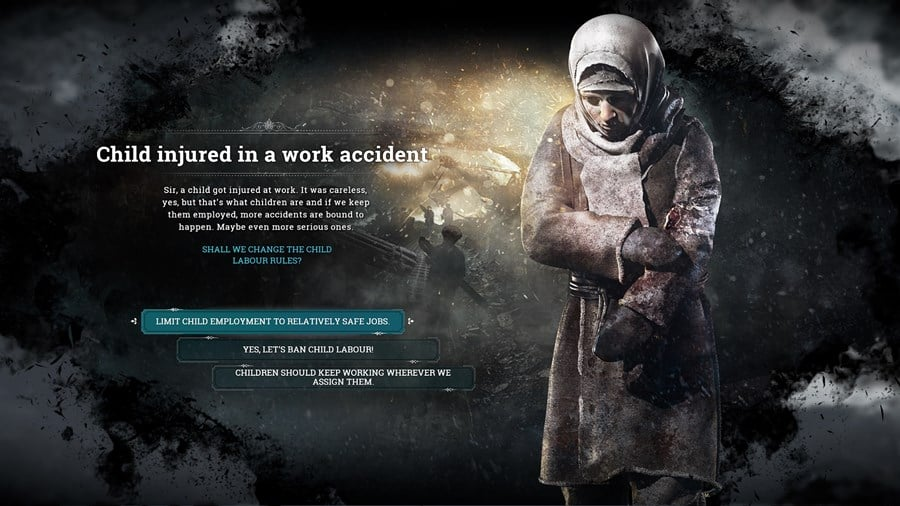
Back on the subject of citizens, the last main thing to know about them is that all citizens are divided into four types; Workers, Engineers, Automatons and Children. Workers are the most common and can work almost any job. The only jobs they that can't work are those that require advanced education, like medical treatment and running the Workshop. Engineers on the other hand, can work in medical posts and Workshops. They can also perform simple labor, but are forbidden from hunting, which Workers can handle just fine. Automatons are giant steam-powered robots that don't need to sleep or eat, can work 24 hours a day without pausing, and are immune to the ever-decreasing cold. They do need to recharge every now and again, but these things are very powerful. Think of Automatons as Workers on steroids. Automatons can work almost any job, and the Workshop can research ways to make Automatons even better. Automatons are also the rarest citizen type in the game. You won't get a lot of these guys, unless you're playing The Arks Scenario. And finally, Children cannot work any jobs at all under normal circumstances, but they still need to be cared for like any other citizen. But notice my choice of words there. They cannot work under "normal" circumstances. And now we get to talk about my favorite thing about Frostpunk, which is how it handles morality.

Image found on trueachievements.com

As the Captain, you have the authority needed to pass laws. You can pick which laws to pass from a branching list, structured like a skill tree from a normal roleplaying game. Not all the laws are particularly nice. In fact, the further down the list of laws you go, the more tyrannical you become. The laws start off sensible enough. Legalizing experimental treatment to save frostbitten citizens is a no brainer. Replacing solid meals with soup because its cheaper to create makes sense when you need make every ration worthwhile. And while it seems harsh at first, extending the work shift from 10 hours a day to 14 hours a day is essential to producing enough resources to finish major construction projects. But as the winter worsens and the needs of your people become more demanding, you will be pushed to pass laws that are dubious at best, and straight up evil at worst. For example, if you are really desperate for more Workers, you can legalize Child Labor, which turns all Children in the City into Workers. Running low on food? You can legalize cannibalism and start turning the deceased into rations. You don't have to pass the unethical laws if you don't want to, in fact there's a secret golden ending that's acquired if you beat any of the main scenarios while practicing only "humane" laws. It's just a lot harder to do a "good guy run" because the evil laws offer some kind of practical benefit at the cost of one's own moral integrity.

And this leads into the biggest aspect of the law system; The Purposes. Without spoiling the story too much, eventually you will have to pick a Purpose for your City, which is some kind of ideology to really bring people together and form a longer-lasting community. Your options are either Order, which rules with militaristic strength and discipline, or Faith, which rules with spirituality and religious devotion. Both of these options unlock a set of unique laws and buildings to match their respective themes. Both of these start off fairly benign. And both of them get really scary when you push them too far. Order seems like the obvious bad guy option at first, since the Order-only laws and Order-only buildings are eerily reminiscent of Big Brother from 1984. I'm talking things like Propaganda Centers and armed guardsmen publicly beating disobedient citizens to the brink of death just to keep the rest of the City in line. But Faith is arguably just as amoral. In fact, for everything Order does, Faith has something that accomplishes the same effect, just with a vaguely religious coat of paint over it. Instead of propaganda, Faith has sermons. Instead of public beatings Faith has "mandatory penance" (which still involves dissenters getting publicly beaten). Order and Faith are ultimately two sides of the same coin.

But the thing you need to remember is that neither Order nor Faith start off evil right away. They always start benevolent, Like Order starts with just a neighborhood watch to keep people safe, watchtowers that lower discontent for anyone living near them and the ability to hire foremen to oversee a building's production (thus making any jobs in that building produce more resources). Faith starts with churches that give Hope to anyone living nearby, field kitchens that raise the temperature of any adjacent building while also providing rations for the area, and houses of healing which work as a decent alternative to traditional infirmaries. Order and Faith only become evil when pushed too far. In fact, the final Purpose law, called New Order or New Faith, is by far the most extreme law in the game and is the only law that will actively cause the deaths of a few citizens. If you legalize New Order, the Captain crowns themselves Supreme Leader of the City and establishes a totalitarian regime, and anyone who opposes the regime (between 12 and 30, depending on the City's total population) will be executed. If you legalize New Faith, the Captain declares themselves to be the second coming of the Messiah and converts the City into a cult with a zero-tolerance policy on any faith that is not the state religion. And just like with New Order, anyone who opposes the cult (again, 12-30 people) will be executed. But hey! At least Hope will be permanently maxed out for the rest of the game! …And it will also be renamed to "Obedience" (for Order) or "Devotion" (for Faith). Because at that point, the people have given up hope for a free society, but are now either too loyal or too scared to leave the City.

But why would you go so far with these Purposes? Because as the situation grows more dire, those "evil" laws might be the one thing allowing you to repair the damage done to your City. Remember, the ultimate goal of Frostpunk is to make sure the City survives the Winter. As long as you have just enough citizens to keep the City operational, you can and will push your people to their absolute limits. Mild spoilers for the A New Home Scenario, but halfway through the story you learn that the closest neighboring City, Winterhome, has been destroyed. This causes an existential crisis in your citizens, since the plan prior to this point was to contact the other Cities and establish trade routes and supply lines so that the Generator communities could survive long term. Because of this, a  group of rebels will start making plans to leave for London. You have 14 days to convince them to stay. And every day that passes, if you don't raise Hope high enough or get Dissent low enough, the rebels will convince another citizen to leave. But those harsher Purpose laws that allow your guards/witch hunters to beat criminals in public or spy on them in their own homes? Those laws let you get the rebels under control. If the rebels get really out of hand, these evil laws might be the ONLY way to get the rebels under control.

Okay, that should cover the "universal" parts of Frostpunk. Let's talk about specific Scenarios.

Image found on trueachievements.com

A New Home. The main Scenario, serving both as a tutorial for the game as a whole and setting the standard for which all other Scenarios are to be judged by. You start in a spacious crater with plenty of building room, 80 citizens and enough supplies to get your first set of buildings established. The win condition here is to simply survive for more than 48 days. Once you make it past day 48, your City is deemed stable enough to not only survive the whole winter, but even beyond it. The final week of this Scenario is positively brutal, as a violent blizzard tears through your City. This Storm will disable Hunter's Huts and Hothouses, meaning that the only source of food your City will have will be whatever rations you stockpiled ahead of time. Additionally, the Storm will force the temperature to start dropping rapidly. Nothing short of a fully upgraded Generator can produce enough heat to survive this. The Storm is the closest thing Frostpunk gets to a boss battle, though you cannot defeat the Storm in any meaningful way. All you can do is prepare, stock up on rations and coal, and pray that your City survives long enough to make it to Day 48. This is also the Scenario with the Londoner rebels, and how you deal with that will also effect the ending.

The Arks. In this Scenario you start in a narrow ravine with significantly less building room and only 45 citizens. All of these citizens are Engineers however, and to make up for their lack of numbers, they also start with an Automaton. The goal of this Scenario is to protect the Seedling Arks, special greenhouses preserving the seeds of every plant in the world. The plan here was to breed some plant life that could survive in a post-Great Frost world. Unlike the other Scenarios, this one has a secret alternative win condition. A neighboring City called New Manchester is falling apart and needs a bulk order of supplies from your City to survive. You can choose to either ignore New Manchester and focusing only on your own City, abandon the Arks to save New Manchester, or try and save both New Manchester and the Arks at the same time. The biggest challenge this mode presents is the fact that your City's population never increases, so the only way to get more workers is to build Automatons. In fact, this game mode can best be described as "Oops! All Automatons!" But this mode is uniquely challenging in its own right. Because depending on how quickly you find New Manchester, you might not have enough time to send them any supplies at all. When I found them there were only three days left before the Storm came. And even if you do find them in time, you still need to have a good enough industry to fund basically two whole Cities at the same time.

The Refugees. In this game mode, you start with only 43 citizens in a star-shaped canyon, making construction somewhat awkward. But true to its name, in this Scenario dozens of refugees will flock to your City in groups of 15, rapidly expanding your population up to 270. The win condition here changes throughout the Scenario. At first, it's to make sure that at least 250 of those 270 refugees survive for a whole week. When that week is over and you succeed, the game keeps going. Then a second wave of refugees comes to your City in groups of 100 people each. Now that doesn't sound too bad at first. There's just one problem. The second wave of refugees are all rich, upper class nobility while the first wave were all peasants and farmers. Also, the working class straight up stole this Generator site, because this specific Generator was meant for only the upper class elites of the British Empire. So there's a lot of bad blood between the two groups and its up to you to decide what to do with the second wave of refugees. Personally, I found this Scenario to be the easiest of the main four. The weather is at its absolute calmest here with not a single Storm in sight, and the only real challenge is making sure you have enough food and housing for all the refugees. And while I like the story here, a classic struggle between the ruling elite and the working class, the ending is oddly anticlimactic. 

The Fall of Winterhome. This Scenario is by far the most challenging and the most complex out of the main four. Winterhome, canonically, was destroyed before A New Home even began. And in this game mode, you start with a fully constructed City in a crater not unlike the A New Home City, with a population of over 600 citizens. But there's just one problem. The previous Captain of Winterhome was a moronic tyrant whose incompetence nearly destroyed the City before the Scenario even began. You want to know how bad the previous Captain was? He built the City with the most awful layout imaginable, with lots of wasted space and redundant roads. He legalized Child Labor for all jobs despite having a large enough adult population to fill out every job opening available. His tyranny and incompetence got so bad that the people of Winterhome overthrew him, but in a final act of spitefulness, the previous Captain torched over half the City, rendering most of the buildings unusable.

Image found on trueachievements.com

In Fall of Winterhome. you play as the replacement Captain, who was chosen to lead by the rebels who overthrew your predecessor. And Fall of Winterhome gives you quite possibly the worst start imaginable. Over half the buildings and roads need to be torn down and replaced, over a third of your 600+ citizens are gravely ill and need medical care immediately, and you have no choice but to enforce some of the laws that the previous Captain passed because there's no way to repeal a law once it is in effect. Which means you get Child Labor whether you want it or not. The win condition is to stabilize the City by removing at least 30 ruined buildings, raising Hope to 50% or better, and lowering Discontent to 25% or less. You have one week to accomplish these three tasks. Once you do, the win condition changes once again. As it turns out, the Winterhome Generator is malfunctioning and your Engineers have no way to repair it. It could have been fixed if the problem was handled earlier, but the previous Captain deliberately ignored the problem until it was too severe to solve. In other words, the previous Captain was so incompetent that he turned Winterhome into a ticking time bomb. So now you have to construct the Dreadnought, a giant armored tank which is effectively a City on wheels, and use it to evacuate Winterhome. This process involves producing a metric boat load of steel, coal and rations. And there's also one last issue to worry about. The Dreadnought, once fully constructed, only has room onboard for exactly 500 people. You have more than 600. While the other Scenarios can, hypothetically speaking, be completed without suffering a single casualty, Fall of Winterhome is the only Scenario where people will die no matter what. Even if you stabilize Winterhome, cure the gravely ill of their sicknesses and construct the Dreadnought in time for the evacuation, at least 100 of your citizens will be left behind so the rest can live.

On the Edge. This is one of the two DLC Scenarios, and serves as a direct sequel to A New Home. In this game mode, you don't have a Generator at all. Instead, you control an outpost being funded by the City from A New Home, with your heat coming from a set of Steam Hubs. And because your heat comes from another City entirely, you are the mercy of their Captain's laws. As such, you have to donate a portion of your supplies every day to keep your outpost running. You can also form political alliances with other outposts, which is the only way to get resources that your outpost doesn't have access to. And because your outpost can only produce steel and steam cores, that means making trade deals with a lot of people if you want to survive here. Also, you have the least amount of building room out of all the Scenarios. True to its name, you are building on the edge of a literal cliff. What makes this DLC amusing in hindsight is that it seems to be a proof-of-concept for Frostpunk 2. Both On the Edge and Frostpunk 2 take place multiple years after A New Home, both On the Edge and Frostpunk 2 focus heavily on political alliances, and both On the Edge and Frostpunk 2 feature the establishment of outpost colonies that donate a portion of their own resources to fund the construction of the main City.

The Last Autumn. This DLC is a prequel Scenario to all the others. Taking place before the Great Frost arrives in the Northern Hemisphere, you are tasked with building one of the Generators that became vital to the success of the other Cities. This Scenario radically overhauls the Purpose laws. Instead of Order vs Faith, it's now Engineers vs Workers. Because this is still the 18th-19th century, worker's rights aren't really a thing. So the Generator project is a massive OSHA violation, and you need to choose between legalizing worker rights to make the project safer, or giving more power to the Engineers so the project can be finished in time. And just like with Order and Faith, the further you go into your Purpose, the more amoral and sinister you become. Just for example, the Workers will literally start a communist rebellion if you give them too much power, and the Engineers will gleefully send dozens, possibly hundreds of people to their deaths just to keep the construction project on schedule. Neither side are saints, but they are canonically the only reason the Cities in the other Scenarios can survive at all, since these guys built the Generators in the first place. This is the only game mode where you don't have to worry about temperature, because the Great Frost isn't here yet. As such, coal isn't as important here as it is in the other Scenarios. The win condition here is to finish construction of the Generator, which is done in stages, and make sure that each stage of the project meets a specific deadline. Failure to keep the project on schedule results in you getting fired.

And finally, Endless Mode. Endless Mode has three different campaign options, two in the base game and one in the DLC. These campaigns are called Serenity, Endurance and Builders. In all three campaigns, you can pick the starting location, which not only includes all of the locations from the main six Scenarios, but even three brand new locations not available anywhere else. Those exclusive options are the Flats, which is an open field with tons of building room, in fact this is the single largest location in the game. But resources are further away than normal in the Flats, so building roads is even more important here. Then there's the Rifts, which splits the available space up with bottomless pits that you have to build bridges over. And finally, there's the Crags, which is a somewhat large field with giant rock formations peppering the landscape, and you have to build your City around those rocks. Additionally, you can enable Hazard Events, which cause randomized problems to occur in your City, such as forcing you to spend twice as much steel to build something or temporarily disabling your hothouses. Personally, I'm not a fan of the Hazard Events, and now whenever I play Endless Mode I turn them off. The most interesting thing about Endless Mode is that it gives you an optional quest to collect relics, which are items that were made before the Great Frost came. These relics provide some nice lore that isn't accessible anywhere else in the game.

Image found on steamdb.info

Anyway, in Serenity mode,  you start with 105 citizens, most research projects already completed and the weather is significantly calmer than normal. Temperature drops are rarer and the Storm (which happens once every 14 days in Endless) now only lasts a single day instead of a whole week like in A New Home. This mode exists for those that don't care about the "survival" part of the survival strategy game and just want to build an aesthetically pleasing steampunk city in peace. In Endurance mode, you start with 80 citizens, the Storm will last for 2-3 days and will gradually become more frequent each time it arrives, and you have just enough supplies to get your first set of buildings up and running. Basically, if you want to do A New Home again but in a different location and with a hypothetically infinite campaign, Endurance mode is for you. Builders mode gives you 125 citizens and works the same way that The Last Autumn does. You don't have a working Generator in this mode yet, and you have to get the Generator operational before the cold becomes too much to handle. 

The only problem with Endless mode (all three versions) is that it almost all of its challenge comes in the first few weeks, and once you get past those first two or three Storms your City is more or less good to go for the rest of time. Now, all the Scenarios are generally pretty short experiences. It only took me 13 hours to complete A New Home, and another six hours to complete both The Arks and The Refugees. I don't remember how long it took Fall of Winterhome but it couldn't have been longer than ten hours at the most. And that sort of length is perfect for what Frostpunk is trying to do. But the problem with Endless mode is once your City survives long enough to be self-sustaining (producing more coal and rations than the City can use up), there's not much that the game can do to put your City in danger. Sure the Storm will come back, but if you can survive it the first time, you can survive it again. And it would even easier to survive it the second time round because you would have access to better technology by then. There's no traditional enemies to fight against in Frostpunk, the only other people you meet are survivors who are more than happy to join your City. And even then, the game has a hard cap of 790 citizens on Serenity mode or 695 on Endurance and Builders mode. Once your City's population reaches those numbers, other survivors will never appear ever again unless you suffer severe casualties in the near future.  There's no political alliances to be made with other Cities, in fact you just straight up don't find any other Cities in Endless mode. You don't even get a rebellion you have to deal with like in A New Home. And once you run out of research projects, laws to pass or room for construction, there's not much left to do. There's an achievement/trophy you can get if your City manages to survive past Day 100 of Endless mode, and I'd say that's a good stopping point for this game mode because you WILL run out of things to do by then.

In terms of presentation, Frostpunk is one of the best examples of the steampunk aesthetic and is just a very pleasing visual and audio experience in general. The whole game carries itself with a somber, melancholic vibe that wants you to reflect on the nature of the human experience. And I'm a sucker for somber, melancholic worlds in fiction. Anyway, every building has a rustic, vaguely Victorian vibe, but with steam pipes pumping heat in and out everywhere. Even the most advanced machines in the game, like the Automaton or the Hothouse, look gritty and weathered. After all, it's kind of hard to keep your tech clean in the middle of an apocalypse. While the 3D models of the citizens look fairly simple, there's more detailed artwork of said citizens that appears during the story events in any given Scenario. One detail I really like is that if you have multiple buildings of the same type right next to each other, their model is changed to look interconnected with branching hallway extensions. This is most obvious on Workshops and bunkhouses. But it makes those buildings feel more complete in a way. Also, the execution animation that plays if you legalize New Order or New Faith is one of the most creatively cruel methods to kill something I've seen in a video game. Said animation involves the victim being chained up, placed on top of the Generator's exhaust vent, and forced to stand there until the next time the Generator releases steam. The sheer force and heat of the vents basically cooks the victim alive. Positively brutal stuff. And if you max out Discontent while New Order/Faith is in effect, then instead of the usual banishment scene, the Captain is given a taste of their own medicine and executed with this exact method. "Reap what you sow" and all that.

The music and sound effects in Frostpunk are exquisite. The way the ice cracks and reforms as the temperature rises and lowers is crisp. The annual barks of the town crier announcing the start and end of every work shift help set the vibe. And said annual barks change depending on which Purpose you chose, with the Faith version of the town crier sounding like a priest and the Order version sounding like a drill sergeant. If you zoom in on specific structures, you can hear some ambient sounds associated with that structure like church bells or the drunken laughter of the local bar patrons. And of course, we got to talk about The City Must Survive, the closest thing the Frostpunk universe has to a theme song. So imagine. Your City is doing well. You got a surplus of coal and rations, sickness is at an all time low, and the overwhelming majority of your citizens have access to proper heating. Then you see the mother of all blizzards approaching on the horizon. You have seven days to prepare for the Great Storm, and as you rescue the last of the survivors from the frozen wilderness, a chilling realization hits you. Your City is not ready. People will die, and there's nothing you can do to stop it. 

And nothing fills you more desperation and dread than hearing The City Must Survive. That one orchestral song is desperation incarnate. When I think of Frostpunk my first thought is that final week of A New Home with the Great Storm battering down on my City. The buildings shutting down from sheer coldness one by one until only the coal mines and infirmaries remained. The people of my City being sent straight to said infirmaries by the dozens due to rapidly spreading frostbite. Forty Workers sacrificing their lives to keep the coal mines operational in such horrid weather. Families perishing in their own homes as the last of the rations run out. And this song, with violins shrieking like it's the end of the World as my City is crushed beneath -230 degree winds. No other event in any video game, movie or book managed to instill in me such despair. And somehow, my City survived. I fully expected to be wiped out completely by the Storm, but against all odds, 492 of my citizens (out of 603) survived. They were beaten, frostbitten and starving, but they survived. And the violins go silent. There is no triumphant chorus of horns to celebrate your victory. Just a peaceful quiet as the surviving citizens reflect on everything they sacrificed to make it this far. This moment right here is now one of my favorite moments in any video game ever. And The City Must Survive is a key factor in making this finale so memorable.

One last thing about the presentation I want to say. At the end of every Scenario, the game will provide some narration recapping all the major decisions you made. While this narration is on screen, you can see a time lapse of your City being built from the ground up. It's a cool way to show how far your citizens have come since the day they arrived at the Generator site. Even if the ending narration taunts you for every evil law you passed and every amoral decision you made. The only criticism I have of Frostpunk's presentation is that I ran into a minor glitch that caused the screen to be covered in a blank white texture, thus preventing me from being able to actually see anything. Reloading to an earlier save was enough to fix the problem, but be aware that such a glitch could happen in your game.

Image found on steamdb.info

Overall, Frostpunk is a somber survival strategy game that succeeds in showing just how soul-crushingly brutal a post apocalyptic setting can be. This game is one of my favorite video games now, and definitely my favorite strategy game. Even if you aren't the biggest fan of strategy games or games along those lines, Frostpunk is an easy game to recommend because it's just a generally high-quality experience. And if you have any interest in steampunk, this is one of the better examples of steampunk in action. So I'd say that Frostpunk gets 5 stars out of 5.

Frostpunk is the property of 11 bit Studios. None of the images used here were created by me. Please support the original creators.