Spencer's Day

Total Pageviews

Showing posts with label Souls Borne. Show all posts

Tuesday, May 7, 2024

Elden Ring, the game that got me to love the Souls Borne series. A very maidenless review.

 This is my third review of a Souls Borne game. I have already reviewed Sekiro and Bloodborne before this game, and I plan to one day review the entire franchise. But here's a funny story you might not know. None of these games were my first Souls Borne game. That "honor" goes to Dark Souls II. And in hindsight, starting with II was probably a mistake, since that game is needlessly oppressive and counterintuitive. As such, I never finished it, but I might replay it again for the purpose of reviewing the whole franchise. But anyway, I bounced off the series for years after trying and failing to complete Dark Souls II. Then I picked up Elden Ring, and that game was so good that not only did I replay the game again as soon as the credits rolled, but it won me over and converted me into a "real" Souls Borne fan. I started tracking down the other games because I liked Elden Ring so much and wanted more games in that style. So here's a heavily biased review of a game that I will openly admit is one of my favorite pieces of media ever. Quick content warning. Elden Ring is rated M for Mature by the ESRB and thus is intended for audiences 17 years old or older. Mostly because of violence. And freaky monster designs. And a subplot where the protagonist gets married to a weird witch lady.

Image found on Wikipedia.org

So what exactly is Elden Ring? It's a medieval fantasy action roleplaying game inspired by Norse and Celtic Mythology that was developed by From Software and published by Bandai Namco, with the story and lore being co-written by Hidetaka Miyazaki (the creator of the Souls Borne series) and George R.R. Martin, of Game of Thrones fame. The game would release on February 24th, 2022 and became an overnight success. Not only was it the best selling Bandai Namco-published game ever made, it was the second best selling game of that year, being second only to Call of Duty 2: Modern Warfare. Which is impressive, since From Software have spent much of their history being a fairly niche developer. It also has a DLC expansion pack planned for release this coming June (at the time of writing), titled The Shadow of the Erdtree. 

And now I have to tell you about the story in this game. Something you need to understand about From Software is that they don't tell their stories with traditional cinematics. Sure, cinematics exist, but mostly to hype up certain bosses and show how much of a threat they are. Most of the story is told through details in the environment, optional conversations with the few friendly faces you'll meet on your adventure, and reading the descriptions of collectible items. This vagueness was deliberate by design. One of Miyazaki's quirks as a writer is that he loves seeing people come up with theories and pool their knowledge together into a cohesive narrative, and his stories are meant to be vague and mysterious for this exact reason. And even though Martin's involvement was a big part of the prerelease marketing, the game feels less like a 50/50 split between his style and Miyazaki's style, and more like a 70/30 split in Miyazaki's favor. Granted, Elden Ring is somewhat more straightforward in its narrative than previous Souls Borne games. I didn't do any additional research on the lore during my first playthrough and felt like I had a good enough understanding of what was going on.

So here's a basic summary of the lore. In the world of Elden Ring, there is an island nation called the Lands Between. The Lands Between were ruled by a Goddess named Marika the Eternal, who was given divine power by an artefact called the Elden Ring. The Elden Ring was a gift from an even more powerful god called the Greater Will, in exchange for Marika's loyalty and servitude. Marika birthed several children who, while not gods in and of themselves, are still incredibly powerful and have the potential to ascend to godhood in certain circumstances. These kids are called the Demigods. Eventually Marika got tired of being the Greater Will's poster girl so she smashed the Elden Ring and faked her death. And then her kids started a civil war to fill the power vacuum. Fast forward five thousand years later, and the Lands Between are a post-apocalyptic shell of their former glory. Monstrous dragons burn down villages, undead zombies and skeletons attack roaming travelers and a supernatural disease called the Scarlet Rot is spreading through the land like a plague.

You play as a Foul Tarnished, an undead super soldier brought back to life by Marika's Grace and given a task. Track down the scattered remains of the Elden Ring, repair it and claim the throne of the Next Elden Lord. You are not the only Tarnished on this quest, however. In fact there are potentially hundreds of Tarnished running around. But only one of them can be Elden Lord. So any alliance between Tarnished is temporary at best. And in typical From Software fashion, not even ten minutes after waking up your Tarnished gets thrown into a boss fight that you are supposed to lose. Though you do get a cool sword if you beat it on your first try. After that scripted loss, you wake up in a cave and can go through an optional tutorial that teaches you the controls and basic game mechanics. Said tutorial ends with a boss fight against the Soldier of Godrick, which is a much more reasonable "first boss" than the actual first boss. Granted, the Soldier of Godrick is just a slightly buffed version of the basic undead wretches you've been fighting in the tutorial, so he isn't meant to be too hard.

Image found on RPGFan.com

Elden Ring has a pretty robust character creator, and I am a sucker for a good character creator. You can customize the hair, facial features, body type, gender and more. But more importantly, the game has a bunch of Classes. One thing I love about this game is that there are a ton of different ways to customize your fighting style. Do you want to swing the biggest and heaviest swords imaginable? You can do that. Do you want to run in and unleash a flurry of lightning fast stabs and slices with a pair of daggers? You can do that. Do you want to cast magic spells and shoot laser beams? You can do that. But keep in mind that nothing in this game is class-locked. As long as you meet the minimal stat requirements to use a weapon or cast a spell, you can use it. Even if you start the game as a Hero (a bulky juggernaut who excels with Strength focused weapons but struggles with spellcasting), you can learn magic spells if you put a few upgrades into Intelligence. 

The stats all do more or less what you expect them to. Strength makes the big heavy weapons better, Dexterity makes the fast smaller weapons better. Vigor gives you more health and defense, Endurance gives you more stamina (letting you jump and dodge more frequently) and carry heavier items on you. Intelligence and Faith are both your "magical" stats, with the former making star-themed sorcery better and the latter improving holy incantations. Mind gives you a bigger Focus meter, thus letting you cast more spells before needing to recharge. And finally, Arcane is a weird stat. It makes enemies drop items upon defeating them more frequently, and boosts the power of status effects like Poison, Frostbite and Bleeding. Practically speaking, Arcane is a stat that can be safely ignored if you don't plan on using status effects, since it offers no other benefits to combat. But status effect builds are comically strong. During my second run of the game, I played a Faith/Arcane hybrid character that tore through the game far faster than my original sorcery character did.

The classes mostly exist as a foundation to build off of instead of a railroad you must follow for the whole game. That being said, they do determine what kind of weapons and armor you start the game with, if anything. And it's generally better to specialize than to generalize. A pure Strength build will generally outperform a Strength/Dexterity hybrid. There are exceptions of course. The aforementioned Faith/Arcane build I made was almost comically strong. And the only reason I made that build was because I wanted to make a "dragon" themed character and all the "dragon" themed spells are designed to work with both Faith and Arcane equally. And also in typical From Software tradition, one of the classes, simply called the Wretch, starts with literally nothing more than a wooden stick and a loincloth. The Wretch's only redeeming quality is that it starts with a 10 in every stat, meaning if you can't make up your mind on what to play, the Wretch offers a perfect blank slate that can be easily molded into any play style you want once you find some real weapons and armor. Miyazaki himself has gone on record saying that playing as the Wretch is the closest thing the game has to a hard mode, so maybe don't play Wretch during your first playthrough unless you are very confident in your skills or you don't mind a rougher start.

Elden Ring controls more or less how you expect a Souls Borne to play. I played the game on PS4 and will be using that console's controller as a frame of reference. But anyway, you use the right and left bumper/trigger buttons to attack with whatever weapon is held in your character's left hand and right hand, respectively. The circle button is your dodge, the square button lets you use consumable items like potions or throwing knives. If you have a shield in hand, you can use it to block and parry enemy attacks. You collect a universal currency called Runes that can be used to purchase upgrades for your character, such as increased stats or better quality weapons and armor. All unspent Runes are dropped if you die and must be manually recollected on your next life. All of this is standard stuff. What's new to this game is the ability to JUMP. No, really, this is the first Souls Borne game with an actual jump button. While there was technically a jump in the previous games, it was clumsy, awkward and only worked if you had enough room for a running start. Now, the jump action is tied to a single button and feels actually good to use. You can also attack while jumping. And jump attacks are surprisingly strong. In fact, speed runners who are better at this game than I am discovered that the fastest way for Strength builds to defeat enemies is by doing jump attacks repeatedly. But back on the subject of new mechanics, there's a new technique called a Guard Counter. Basically, if you hit the heavy attack button right after blocking, it charges the normally slow heavy attack instantly.  You can also ride around on a magical steed called Torrent, who is not only much faster than the Tarnished but can also double jump. Torrent cannot be brought indoors, sadly, but he does make navigating the outdoors much easier. And the final new thing are Spirit Ashes. Spirit Ashes are magic spells can be cast once per boss battle that summons a ghostly version of certain monsters and warriors, who will assist you in battle automatically. Spirit Ashes are a nice option to have if you've been struggling against a boss and need just that extra bit of Jolly Cooperation to finish it off. Of course, regular multiplayer co-op is still a thing.

After the tutorial ends you are dumped into the Lands Between properly. You are free to explore wherever and however you want. The amount of freedom and exploration in Elden Ring is simply staggering. A lot of people say that Elden Ring is the most "beginner friendly" Souls Borne game. That is technically true. Not because From Software added an "easy mode" or toned down the enemies and bosses. In fact even the basic enemies can obliterate you if you're not careful. But because there's so much freedom in the open world, if you ever get stuck on a boss, all you have to do is go somewhere else and come back later once you get some upgrades under your belt. The previous games were a lot more linear in their level design, meaning if you got stuck on a boss, you had no real choice besides trying to brute force your way to victory. And if you know where to look, you can find some really powerful weapons long before the first "real" boss.

Image found on RPGFan.com

Speaking of bosses, this game has a lot of bosses. In fact, at 168 named boss monsters, it has the most number of bosses of any Souls Borne game ever. Funnily enough, out of those bosses, only 12 of them are required to actually finish the game. The rest are optional, but usually reward you with a powerful weapon or spell upon defeat. The only thing I can say negatively about is that most of the non-plot-relevant bosses are recycled at multiple points in the game (meaning you fight them more than once). Some more than others. But considering that Elden Ring is supposed to be From Software's "biggest" game, the world being so huge and packed with details means that the only real way to fill out the game world would be to recycle content. But the good news is that all of the Demigods (sans Godrick) are unique and only fought once. And honestly, the Demigods feel like they have the most amount of polish and effort put into them. They all get an intro cinematic hyping them up. They all are fully voiced and surprisingly chatty, with some of them taunting the Tarnished mid-battle. And of course, they are (generally speaking) the most challenging bosses in the game. 

On the subject of challenge, Elden Ring's difficulty is a little bit all over the place. Back when the game first came out, no one could agree if it was the easiest Souls Borne, or if it was the hardest. The answer is yes. Yes, it is the hardest. But also yes, it is the easiest. That sounds like an obtuse non answer and well, it is, but hear me out. You remember when I said that the game offers tons of different options for developing a unique fighting style? Not all builds are created equally. Elden Ring has 308 different weapons to collect and 171 different magic spells to learn. And generally speaking, 10% of those weapons and spells are so weak that using them is for all intents and purposes, handicapping yourself. 50% are just good enough to get you through the game, though you might struggle against certain enemies. And the rest are so comically powerful that they turn even the toughest battles into a cakewalk. And those comically powerful weapons can potentially be accessed as soon as you leave the tutorial area. The only thing consistent about the game's difficulty is that there is a huge spike in enemy damage in the final two regions of the game, the Mountaintop of the Giants and Crumbling Farum Azula. The enemies and bosses here do so much damage that you need at least 40 points into Vigor just to survive more than one attack. To put that into perspective, the previous games in the series could be beaten with 25 Vigor or less, and any more than that was the defensive equivalent of overkill. 

EDITOR'S NOTE: The most offensive example of Elden Ring's weird difficulty balancing is a boss called Malenia, the Blade of Miquella. She is by far the hardest boss in the game, putting up more of a fight than even the final boss. Her attack patterns and movement are so fast they push Elden Ring's combat to the absolute limit. She honestly feels like she belongs in a different, much faster game than Elden Ring. This is on top of being able to "steal" health from you with every successful slash from her katana. This is a boss that essentially forces you to go the whole fight without getting hit once, because that's the only way to stop her from healing. Even blocked attacks will still heal her. And that's not even mentioning how she has two full health bars AND she adds a poisonous Scarlet Rot effect to her attacks once her first health bar is emptied. Before you jump to conclusions and assume I'm singling her out because I have a "skill issue" or need to "git gud" let me just say this. Malenia took me 13 tries to beat. Every other boss took 2 or 3 tries each. This was with a sorcery build I had planned ahead of time specifically to counter her. My criticisms of Malenia aren't because she's a hard fight. It's that she runs counter to the rest of the game's design, punishing defensive melee builds that rely on blocks and parries for defense and demanding that the player plays this one specific duel to absolute perfection, because anything less than perfect will result in failure. Thankfully, Malenia is an optional boss and the only rewards for beating her are the bragging rights and a replica of her katana. I think my opinion of Elden Ring would sour if she was mandatory.

Ironically, the hardest challenge in the whole game doesn't even come from its bosses or from its exploration. It comes from the side quests. All throughout the Lands Between you can meet various characters that are also traveling on their own adventures. You can choose to help them with their problems, but a lot of the side quests are so cryptic and obscure that you need a walkthrough on hand just to do them properly. And not helping matters is that if you defeat certain bosses before starting the side quests, the characters associated with might just peace out and move to a different location or even leave the game world entirely, thus preventing you from finishing that character's quest. To add insult to injury, there is no way to check which side quests you've found or finished within the game itself. You just have to hope your memory is good enough to revisit past areas. And even if you find the right characters in the right spot, the solution to their problem can be borderline esoteric. Take Boc the Seamster for example. Towards the end of his side quest, he expresses concern for his unsightly appearance and asks the Tarnished if they know of any way to "make him beautiful." There are two ways to end this quest. The simplest solution is to tell him to go visit a sorceress named Rennala of the Full Moon, who possesses the power of rebirth. Only problem is that Rennala still hasn't perfected her rebirth spell yet, so Boc's "beautiful" new body dies just a few minutes afterword. You would think that simply telling Boc that he's beautiful enough as is would persuade him to stay where he is, but no. You need to travel to a completely different region, grab an item called a Prattling Pate, come back to Boc and use that item to tell him that he's beautiful. There is no indication that such an item even exists, much less where to find it. The other side quests work similarly to Boc's. The simple solution will nine times out of ten get the character killed off (or worse) and the only way to save them is to try something weird and out of the box. There is only one side quest that breaks this rule.

Image found on Wikipedia.org

Oh boy, it's time to talk about Ranni the Witch. This character is quite the fan favorite, thanks to a memorable design, distinct Welsh accent and being the only "friendly" demigod. I'd be lying if I said that I wasn't a Ranni fan, myself. She also has the only quest where doing things out of the "intended" order won't ruin it. In fact, the only real way to fail Ranni's quest is to attack her deliberately. The best thing about Ranni is that she straight up tells you where you need to go and what you need to do to complete the quest. Ranni wants to find a special dagger in an underground city and tells you where to go to find said dagger. Ranni wants the demigod Radahn destroyed as part of her plans, and she tells you to go find Radahn and kill him. Her quest is the only one that is this straightforward. Of course, the beautiful simplicity of her quest isn't the only reason why I like Ranni. The other reason is that her lore is fascinating. She was one of the demigods responsible for turning the Lands Between into a nightmare hellscape. Despite being responsible for many of the horrors that the Tarnished encounters, she has a genuine desire to overthrow the gods and give humanity true, absolute freedom. The third reason I like Ranni is the simple fact that her quest ends with her and the Tarnished getting married. And there's a whole alternate ending, heavily implied to be the best ending, that is rewarded for going through with said marriage. Ranni even gives you the Moonlight Greatsword, which is literally From Software's mascot that they put in every game they work on, as a wedding gift. Out of all the games I have played in my life, Elden Ring is the only one to have an actual marriage in it. Granted, it's a political marriage and Ranni makes it clear her main reason for marrying the Tarnished is because she needs a loyal spouse in order to ascend to godhood. Because marriages in this setting aren't just a romantic ceremony. They are a ritual meant to unlock the true power of the divine. But without context, the idea that Elden Ring's best ending requires you to get married is oddly amusing.

In terms of presentation, Elden Ring is by far the most colorful Souls Borne game. This isn't to say that it's all sunshine and rainbows. Just that it leans more into the "fantasy" side of the phrase "dark fantasy." The monster designs are about what you expect from From Software. Lots of horrifying monstrosities with limbs coming out of places they do not belong. In fact, there's a general motif of hands and arms in the character designs. A lot of characters either have more arms than a normal human, or they have something weird going on with the arms they do have. Just to give a few examples, Ranni has four arms tucked into her robe, Godrick the Golden has two dozen arms erupting out of his back, and Rykard fights with a sword made of bloodied arms. And of course, the main mascot boss of this game, Malenia the Blade of Miquella, has only one natural arm. Her right arm has been replaced with a golden prosthetic that has a retractable sword attached to the wrist. The only bad thing about Elden Ring's aesthetic is that it can at times look a bit too similar to the Dark Souls trilogy. I kind of wish it leaned harder into the Nordic Viking/Celtic Mythology vibes, which are present in things like the Erdtree being modeled after Yggdrasil the World Tree and Malenia's helmet resembling those worn by Valkyries, but the Nordic/Celtic influence is nowhere near as obvious as say, Bloodborne's Victorian vibe or Sekiro's Feudal Japanese aesthetic.

But on a more positive note, we got Legacy Dungeons. Legacy Dungeons are special locations scattered around the open world. These areas are designed to resemble the level design from older Souls Borne games. Not only are they gorgeous to look at, the Legacy Dungeons are by far the most complex areas to navigate, with lots of winding paths that loop back in on themselves, hidden shortcuts and traps. The Legacy Dungeons are a true highlight of Elden Ring's art style, with a personal favorite of mine being Raya Lucaria Academy. It's a giant school for witchcraft and wizardry magic users that rests underneath the pale blue light of an magically conjured night sky, complete with a full moon looming overhead. You work your way up the schoolrooms and past a debate parlor, fighting and/or running past scholarly sorcerers and living puppet soldiers. You eventually reach the tallest point in the school, the Grand Library, where Rennala resides. 

Another Legacy Dungeon I love is Leyndell the Golden Capital. It is exactly what it sounds like; The capital city of the Lands Between. It is far fancier and more upkept than the rest of the world, looking almost serene compared to the hellscape outside its fortified walls. The roofs of the buildings are golden, the streets are lined with golden bricks, even the enemies here fight with golden weaponry. Also, there's a petrified corpse of a dragon so large that it functions as a platform/bridge you can walk on. And some people who are much smarter than me did some measurements and found this corpse dragon (named in the lore as Gransax) is more then 4 times the size of the Dragon God, a boss from the very first Souls Borne game, Demon's Souls. Keep in mind that the Dragon God was the biggest monster From Software ever created and they have yet to make a living  monster that large ever again. One shudders to think what kind of boss battle a dragon of that size could be like. Maybe that's one of the DLC bosses; a dragon as large as Gransax, but actually alive.

Image found on RPGFan.com

In terms of sound design, music and voice acting, it's all good. The monstrous roars of the various beasts in the Lands Between are disturbing, and the sound of clashing blades is crisp. The music is about what you expect from From Software. Lots of intimidating orchestra with vaguely Latin sounding lyrics. The music only really kicks in when you discover a boss, though there is some ambience in safe zones like the Roundtable Hold or the Volcano Manor. My personal favorite in the whole soundtrack is the Godskin Nobles' theme. It can best be described as "evil Catholic choir music." Which, considering that the Godskin Nobles are a cult that collects the skin of demigods and fashions clothes out of said skin, is weirdly fitting in a morbid way. And since the Godskin Nobles are fought multiple times, you get to hear their theme music more than once. The Ancestor Spirit is another boss with a good theme. It has really pretty and tranquil music, which sounds almost out of place for a battle with an otherworldly animal spirit.

The voice acting is some of the best in the series. One detail I like about the game is that all of the demigods are ancient (being 5,000 years old or older), and as such they all speak in old-timey Shakespearean English (with a lot of "thee" and "thou" and "thy") to show just how old they are compared to the regular mortals, who speak in modern English. Elden Ring is probably the most quotable game in From Software's catalogue. There's a lot of good quotes in this game. You have funny quotes like the White Masked Varre saying "Unfortunately, it appears you are maidenless" at the start of the game. But then you have incredible one-liners like Godfrey saying "I have given thee courtesy enough!" or Malenia saying "You will witness true horror..." I think my favorite piece of voice acting is when you confront Morgott, the Last of all Kings. The scene starts with him walking down a flight of stairs while listing off each and every demigod responsible for the millennia of warfare and violence that has plagued the Lands Between. With each name, the anger in his tired old voice grows and grows. Eventually he explodes with this line; "Willful traitors, all! Thy kind art all of a piece! War lords, emboldened by the flames of ambition! So have it writ upon thy meagre grave... Felled, by King Morgott! The Last of All Kings!" It's a beautifully written and voice-acted speech that conveys all the pent up rage and frustration Morgott feels about his fellow demigods, and how he believes that the Tarnished will become just as bad as Marika if they become Elden Lord. Morgott isn't an antagonist because he's evil. He's an antagonist because he's scared that the Tarnished will repeat his mother's mistakes and has taken great effort to prevent such a scenario from occurring. Morgott's my favorite boss in this whole game, both because he is fun to fight and because I enjoy the lore and narrative surrounding him.

My only complaint on the voice acting has less to do with acting itself and more to do with the translation. You see, From Software is a Japanese company. That means that Japanese is their native language. Obviously. But there's a bit of translation error. And normally, translation errors do happen in From Software games, but they are usually minor and inconsequential details that don't affect the experience. This game's translation error completely changes Ranni's speech at the end of the game, should you go through with her marriage and allow her to become the Goddess of the Full Moon. In English she says that she plans to "bring forth a chill night, of fear and loneliness, without the need to feel ever again." In Japanese she says that plans to "take the chill night far away from here, as I walk the path of fear and loneliness." The former sounds like she is causing another doomsday. The latter sounds like she is sacrificing herself for the betterment of humanity. This is not the fault of Ranni's voice actress, Aimee-Ffion Edwards, but is a little "whoopsies" in the translation. Side note, I really love the sound of Ranni's voice. She could read a phone book out loud and make it sound interesting.

Image found on RPGFan.com

Overall, Elden Ring is a great jumping on point for anyone new to the Souls Borne series. Is it perfect? No. I still wish that side quests were easier to keep track of, and the game is a bit too similar to Dark Souls aesthetically for my liking. But it's by far the most beginner friendly game in the franchise. And I'm thankful that this game showed me how fun Souls Borne games could be. If you have heard of From Software's work but were scared off by their infamous difficulty, this game, while not being easy per se, is far more accessible than its predecessors. It's definitely one of the better "open world" games out there. I give Elden Ring five stars out of five.

Elden Ring is the property of Bandai Namco and From Software. None of the screenshots featured here were created by me. Please support the original creators.

Wednesday, January 31, 2024

Bloodborne, mysterious, macabre, masterpiece. A very bloody review.

So let me ask you a question. Have you ever wanted a high quality action horror video game based on the works of classical horror authors like Bram Stroker and H.P. Lovecraft? One that has you fighting against grotesque monstrosities with weird and unusual weaponry? One with a deliberately vague storyline that is open to multiple meanings and interpretations? Well do I have the game for you! Because today, we are reviewing Bloodborne, an action-horror game that meets that exact description. Bloodborne, for the unaware, is part of From Software's Souls Borne franchise. In fact, that's where the "borne" part of the title comes from. The "souls" part comes from the first two games in the series, Demon's Souls and Dark Souls. Other games in the series include Sekiro: Shadows Die Twice and Elden Ring. I have already reviewed Sekiro, and figured I would tackle the rest of the franchise while I'm at it. So let's continue the Souls Borne review series with Bloodborne.

Image found on wikipedia.org

So what is Bloodborne? It is, as previously mentioned, a Gothic Horror action roleplaying game developed by From Software and published by Sony as a Playstation 4 exclusive. It was released in 2015 and received an expansion pack titled The Old Hunters in 2016. The game was directed by Hidetaka Miyazaki, whose prior success with Dark Souls and Demon's Souls led to him being considered a bit of a legend in the video game community at large. A quick content warning before we continue. Bloodborne is rated M for Mature by the ESRB and thus it is intended for audiences 17 years old or older. Additionally, the game can potentially delving into some disturbing subject matter. So reader discretion is advised. Though to be fair, the game is called BLOOD borne. There's going to be blood in a game called BLOOD borne. In fact, almost half of all the collectibles in this game have the word "blood" in their name. Blood Vials, Blood Echoes, Blood Stone Shards, Cold Blood Dew, Pungent Blood Cocktails, and Beast Blood Pellets are just a few examples of all the "blood" themed items in this game.

The story of Bloodborne is a little bit strange in how it is told. Like all games in the Souls Borne series, the story is not told through traditional cinematics. It is told through the flavor text of collectible items, through environmental details that you may or may not notice while playing, and through optional conversations with the few friendly characters you can potentially meet. Bloodborne itself is a story that wrapped in heavy symbolism and double meanings. The game is almost a decade old and people are still discussing and debating its lore and meanings. I've seen the game be interpreted as anything from a metaphor for the afterlife, a cautionary tale against the dangers of unrestricted science experiments, to even a tragedy about the struggles of womanhood and childbirth. Which one of these interpretations is correct? The answer is Yes, because Souls Borne games tend to be open ended enough for multiple equally valid interpretations. The only thing that everyone can agree to is that the game's aesthetic and "vibe" is heavily inspired by the likes of Bram Stroker, the man who (among other things) created Count Dracula, and H.P. Lovecraft, the man who (among other things) created Cthulhu. So lots of unspeakable truths lurking in the shadows, lots of ordinary people hiding terrible secrets in plain sight, and as previously mentioned, a whole lot of blood. What's impressive about Bloodborne is that it somehow manages to justify the existence of game mechanics through its lore. Everything, from multiplayer to enemy placement to even the player's ability to retry failed battles has some kind of explanation in the lore for it.

So let's start at the beginning of the game. You play as a customizable, but mute foreigner who has come to the fictional city of Yharnam in order to receive treatment for an unknown disease. Yharnam is basically Victorian Era England, but cranked up to eleven. And this city is famed for its miraculous healing medicine, capable of treating any illness or disease. The medicine was created and distributed by a religious organization known simply as the Healing Church. There is just one problem with the miracle medicine. It's made with blood. Not just normal blood either. But Old Blood. What is the Old Blood, you ask? I can't really say without getting super deep into the lore, but all you need to know is that the Old Blood gets a little funky when you overindulge in it. And it's described as being highly addictive in nature. To quote the description of the Pungent Blood Cocktail; "In Yharnam, they make more blood than alcohol, as the former is more intoxicating."

Your character wakes up in a clinic after receiving a blood transfusion. Step outside and you will find the city of Yharnam in complete and utter chaos. Angry mobs armed with torches and pitchforks patrol the streets, upper class citizens barricade themselves in their homes with warding incense, and werewolves prowl the backstreets and darkened corners of the city. The angry mobs are quick to accuse you of being a werewolf, and any werewolves caught by them get crucified and burnt at the stake, for those classic "paranoid witch hunter" vibes. You are free to explore Yharnam from here. Though in typical From Software fashion, you can run into an outrageously strong werewolf within minutes of the game starting, and while you can defeat it if you are good at the game, you are intended to get killed by it. Upon dying to this werewolf (or any enemy, really), you are teleported into a safe zone called the Hunter's Dream. There you meet Gehrman the First Hunter. Gehrman is an elderly, retired werewolf hunter who bestows upon your character the title of Good Hunter and gives you your first real long-term goal to work on. To quote Gehrman himself, "Just go out and kill a few beasts! Don't think about it too hard. All you need to know is that this is for your own good."

Image from neoseeker.com

From here the Good Hunter is handed a Trick Weapon and a gun. The game starts for real here. So let's talk gameplay really quickly. Bloodborne is first and foremost an action game. Combat is fast, fluid and leaves very little room for error. The Good Hunter can have two different weapons in use, one for each hand. You can perform fast, light attacks with the Right Bumper, or slower but more powerful attacks by pressing the Right Trigger. You can use Left Trigger to parry and deflect enemy attacks so long as you are holding a "defensive" weapon in your left hand. This is just standard From Software controls. Unique to this game are guns and Trick Weapons. Guns are exactly what they sound like. Ballistic firearms that can be used to attack from a safe distance. But more importantly, guns are how you block and parry enemy attacks. Basically, if you shoot an enemy right before their attack hits you, they will be stunned and the Good Hunter can perform a devastating technique known as the Visceral Attack. Visceral Attacks will straight up kill weaker enemies in one go while removing a massive chunk of health from bosses and other Hunters. There are also special weapons called Hunter Tools, which function as this game's version of magic spells. Hunter Tools can shoot homing lasers, replace your dodge roll with a short-range teleport or supercharge your Trick Weapon with arcane energy, among other things. Both guns and Hunter Tools use up a resource called Quicksilver Bullets, which can be collected from any defeated enemy that had a gun or used magic. If you run out of Quicksilver Bullets, both your guns and your Hunter Tools stop working. 

Trick Weapons are a little bit more complicated, but they are easily the most iconic part of the game. By pressing Left Bumper you can transform your Trick Weapon into a different form, which changes the move set, combos and damage type of the weapon. While there are only about 30 collectible weapons total, because every weapon comes with an alternate form, in practice the weapon total is closer to 60. Trick Weapon transformations are effectively this game's equivalent of Dark Souls' stance change system. In that game, you can choose to hold a weapon with either one hand to free up a slot for an extra weapon, or with both hands for stronger attacks. But it is a lot more visually impressive to transform a weapon over just choosing how you want to hold it. And the weapons aren't magic or anything. They designed each weapon so you can see all the moving parts and how they connect to each other. All the grooves and gears and interlocking mechanisms are on display. Some of the transformations are simple. The Saw Cleaver starts as a folded blade with a serrated edge, and all transforming it does is unfold the blade for extra reach but slower swings. Other transformations are incredibly stylish and grandiose. Like the Threaded Cane, which starts as a simple cane, but once transformed it becomes a bladed whip covered in razor-sharp thorns. And you can transform your Trick Weapon mid combo. But everything, from swinging your Trick Weapon to shooting with your gun to dodging, consumes stamina. Stamina regenerates as long as you are not attacking or dodging, and the more stamina you have, the more you can keep doing those actions without pausing.

The Good Hunter can be upgraded using a universal currency called Blood Echoes, which are dropped by all defeated enemies. Blood Echoes can be used to buy items from merchants, or to upgrade your stats (more on those in a moment) and weapons. You drop any and all Blood Echoes on you if you die for any reason, though if you are quick enough you can get back to where you died originally and get your Blood Echoes back upon revival. Again, this is standard From Software fare. But what's unusual is the Blood Gem system. Basically, as you upgrade your Trick Weapons, you open up Gem Slots, which allow you to attach a Blood Gem to your weapon. These gems can do anything from boosting damage to adding additional effects like poisoning foes or giving the Good Hunter gradual health regeneration. The only other game (at least to my knowledge) that features the ability to modify weapons like this is Dark Souls III, which was made after Bloodborne. The last main mechanic that is unique to Bloodborne is the Rally. Whenever you take damage, if you attack the enemy that just hit you fast enough, you can heal and get some of your health back. If you do just right, you can completely negate all the damage you just took. This ability encourages you to keep pressing your advantage and fight as aggressively as possible. The Rally is probably my favorite part of Bloodborne's combat and I wouldn't mind seeing it get brought back in a future From Software game.

Now's let's talk stats, since those are just as important as your weapons. The stats themselves are fairly simple, at least by From Software standards, and they do more or less what you expect them to. Vitality gives you a bigger health bar and Endurance gives you a bigger stamina bar. Strength improves big heavy weapons like the Kirk Hammer and Whirligig Saw, Skill improves small lightweight weapons like the Threaded Cane and the Blades of Mercy. Arcane powers up your Hunter Tools while also increasing the chances of enemies dropping extra items upon defeat. The only "weird" stat is Blood Tinge. Blood Tinge boosts the power of gunshots. This includes your guns and any projectile fired from the Reiterpallach and the Rifle Spear, since these are the only Trick Weapons with a ranged attack. But why is the "make guns better" stat called Blood Tinge? The reason is that technically, from a lore perspective, this stat isn't the "make guns better" stat. It's actually the "make blood in general better" stat. Because Quicksilver Bullets are not normal ammo. According to the their flavor text, they are made with metals pulled directly out of the human body. The Good Hunter even has a neat but mildly disturbing ability where, by pressing "up" on the D-Pad, they can sacrifice a portion of their own health to make a fresh set of Quicksilver Bullets. Personally, there were only three fights in the whole game where I was desperate enough for the extra ammo, but the option is there right from the beginning. And indeed, two late game Trick Weapons called the Bloodletter and the Chikage coat themselves in crystalized blood when transformed. These weapons are intended for Strength-Blood Tinge hybrid builds and Skill-Blood Tinge hybrid builds respectively.

Oh, right, builds. A term you'll hear not just in Souls Borne games, but any video game that has adjustable statistics. The term is so widely used by gamers that most won't even bother explaining what it means. But I know some people that don't even play video games that read this blog, so for them, I'll offer a brief explanation. A build is a combination of stats, weapons and items that enforce a specific fighting style in your character. A Good Hunter with high Strength and Vitality is going to fight differently from a Good Hunter with high Skill and Arcane, for example. As previously mentioned, you can spend Blood Echoes to upgrade your stats. Each upgrade gets gradually more expensive. It might start with a few hundred Blood Echoes per upgrade, but the price can easily reach into the thousands or even millions by the end of the game. So while you can max out each stat and make a Good Hunter that's good at everything, such a goal is unrealistic and it is more cost efficient to specialize in one or two stats. Each Trick Weapon scales off of at least one stat, though the rarer weapons require investing in multiple stats to get any real mileage out of them. Ludwig's Holy Blade, for example, demands that you have an almost perfect split between Strength and Skill to use. Some weapons need only one stat to work with, like the Rakuyo, which needs only Skill. The advantage of the "pure" stat based weapons is that you don't need to invest as many Blood Echoes into your stats for them to work, making them a cheaper investment overall.

Image from rpgfan.com

Bloodborne also has multiplayer, though I have admittedly not played around with it that much. I prefer to play these kinds of games solo. But anyway, you can either summon a friend for Jolly Cooperation or invade another player's world (aka their version of the game) and pick a fight with them. For Player versus Player fights, the game always pairs you up with a player with similar Blood level to yours. Blood Level is a number that shows, at a glance, how powerful your character is. 4 is the lowest, 544 is the highest. Every time you upgrade a stat, your Blood Level increases by one. Several years ago, a bunch of nerds on the Internet decided on the "meta" level, which is 120. This Blood Level was your best bet for getting good fights with other players, since most people would be nearing the end of the game while at this Blood Level. By that point, players would have access to (almost) every Trick Weapon, gun type, Hunter Tool and have the stats needed to use most of these items. Ergo, Blood Level 120 is the most "fair" level for player vs player combat. But more importantly are messages and co-op summons. Basically, you can summon friendly players into your world to help out against a boss you are haven't defeated yet. While it is true that summoning a friend or two will give all bosses extra health, as long as your friends are competent players, every fight in the game will be easier overall. The way you actually summon other players into your world is a little bit esoteric, but this is a problem with every Souls Borne. Basically, if you want to be summoned to help a rookie out with a boss, you need to make a summon sign. You then need to wait patiently for another player to find your summon sign in their version of the game, and they need to click on it. And if you want to do the summoning yourself, then you will burn through a secondary currency called Insight for every person you summon. If have zero Insight, then you can't summon at all, even if you found another player's summon sign. I'll discuss Insight in more detail later, because it is a fascinating concept.

And finally, messages. You can leave messages on the floor for other players to read. You cannot type anything out yourself, however. You have mix and match pre-written phrases to get your meaning across. While these messages can be helpful hints like "Hidden Door Ahead" or "Large Beast, therefore, Try Fire" the community naturally uses this system for dumb jokes. The result is that in addition to helpful messages, you also get messages like "Lover Ahead" in front of literally any female character in the game or "Try Jumping" in front of bottomless pits. Honestly, the messages are my favorite part of Souls Borne multiplayer, because it's a total coin flip. Either a good Samaritan gives you genuinely good advice that helps you through a tough level or boss, or a goofball haves a laugh at your expense. And if a Souls Borne game doesn't have people making messages that are equal parts helpful, funny and stupid, is it really a Souls Borne?

There's also Attire, collectible outfits that change the look of the Good Hunter. While they do provide defense bonuses against certain kinds of attacks, the damage mitigation is low enough to not be worth worrying over. The only time that Attire really matters is if you are going through a level or fighting a boss that causes status effects, like poison or Frenzy. Wearing Attire that resists that status effect means you can stand in its presence longer before taking damage. This is especially important for Frenzy, because if Frenzy activates you lose 75% of your maximum health. Which in practice means that getting Frenzied is an instant kill, because if you get hit while Frenzied, you kind of just die. And obviously, if you have less than 75% of your maximum health, Frenzy will kill you by itself. Thankfully there's only one real enemy that inflicts Frenzy on you, and said enemy can only be found in three places in the game. But anyway, as long as you are not dealing with something poisonous or something that can Frenzy you, you are free to wear whatever Attire set you want. Go full Fashion Souls if you desire.

The last gameplay thing I want to discuss is how healing items work. So normally, in Souls Borne games you have three healing potions that refill automatically when resting at a checkpoint, with the ability to unlock more as the campaign progresses. What the potion is called varies from game to game, but the general idea stays the same. These refilling but sparse potions encourage you to wait until the last possible moment to heal, out of fear of wasting a heal before reaching the next boss. But in this game, you heal with Blood Vials. You can carry up to 20 Blood Vials on you, though once used they are gone forever. Most enemies drop Blood Vials in addition to Blood Echoes upon death, so can get replacements relatively easily. The downside is that if you run out of Blood Vials while fighting a boss and then die to said boss, instead of being able to challenge the boss again immediately you have to go back to a previously cleared area and kill all the enemies there in order to restock on Blood Vials. Which also has the coincidental effect of giving you more Blood Echoes, which can then be used to upgrade your character to make the next boss fight attempt more manageable. While I like both styles of healing, there were times in my Dark Souls III playthrough (which I started right after finishing Bloodborne) where I wished I had Blood Vials again. Because the levels in that game are so long (at least the ones I've seen so far) that I feel like it's easier to run out of healing items before you even reach the next boss. With Bloodborne, the generous nature of Blood Vials combined with the Rally made it very easy to get to each boss with plenty of health remaining.

Okay, let's talk about the lore. Apologies in advanced if I get any information wrong. From Software games are infamous for cryptic and mysterious stories. But anyway, you remember that Insight stuff I mentioned in the multiplayer section of the review? Well, Insight does a lot more than just allowing for Jolly Cooperation. It is a measure of how much knowledge about Yharnam that the Good Hunter has collected. It goes up every time you see a boss for the first time, every time you talk to a friendly character, every time you read a lore note. But in addition to representing knowledge, it also represents madness and insanity. The more Insight you have, the weirder and more bizarre the game becomes. Certain enemies start using strange magic spells that they don't use normally. You start hearing the sound of a baby crying faintly in the background. And if it gets high enough, you will start seeing gigantic, horrifying monsters known as the Great Ones who were previously invisible. One of the many themes of Bloodborne is the idea that knowledge comes with a price. As you learn more about Yharnam, you learn that is not just a simple werewolf infestation plaguing the city. The real problem is somehow even worse. Mild spoiler warning here.

Image from rpgfan.com

So several years before the start of the game, a bunch of nerdy scholars from the College of Byrgenwerth (Yharnam's most prestigious academy) made a discovery. Gods were real. Sort of. They found the Great Ones, alien creatures who were so powerful and so wise that the only word that could accurately describe them is "godly." The scholars of Byrgenwerth became obsessed with these Great Ones, and they aspired to become as powerful as these cosmic beings. And when they learned that a pregnant Great One named Kos (or some say Kosm) was sighted at a fishing hamlet, the scholars launched an expedition to study her. There was just one problem. Kos was dead. It's unclear if Kos was already dead by the time the scholars got there of if the scholars murdered her as part of a cruel experiment. Either way, the scholars desecrated her corpse and extracted her umbilical cord. And then they slaughtered the entire hamlet to keep the knowledge of their sins secret. As the scholars learned more about Great One biology, they more they realized that the human body cannot physically handle the power or wisdom that Great Ones have at their disposal. So they split off into several smaller factions, each with the same goal of trying to bring humanity up to the Great One's level. They just did it in very different and very horrifying ways.

Laurence the First Vicar founded the Healing Church and used the Old Blood, which is the blood of Kos's offspring, to create miracle medicine. Unfortunately, Laurence and his followers became the first werewolves due to their proximity to the Old Blood. Micolash the Nightmare Host created a secret society called the School of Mensis that tried to make their own artificial Great Ones by performing occult rituals and human sacrifices. When the experiments failed, Micolash resorted to surgically attaching stolen eyes to the inside of his body, because natural Great Ones have extra eyes and Micolash figured that the extra eyes was the secret to their power. Queen Annalise stole a portion of the Old Blood for herself, and used it to turn her entire family into immortal vampires called Vile Bloods. But despite her vampiric transformation, she was content to stay in her castle while the rest of Yharnam burned around her. And Headmaster Wellam was disgusted and outraged by the depravity of his peers and retreated back to Byrgenwerth, turning the college into a makeshift fortress. But everyone who used the Old Blood in any capacity is doomed to one day become a werewolf. Heck, even the Good Hunter is doomed to this fate. The blood transfusion they received at the start of the game was done with Old Blood. And this is the canon explanation for why the Good Hunter always comes back after dying. The Old Blood coursing your veins will not let you stay dead, for a Hunter must Hunt, even in death. But the funny/tragic thing about the lore is, despite every faction trying to become more like the Great Ones, the Great Ones themselves barely acknowledge humanity in any capacity. The majority of them are indifferent to humanity's plight. Because one of the biggest inspirations for Bloodborne was H.P. Lovecraft, who popularized the idea of villainous creatures that are dangerous not out of deliberate malice, but cold indifference. Lovecraftian monsters view humanity the same way humans view wild animals, both for better and for worse. Unlike Lovecraft's monsters, the unknowable horrors in Bloodborne can be wounded or even killed by a sufficiently well-equipped Good Hunter. In other words, you can go from hunting simple werewolves to hunting alien gods. 

In case it wasn't obvious, Bloodborne is one of the darkest and most depressing stories in all of fiction. No one is having a good time in Yharnam. This setting is equals fascinating to learn about and disturbing to live in. If you have ever heard of the term "Grimdark" Yharnam is a peak example of Grimdark in action. Grimdark, for the unaware, is a term in storytelling and media analysis that describes a cynical setting with no hope, a setting that is meant to serve as some kind of cautionary tale. Usually with the lesson being "Don't let real life society turn out as bad as this fictional society." And the worst/best part of it is, there is very little the Good Hunter can do to help the people of Yharnam. By the time the game starts, the atrocities committed by the Healing Church, the Vile Bloods and the School of Mensis have already caused so much damage that Yharnam is doomed to fall no matter what. In fact, there's a grand total of six named characters who even have a chance at living through the whole campaign, and that's dependent on player intervention. But you can still bring the likes of Laurence and Micolash to justice, right? Well you can, but by the time you meet them they are so far mentally gone that slaying them is akin to putting down a sick animal.

But now let's discuss the main highlight of Bloodborne, the bosses. This is quite possibly the best lineup of bosses in any From Software game, at least of the games that I have played. Literally the only bosses I don't like are the Chalice Dungeon bosses, but I don't mind the Chalice Dungeon bosses because the Chalice Dungeons themselves are optional and not required for progression. Their main purpose is to be semi-randomly generated bonus levels that you can play through to stock up on Blood Echoes, Blood Vials and Blood Gems quickly. Most of the bosses here are basically just buffed up rematches against bosses from the main campaign, alongside some unique bosses that I admittedly don't feel as polished as the main bosses. But there's a lot to like here. Take the two first bosses in the game, Father Gascoigne and the Cleric Beast. The former is a rogue hunter not unlike your character and he uses similar equipment to yourself. The latter is a giant werewolf with a lopsided arm. These are the first two bosses available at the start of the game and they both set a good precedent for what you can expect going forward. And generally speaking, most bosses fall into two categories. Humanoid bosses that fight similarly to the Good Hunter and giant-sized bosses that fight with monstrous flailing, with very few exceptions to this rule.

But in terms of difficulty, Bloodborne is interesting. From Software have developed a reputation for making challenging games that push one's skills to their limit. Miyazaki himself has said that that without struggle, victory is hollow and meaningless. As such, the franchise openly prides itself on its high difficulty. Generally speaking, normal mode in a From Software game would be equal to a hard mode in any other franchise. For a frame of reference, I have already played Dark Souls II, Sekiro and Elden Ring prior to playing Bloodborne. And honestly the game has a good sweet spot of difficulty. It's harder than Elden Ring (which allows you to get comically overpowered very easily) but easier than Sekiro (which I still consider to be the hardest game that I have ever completed). I honestly don't know how I would compare it to Dark Souls II because the last time I played it was three years ago and even then, I never finished it. I have recently started playing Dark Souls III, which I'd say is more or less even with Bloodborne. All of this is to say that Bloodborne is by From Software standards, a fairly intermediate game. If I was reviewing the base game by itself, I'd say it's overall a pretty smooth experience. Most bosses don't take more than three or four tries to defeat, and most of the more annoying enemies are all in optional bonus levels called Chalice Dungeons, which can be safely ignored if you don't care about 100% completion.

But this is not a review of base game Bloodborne. We're doing the DLC while we're at it. The Old Hunters DLC pack (which is included for free in the Complete Edition) adds in five brand new bosses and associated areas, alongside a handful of new guns and Trick Weapons. And the DLC bosses are by far the toughest challenges in the entire game. Based on my experience, the base game bosses take about three or four tries on average. Some, like the Cleric Beast and Father Gascoigne, only took one try. The Old Hunters bosses all took about nine or ten tries before I defeated them. The exception to this was the Orphan of Kos. I legitimately lost count how many times that I died to the Orphan. My total playtime for the whole game was a little bit over 80 hours, but I can promise you at least 20 of those hours were spent on just the Orphan of Kos fight. The Orphan is by far the hardest boss in the game. Even when I did defeat it, I was all out of Blood Vials, Quicksilver Bullets and had less than a quarter of my health bar remaining. It was brutally challenging. But it was still fun, despite it all. In fact, in terms of boss design and lore, the DLC bosses are among the best in the whole game. Anyway, the DLC takes place in the Hunter's Nightmare, a personalized hell designed to punish the Scholars of Byrgenwerth and their various successors for the crime of desecrating Kos's body. It is here that you learn the dirty little secrets of Laurence's Healing Church along with every other faction leader. Honestly, the DLC adds in so much content that elevates the whole experience. Old Hunters takes Bloodborne from a "good" game to a full on masterpiece. So if you can get the Complete Edition, that would be the best way to experience the game as a whole.

Image from rpgfan.com

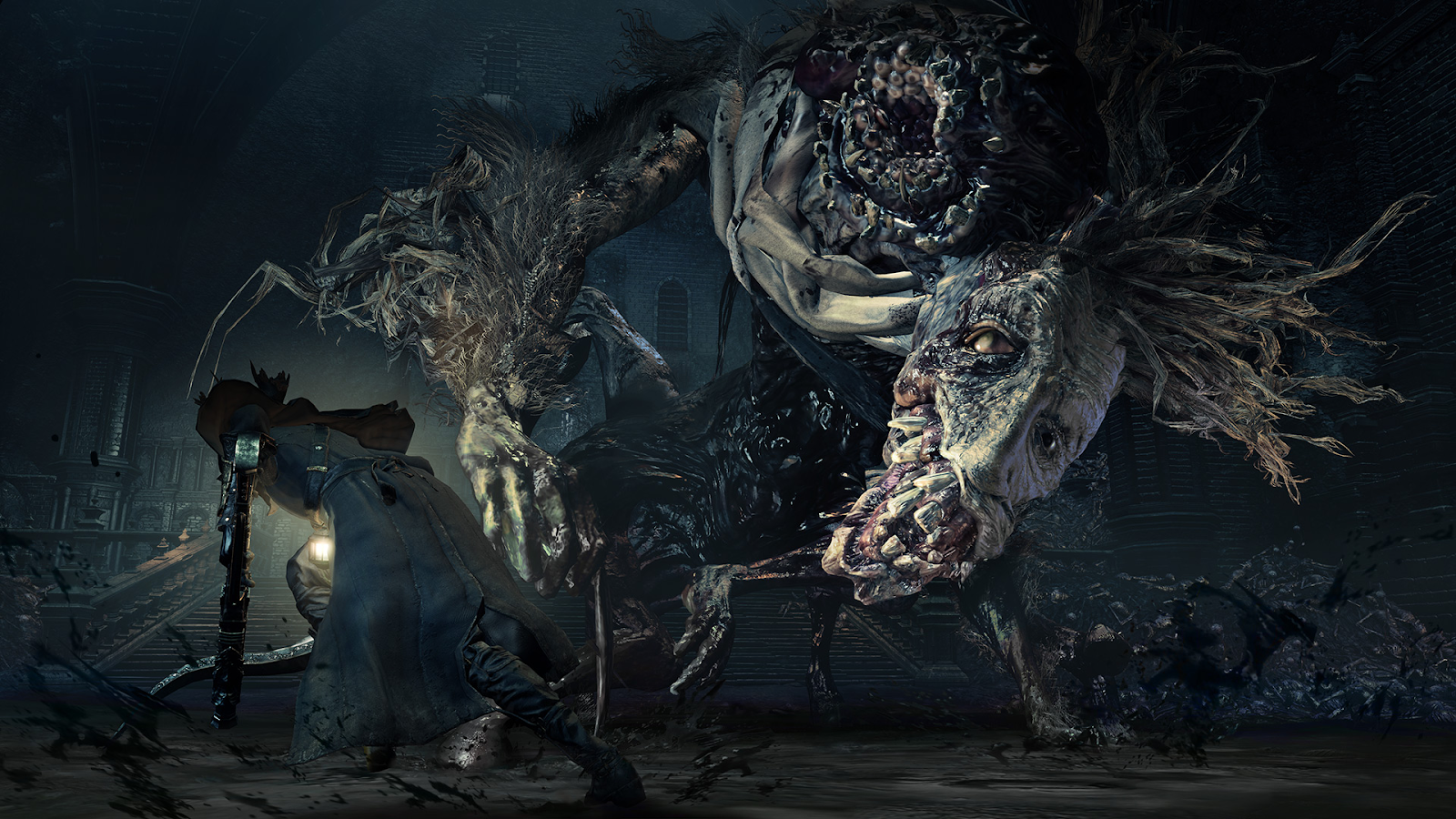
Actually, you want to know how good Old Hunters is? One of the first bosses in the DLC is Ludwig the Accursed. Ludwig was a character mentioned frequently in the base game item descriptions. Heck, one of the Trick Weapons is literally called Ludwig's Holy Blade, a name that implies that you are using a weapon that belongs to a more accomplished Hunter. Ludwig was described as a paragon, a champion and an inspiring leader. A true hero that all Hunters aspired to be more like. And you get a chance to meet Ludwig in the Hunter's Nightmare. He has been twisted and deformed into a grotesque horse-like monster covered in misshapen limbs, driven completely feral by the curse of the Old Blood. Ludwig's monstrous form is sickening to look at, and his pained growls make you feel pity for him. That is, until halfway through his boss fight. Once Ludwig takes enough damage, he becomes lucid and starts fighting with a greatsword that glows bright blue with moonlight. His whole design unfurls from a chaotic mess with no recognizable anatomy or body plan, into something that actually somewhat resembles a real man. A deformed man to be sure, but a man nonetheless. This transformation turns what would be an instance of putting down a sick animal into an honorable duel, letting Ludwig end his life as the hero he once was and face death with dignity. Not only does Ludwig have the most iconic design and theme song of any boss in Bloodborne, the sword he uses once he becomes lucid is the Moonlight Greatsword (pictured above). This weapon is a sort of mascot for From Software. It is their pride and joy. It is their Pikachu. It is their Mickey Mouse. Every From Software game will find a way to include the Moonlight Greatsword, and having Ludwig be the original owner of such a legendary weapon makes him far more impressive for longtime fans of the Souls Borne franchise. And once defeated, you can use the Moonlight Greatsword for yourself.

In terms of presentation, Bloodborne is a very nasty game. Though this is by no means an insult. The character and monster designs are meant to be weird and bizarre at best and absolutely vile at worst. The Trick Weapons are by far the coolest looking weapons in any From Software game, and it is obvious they put a lot of thought and effort into making the weapons look like somewhat believable pieces of machinery. Attire is also stylish, with lots of fancy hats and long trench coats with the occasional robe here and there. It matches the time period that the game emulates immaculately. Speaking of, Yharnam is my favorite location in a From Software game. It's Victorian Gothic architecture and fashion gives it a unique "vibe" that not a lot of games go for. And of course, there's the blood. Blood splatters with every hit, painting the environment with a thick crimson hue. Heck, the longer you fight, the more bloodstains appear on your character's clothing. If a fight drags on long enough, the Good Hunter might become absolutely drenched in the stuff. But the violence here feels tasteful, since this is ultimately a story about the misuse of alien blood, and a story about blood is pretty much required to show the spilling of it. Like, you can't have a vampire story where the vampire doesn't drink blood. That's the whole point of vampires. But I digress.

The only downside on the visual end of things is that Bloodborne is locked into running at 30 frames per second. This is fine, and the game holds a stable frame rate from start to finish. Except for the fight against the Loran Dark Beast. The Loran Dark Beast is a Chalice Dungeon boss, and thus it is not required for 100% completion. And it's a good thing too. Because the Loran Dark Beast is the worst boss in the game. Not because it's hard or has dangerous attack patterns, but because the PS4 literally can't handle this one boss. It is a large "monster" type boss that moves around quickly, has bounce physics applied to its fur and is covered from head to toe in electric sparks. And as it turns out, the behind the scenes graphics engine has a hard time keeping up with a large, fast, furry monster covered in lightning. The frame rate drops so low that at times, it feels like a slide show. This is the only instance of the game suffering from frame rate issues. Honestly, if it didn't have fur or electric sparks it probably wouldn't hurt the frame rate as much. Thankfully, this is a skippable boss not required for progression, but if it was mandatory, it would definitely sour my experience with the whole game.

Voice acting and sound effects are top notch. Highlights of the sound design include subtle things like the sound of footsteps changing based on the material you're walking on, being softer on rugs and carpets and "clunkier" on hard surfaces like stone or metal. I also like the mechanical whirring and clicking of the Trick Weapons as they switch from one form to another. Obviously, the sounds that monsters make vary between horrifying roars to disgusting gargling. I only listened to the English voice acting and cannot speak for the Japanese voices, but the English voices fit the game's vibe perfectly. Highlights of the game's vocal talents include Micolash's insane occult ramblings during his boss fight, as well as the Healing Church Hunter Alfred's passionate (albeit disturbing) speech about avenging his martyred mentor. But if I had to pick a favorite voice role, it would be for Gehrman. Voiced by Allan Corduner, Gehrman presents himself as a feeble old man bound to a wheel-chair. This is a façade, he is far more powerful and Insightful than he lets on. And rarely, while in the Hunter's Dream, you can catch Gehrman talking in his sleep. And his half-asleep pleading for someone, anyone, to bring the Hunt to an end is one of the most depressing lines of dialogue in any video game I have ever played.

On a more uplifting note, Bloodborne has some of the best music in From Software's catalogue. The Hunter's Dream music is a hauntingly beautiful melody that sounds both peaceful and melancholic, serving as a respite from the horrors of the Hunt. Mergo's Lullaby is a simple music box tune that sounds sinister and foreboding. All of the bosses (except for Mergo's Wet Nurse, who gets a remix of Mergo's Lullaby) get a full orchestra to announce their arrival. And all of the bosses related to the Healing Church get bombastic Latin choirs which have lyrics that (when translated into English) retell the story and lore of those characters. The best song would definitely go to Ludwig the Holy Blade. It starts off like a messy and chaotic war chant, reflecting the decrepit state you find him in. But when Ludwig becomes lucid, it transitions into a graceful waltz. It even uses cymbal clanging to represent the clashing of swords, further solidifying the feeling of an honorable duel. A fitting song for a hero's last stand. 

Image from rpgfan.com

Generally speaking, Bloodborne has earned its reputation as From Software's magnum opus. Out of all the Souls Borne games I have played, I consider to be the best so far. As long as you have Old Hunters. That DLC turns a good game into a great game. Again, the Complete Edition is probably the best way to play the game. But even ignoring the DLC, this is still a fun romp through a werewolf infested fantasy version of Victorian England, and that's a good enough sales pitch to stand out on its own. But anyway, in terms of what game is best for newcomers to Souls Borne, I would say it's a tie between this game and Elden Ring. The only truly bad things I have to say about this game is that Loran Dark Beast exists and that as a PS4 exclusive, not everyone will have the ability to even play this game. But overall, I give Bloodborne 5 stars out of 5.

Bloodborne is the property of From Software and Sony. None of the images used on this blog were created by me. Please support the original creators.