Spencer's Day

Total Pageviews

Showing posts with label sci fi. Show all posts

Friday, January 31, 2025

Star Wars: Jedi Survivor, it's a Souls Like IN SPACE. A very Forced review

Star Wars is an absolute monolith of a franchise. Everyone has either heard of it, saw at least one of the nine main movies or played one of the literal 100+ video games. Back in 2020 I reviewed Star Wars Jedi: Fallen Order, a surprisingly competent game that combines the "Space Western Samurai Movie" aesthetic of the franchise with Souls Like combat and Metroidvania style exploration and upgrades. All things considered, this combination worked shockingly well. So naturally, a sequel to Fallen Order was released in 2023, titled Star Wars: Jedi Survivor. I knew I wanted to review it, because not only do I like Star Wars, I am a big fan of Souls Like games. That being said, I came away with mixed feelings on this game, for reasons I will explain more thoroughly later.  Before we begin, I have a few disclaimers. Firstly, I played the game on Playstation 5, and thus can only speak to its performance on that system. Secondly, I have already explained terms like Souls Like in greater detail in other reviews, and will assume you know the basics of the genre. I will also offer (brief) explanations of common Souls Like terminology as needed.

The official box art of Star Wars: Jedi Survivor, featuring Cal Kestis and BD-1. Image found on Wikipedia.org

In the event you somehow don't know what Star Wars is, here's an attempt to summarize over 40 years of lore. A long time ago in a galaxy far, far away there was a Galactic Republic. The Republic was the de facto main government of the entire galaxy, with senators and representatives from literal thousands of different planets. One day, the Republic went to war with a group called the Confederacy of Independent Systems, called the Separatists for short. The Separatists didn't want to live under Republic rule, and unleashed an army of robotic minions called Battle Droids to terrorize the Galaxy. The Republic responded by creating an army of super soldier clones, and tasked an ancient order of psychic warrior-monks called Jedi Knights to lead said clones into battle. The Republic came very close to winning the war, thanks to the clones' tenacity and the Jedi's otherworldly Force powers giving them a distinct advantage. However, the clones were actually a trap devised by Chancellor Palpatine, who was manipulating both sides of the war for his own benefit. When Palpatine told the clones to "Execute Order 66" all the clones turned on their Jedi masters, killing 90% of them in a violent coup. To add insult to injury, Palpatine corrupted the strongest Jedi of them all, Anakin Skywalker, and turned him into an evil cyborg samurai called Darth Vader. With no one left to oppose him, Palpatine rebuilt the Republic into the first Galactic Empire, with himself as Emperor and Darth Vader as his personal enforcer..

In both Fallen Order and Jedi Survivor, you play as a Jedi Knight named Cal Kestis, who as previously mentioned is a survivor of Order 66. Back in Fallen Order, he and his friends found and destroyed an artifact showing the location of every Force user in the galaxy. This was important, because the Empire is still hunting down and executing the few survivors of Order 66, and converting the few "neutral" Force Users into Sith Inquisitors. Also, Cal attempted to fight Darth Vader. Emphasis on the word "attempted." Cal is meant to be a fairly average Jedi. He's a good swordsman, his Force powers are strong enough to compete with most other Force Users, and he has a knack for improvising and adapting to his opponents mid-battle. But Darth Vader is the strongest Force User in the galaxy. Darth Vader's entire purpose, narratively speaking, is to be an absolute menace that puts the fear of death in the heroes. You see Darth Vader approaching, you run. Don't fight him. You will not win. 

Jedi Survivor takes place five years after the first game. Cal is now working with Saw Gerrera, leader of a rebel group trying to overthrow the Emperor. Meanwhile, his old friends Cere, Greez and Merrin have all gone their separate ways. The game starts with a tutorial mission in which Cal and a crew of Saw's rebels kidnap an Imperial Senator and steal confidential information, right in the middle of Coruscant (the Imperial capital). This mission shows off all the main mechanics of the game, from combat to puzzle solving to climbing sections. One thing I like about the game is that Cal starts off with all the movement upgrades from the previous game already unlocked, such as double jumping and running on walls. The tutorial ends with a boss fight against a Sith Inquisitor known as the Ninth Sister, who was actually a major villain from the first game. In this game she gets bodied, because Cal has spent the five year time skip training and perfecting his abilities, and the Ninth Sister did no such training in the meantime. And that's actually a good way to show both narratively and mechanically how much stronger Cal has grown in the transition between games.

The mission ends in a bust, as four out of the five rebels assisting Cal are killed in action and the senator is killed as collateral damage. Cal and the last surviving rebel, a gunslinger named Bode, barely escape from Coruscant. Unfortunately, Cal's ship, the Mantis, is damaged in the escape. Before he crash lands, Cal redirects the Mantis onto an Outer Rim planet called Koboh. This wasn't a random landing spot, for Cal knows that one of his old friends lives on Koboh. So he's hoping that said friend will help him repair the Mantis. The Outer Rim is essentially the Wild West in space. While it's technically a part of the Empire, it's so far removed from "civilized society" that criminal organizations and bounty hunters are allowed to do whatever they want with very little consequence. In the case of Koboh, the locals are routinely bullied and harassed by a bandit gang called the Bedlam Raiders. What makes the Raiders dangerous is that they got their hands on Separatist technology, and thus have access to Battle Droids. And the higher ranking Raiders have figured out how to make their own Lightsabers. But anyway, the game starts for real here.

Jedi Survivor has open-world exploration across five different planets. Though truth be told, it is very obvious Respawn put most of their effort into Koboh. It is by far the biggest planet you can explore, has by far the most number of collectible items and is one of two planets that allow Cal to ride on the back of an animal to cover greater distances. But back on subject, Cal can check his map via a helper droid called BD-1, and said map will highlight the location of the next story objective in gold. But there is nothing stopping you from ignoring the main story and exploring the wilderness. Even during high-stakes missions that seem like they would be time-sensitive, there is nothing stopping Cal from taking a lengthy detour to grab a new outfit or fight a secret boss. 

Cal clashes Lightsaber blades with a Bedlam Raider. Image found on starwars.com 

Speaking of fighting bosses, the single best thing about both Fallen Order and Jedi Survivor is the combat. Cal is armed with a Lightsaber, obviously. He can use it both as a melee weapon and to deflect laser blasts from enemies back at them. Additionally, he can use the Force to grab enemies and objects and throw them around, or throw his own saber like a boomerang. He can even use the Jedi Mind Trick to manipulate enemies into fighting each other. Cal feels powerful when you mow down hordes of Stormtroopers or Raiders, which feels appropriate. Cal may be only an "average" Jedi in terms of raw power, but even the weakest Jedi will be leaps and bounds more powerful than a regular soldier. The only people who can give Cal a challenge are either other Force Users, armored mechs or giant monsters. So naturally, almost every boss encountered in this game belong to one of those three categories. The only exception to this rule is an Imperial Stormtrooper named Rick the Door Technician, who is a joke boss clearly meant to be a pushover that goes down in exactly one attack. All things considered, Rick is an excellent example of how to do a "joke boss." Like, you find him at the end of a grueling gauntlet in which you fight through an army's worth of Imperial forces, and by the time you reach him you should be low on healing items. So when a boss health bar appears at the top of the screen, you get filled with a brief sense of dread until you realize that the boss is literally just a dime-a-dozen Stormtrooper that's no different from the ones you've been slicing through the whole game. And they gave him the most normal sounding name in the history of Star Wars.

While it is true that this is a Souls Like, and thus has a stamina-based combat system, Jedi Survivor is meant as a "baby's first" Souls Like experience. For example, the way this game handles stamina is very forgiving. The stamina equivalent of this game, the Force, only drains when using either a strong attack or when using a Force Technique. Basic attacks actually charge up Force instead of draining it. Additionally, blocking is given its own dedicated meter that does not affect the Force meter in any way. As long as the block meter isn't completely empty, Cal can keep blocking attacks. Speaking of blocking, tapping the block button right before an attack hits will parry it, which does not drain the block meter and has a chance to knock the attacking enemy off balance. How strict the timing is varies based on the difficulty you are currently playing on. Speaking of which, the fact that Jedi Survivor even has multiple difficulty settings further reinforces the idea that it's a baby's first Souls Like. Most games in this genre don't even have adjustable difficulty, since a lot of these games advertise themselves as a deliberately challenging experience meant to push your skills to their limit. But there's absolutely no shame in playing on a lower difficulty setting. In fact, as long as you are not in battle, you can change the difficulty whenever you want. I started the game on Jedi Master mode (the equivalent of hard mode), but brought the difficulty down to Jedi Knight (the equivalent of medium difficulty) and found the game more enjoyable from then onwards.

New to Jedi Survivor are the Stances. Stances change Cal's fighting style and modifies the shape of his Lightsaber's blade. Also, with the sole exception of Single Blade Stance, all of the Stances are based on the fighting styles of fan-favorite characters from throughout the franchise (Darth Maul, Ahsoka Tano, Kylo Ren, etc.). Cal can only equip two Stances at a time, though he can swap them out at Meditation Points (the main checkpoint of this game). Each Stance comes with its own set of attacks, defenses and combos. Keep in mind you don't start with all five Stances available. You start with two and unlock the other three throughout the main story. That being said, none of these Stances are spoilers, since they are all over the marketing and serve as the main "sales pitch" of the game. While Jedi Survivor doesn't use stats like a normal Souls Like, the Stances all play like classic Souls Like archetypes. Just to give a few examples, Cross Guard Stance is your big heavy Strength Build with slow but powerful swings, Dual Wielding is like a Dex Build with high speed and mobility but poor defenses and Blaster Stance is your long range "archer" build.  Returning from the first game are Single Blade stance and Double Blade stance. The former is literally just Cal's move set from Fallen Order, while the latter is a Darth Maul inspired fighting style that can clear out crowds of enemies with wide reaching spin attacks.

The second best thing about Jedi Survivor is the customization. You can change Cal's hairstyle, what kind of facial hair he has (if any), his outfit and his Lightsaber's appearance. In fact, finding new customization options for Cal's appearance is the main collectible in the game. The Lightsaber customization is especially thorough. Not only can you change the color of the blade, you can swap out each individual part of the hilt. Those being the blade emitter, the switch, the grip and the pommel. You can even change the materials used the Lightsaber's construction, which changes both the color and the textures on the hilt. You can make it look wooden, metallic, plastic or any combination of the above. Some materials like Beskar Steel even have unique patterns on them. The pistol used in Blaster Stance can also be customized with similar options to the saber itself. The only restriction on the saber customization is that you cannot make your Lightsaber have a red blade during your first playthrough. This is mostly for lore reasons, seeing as how only Force Users who have been corrupted by the Dark Side have red blades on their Lightsabers. And Cal hasn't been corrupted (yet), so no red blade for him.

One odd design choice is how this game handles currency. Because unlike every Souls Like game ever, Jedi Survivor doesn't have a universal currency. Each merchant has a special collectible item associated with them exclusively, and the only reward for defeating enemies are Skill Points. Skill Points are used to unlock new abilities and techniques for Cal, or to improve the powers he already has. Almost all of the merchants only sell cosmetic items for either Cal himself, his Lightsaber or for BD-1. The only merchant who does sell items with actual impact on gameplay is a retired bounty hunter named Caij, and even then she only sells ammo types for Blaster Stance. Personally, I don't really like how every merchant gets their own unique currency that only they will accept. If they really wanted Skill Points and "merchant money" to be separate resources, they could have just called the latter Credits and have that work as a semi-universal currency. Especially because Credits already exist as a universal currency in the Star Wars universe. 

Back on the subject of the actual story, Cal and Bode meet up with one of Cal's old friends, Greez the four-armed alien gambler. During the 5 year time skip, Greez settled down on Koboh and opened up a bar called Pyloon's Saloon. This saloon serves as the main base of operations for Cal and his friends, at least while they are on Koboh. Greez agrees to repair Cal's ship and even shows Cal his private stash of ship parts for just the occasion. This event leads to Cal accidentally discovering an abandoned Jedi temple, whose caretaker droid is somehow still active. This droid is Zee, and she reveals that her old master was an ancient Jedi named Santari Khri. Santari, along with her best friend Dagan Gerra, discovered a mythical planet called Tanalorr. Tanalorr is hidden inside a nebula, and cannot be accessed without a special compass.

Cal and Night Sister Merrin. Image found on starwars.com

So Zee tells Cal and Greez about Tanalorr, and our plucky protagonists see an opportunity. Greez is interested in Tanalorr because Tanalorr is said to be filled with riches. Cal is interested because he's losing faith in his ability to fight the Empire. After all, he has been working with Saw Gerrera for over 5 years and despite their best efforts, the Empire isn't slowing down. But a hidden planet that the Empire can't access is the perfect place to raise a new generation of Jedi, or at least develop a new rebel base. So Cal investigates the key to finding Tanalorr. During his travels he wakes up Dagan Gerra, who was stored in stasis this whole time. Dagan is an accidentally funny antagonist. This man woke up after a 200+ year long coma, learns about the destruction of the Jedi Order, and immediately falls to the Dark Side. Like, Dagan literally modifies his Lightsaber to produce a red blade mere seconds after being released, while in the middle of a conversation with Cal. Now granted, some later flashbacks reveal he was corrupted long before being put in stasis. But still, bleeding out your Lightsaber to produce a red blade is one heck of a first impression. Anyway, Dagan is the main antagonist for this game, as most of the plot is spent racing against Dagan to get to Tanalorr first. Cal and his friends want to use Tanalorr as a sanctuary, Dagan wants to use it as the birthplace of an Empire of his own. Letting Dagan get there first would be replacing one tyrant with another. And because I don't have a better place to mention it, be prepared to hear the word "Tanalorr" a lot. Everyone (Mostly Dagan) brings it up in conversation so often that if you were to make a drinking game out of it, you would get hospitalized.

Cal's journey brings him to Jedha, a desert world where Merrin, Cordova and Cere have been running a sanctuary for persecuted Force Users called the Hidden Path. Cere and Cordova are two of the last surviving Jedi Masters (and act as mentor figures to everyone else), while Merrin is a Night Sister. The Night Sisters are technically Force Users, but the way they use the Force is completely different from everyone else. Think of it like this. Jedi and Sith are samurai IN SPACE, and they use the Force to do better samurai stuff. Night Sisters are witches IN SPACE, and they use the Force to do better witchcraft. Anyway, Merrin will assist Cal in battle while he's on Jedha, immobilizing enemies with her witchcraft and opening up portals that he can jump through to quickly travel across greater distances. Also there's a romantic subplot between Cal and Merrin, as the two clearly have feelings for each other despite coming from very different cultures. It's an alright romance, nothing too annoying, gross or problematic about it. But this is coming from a guy who generally dislikes romance in media, so take anything I say about romance in general with a grain of salt.

The bulk of the game's first two acts consist of Cal, Bode, Greez and Merrin traveling from one planet to another. They try to track down the compass leading to Tanalorr before Dagan Gerra can, while fighting off both the Empire and the Bedlam Raiders. Truth be told, this part of the story is kind of weak in my opinion. Throughout this part of the game I felt like I was just going through the motions instead of getting properly invested in the story. The most interesting thing that happens in this part of the plot is Cal fighting this dude called Rayvis, who is the leader of the Bedlam Raiders and Dagan's right hand man. There are two reasons why I like Rayvis. The first is that he is a Gen'Dai, a species of alien that was declared non-canon back when Disney bought the legal rights to the Star Wars franchise. But obviously, the Gen'Dai were made canon again for this game. Which is good, because the Gen'Dai are a cool idea for a Star Wars creature. The Gen'Dai are essentially a mass of rapidly growing nerves and flesh who live inside suits of armor. The armor they wear gives them a humanoid shape, but without it they become an eldritch blob of fleshy tentacles. Anyway, these guys are one of the few aliens that can survive being cut by a Lightsaber because their rapid growth allows them to heal even the most severe injuries. Which means that the Gen'Dai as a species work well as boss monsters. The second reason I like Rayvis is because he's voiced by D.C. Douglas, who also does the voice of Albert Wesker from Resident Evil. And I think that's kind of funny, because Rayvis' villainous monologue that he says at the start of his boss battle feels like something that a Resident Evil villain would say before transforming into a horrifying meat monster. Which fits oddly well, since the Gen'Dai are an entire species of meat monsters.

So I'm going to fast forward to the most interesting thing that happens in the story, which unfortunately requires me to put up a spoiler warning. You have been warned. So Cal manages to defeat Dagan Gerra and find the compass leading to Tanalorr, so he heads back to Jedha. Cal and friends had agreed to expand the Hidden Path to Tanalorr because of how well-hidden the planet is. But then the game hits you with a plot twist. Bode, the gunslinging rebel that's been helping Cal on his adventure was not only an Imperial Spy this whole time, he was also a fallen Jedi turned Sith Inquisitor. So Bode steals the compass and assassinates Cordova, because he's the only person smart enough to reverse engineer the compass. He also exposes the Hidden Path on Jedha to the Empire, and uses the ensuing chaos to flee the scene. Cal gives chase and gets into a boss battle against Bode, but no matter how good the player fights, the duel is scripted so that Cal always gets knocked unconscious while Bode escapes.

The game does something really cool once Cal is defeated here. It takes you to the Game Over menu and asks you to hit the respawn button like it does when the player dies under "normal" circumstances, but when you do, you're not playing as Cal anymore. You're now playing as Cere, who has a completely different move set from Cal. She only has one Stance (Single Blade), but Cere's version is both faster and stronger than Cal ever could be. Her Force Powers are also a lot more powerful. If Cal is meant to be an example of an "average" Jedi, Cere is an example of an "exceptionally strong" Jedi. She isn't as powerful as someone like Starkiller, Darth Revan or Darth Vader, but she is pretty close to them. Which is impressive, since two of those characters are from Star Wars Legends, a sadly no longer canon spin off series where everything in the Star Wars universe is cranked up to eleven. But speaking of Darth Vader, guess who shows up to shut down the Hidden Path?

We get a boss battle against Darth Vader himself, and he is by far the hardest fight in the game. And the funny thing is, Darth Vader doesn't even know about Tanalorr nor does he care to know. Once again, Darth Vader is an outside-context problem that puts the fear of death in everyone involved. Case in point, while Cere is fighting for her life, Vader is lazily deflecting her blows with only one hand, and only takes the battle seriously when Cere manages to wound him halfway through their duel. It's an almost perfect fight, except for one little thing. If you die to Vader through normal gameplay, you have to do the fight again. But if you empty out Darth Vader's health bar completely, instead of dying like a normal boss, Vader stops holding back and finishes Cere with a one hit kill move. I feel like they should have done the Sekiro thing where if you manage to "beat" the unbeatable boss you get an extra cutscene, but still allow the story to progress if you die through normal gameplay. Especially because the Bode fight I literally just described does exactly that. I prefer the way Fallen Order handled the concept of a "lore-accurate" Vader fight better, because in the first game, Vader was straight up invincible. Nothing you could do in the first game could hurt Vader, so the only way to "defeat" him was to run away while he stalked you like a horror movie monster. Because as far as the Star Wars galaxy is concerned, that's what Darth Vader is. That being said, I still enjoyed Jedi Survivor's Vader fight, and it's tied with the Rayvis fight for my favorite boss battle in the game.

Cal prepares to fight a squad of Stormtroopers using Double Blade Stance. Image found on steamdb.info

So Cere and Cordova are dead, and Cal swears to get vengeance on Bode for ratting them all out. And Cal is so outraged by Bode's betrayal that he starts using the Dark Side of the Force, which anyone with even a basic knowledge of Star Wars lore knows is very much a bad thing. But I do like how the Dark Side is used in gameplay as a kind of super mode for Cal. While "Embracing the Dark" Cal automatically switches to Cere's move set and his damage output goes through the roof. Basic enemies like Stormtroopers die in one hit on even the highest difficulty, and the much stronger Purge Troopers and Security Droids go down in two or three hits. His Force powers get upgraded as well, letting him Force Choke enemies and crush droids and mechs with ease. Additionally, Cal can use the Force to slow down time itself while embracing the Dark Side, which allows him to either heal with no consequences or get some free hits in on his hapless victims. Cal could actually freeze time before this point, but the ability felt lackluster prior to the Dark Side upgrade. Also, you remember when I said that you couldn't make Cal's Lightsaber red for lore reasons? The real reason is that while "Dark Side Mode" is active, Cal's Lightsaber changes from its usual color to red, and it returns to its original color once the effects wear off.

The big finale of Jedi Survivor is a three-phase, 2vs1 boss battle with Bode, right inside the heart of Tanalorr. Merrin will help Cal during the first two phases of the battle, but the final phase is a 1vs1 duel. This fight is nowhere near as dramatic or as difficult as the Vader fight, but to be fair, any battle with Vader is going to be both more dramatic and more difficult than anything else in the game. Bode starts the fight with his own version of Blaster Stance, though he later switches to a Dark Side-boosted version of Single Blade Stance for the final phase. It's an okay fight. Not too easy, not too hard. That being said, I find it amusing just how easily Bode goes down when you use Dark Side Mode, and the transition between second and third phase is scripted so you have no choice but to embrace the Dark Side. Like, from Bode's perspective, he isn't the final boss. Cal is, and Embracing the Dark Side is Cal's version of a second phase. Bode's like a Souls Borne character without the resurrection ability, fighting an unwinnable battle. The only thing I will overtly criticize here is that Tanalorr itself is a disappointingly boring planet to explore. It consists of a shoreline leading up to a temple, and the temple's interior serves as the final boss arena. That's it. There's no collectibles or hidden super bosses or anything like that. 

But why did Bode betray them all in the first place? The reason is because he has a daughter named Kata, and he made a deal with the Empire. Bode would work as a spy and in exchange the Empire would spare Kata's life. However, after learning about Tanalorr, Bode decides to betray both the rebels and the Empire so he can raise his daughter in peaceful solitude. Which doesn't strike me as particularly smart. Like, Tanalorr is a whole planet. You don't need an entire planet to raise one child. He could easily just raise his family on one side of the planet and let the rebels/Empire do their thing on the other. But then again, Bode's entire characterization post-betrayal is a real-time reenactment of Yoda's warning to Anakin back in The Phantom Menace. "Fear leads to Anger. Anger leads to Hate. And Hate leads to Suffering." Bode is so scared of losing Kata that he betrays everyone who has ever helped him. When his former friends confront him, he lashes out in anger. His anger turns to murderous hatred because he now views literally everyone in the galaxy as a threat to Kata, and any threat to his daughter must be destroyed. And in his hatred, he frightens and almost kills Kata while fighting both Cal and Merrin at the same time. In the end, Bode is killed by Cal and Kata is shockingly okay with that. Even before this point, Kata agreed with Cal and Merrin that what Bode did was morally despicable. Imagine being such a bad father that your only child not only agrees with your killers that you were a terrible person, but said killers adopt your kid and turn out to be better parents than you ever were. Massive L on Bode's part. 

The game ends with Cal, Greez and Merrin hosting a funeral for all their fallen friends (and Bode). They decide to build a new home on Tanalorr and adopt Kata into their found family. The Empire still doesn't know about Tanalorr, and the Bedlam Raiders are scattered and leaderless due to the deaths of both Dagan Gerra and Rayvis. It's a bittersweet ending, all things considered. And overall, I found the game to be okay and almost good. There is just one problem I neglected to mention, in addition to my smaller critiques. This problem is so great that it needs its own section in the review.

Jedi Survivor is not a well optimized game by any stretch of the imagination. I ran into a plethora of technical problems that dragged the whole experience down. The game crashed on me twice, the first time being during the tutorial. I also experienced a glitch on two separate occasions where Jedi Mind Tricks stopped working, forcing me to restart the game until they did. Some character models didn't load in correctly, causing random body parts to become invisible. Enemies would sometimes get stuck inside walls and if it wasn't for Cal's ability to grab enemies with the Force, I would not have been able to get those enemies unstuck. That last one is especially bad because a battle isn't considered "finished" until all enemies involved are dead. The framerate would also frequently dip during the more intense cutscenes or when traveling between areas. On top of all of this, the game has a 150+ gigabyte download size, meaning this game by itself took up almost a whole third of my PS5's active memory. If the game ran perfectly and didn't have such glaring tech issues, I would have given this game an easy 4 out of 5 stars. But the tech problems are so great that the game fluctuated between a 3 star rating and even a 2 star rating. And you want to know the real kicker? From what I've heard other reviewers say, apparently the PC version has even worse technical issues than the PS5 version. I can't say for certain but if that's that's true, that's a real shame. 

As for presentation, I consider Jedi Survivor to be fairly average. The whole game is fully voice acted and sports motion capture animation for all the main cinematics. But the graphical quality isn't particularly impressive by itself. It's a nice looking Star Wars game for sure, but it does that thing that a lot of Triple-A games do where they try really hard to look photo-realistic but lack either the technology or the budget to pull it off properly. This game looks like your stereotypical Triple-A game. This isn't a compliment nor is an insult. I just wish the game had more of a visual identity of its own. All the games using Capcom's RE Engine do a better job at the "realistic" art style, just to give a comparison. One thing I like is that the camera work in the cinematics. It does the thing that the modern God of War games do where the camera shows everything in a long take format (meaning no sudden changes in the camera angle). Additionally, the camera is slightly shaky, creating the illusion that they were recorded by an onset cameraman. It makes the cinematics feel, well, cinematic. If there was a new theatrical Star Wars movie with this kind of camerawork, I would actually really enjoy it.

The sound design is good. Not only do we have all the classic Lightsaber/Blaster sound effects that we all know and love, there's also a fun little quirk with changing the Lightsaber's color. Each color changes the sound of the "hum" the blade makes when the saber is activated. The voice acting is also generally pretty good. I especially like Merrin's voice, because she speaks in a Slavic accent. I don't know exactly if it's supposed to be Russian or some other variant of Eastern European, but either way it makes her sound like she came from a completely different culture from everyone else. It also makes her sassy remarks even funnier. But I do want give my compliments to Scott Lawrence, who does the voice of Darth Vader in this game. He does such a good job sound-a-liking the iconic Vader Voice used by the late James Earl Jones that at first I thought that it actually was James Earl Jones himself doing the voice. It's not, unfortunately, but like I said, Scott Lawrence does the character justice. Speaking of voice actors, there's a side character named Turgle. Turgle has no plot relevance whatsoever besides handing out the occasional side quest. And you know who they got to voice this goofy frog-looking alien man? Richard Steven Horvitz, a legendary voice actor well known for roles such as Zim from Invader Zim, Billy from The Grim Adventures of Billy & Mandy, and Dag from Angry Beavers. I was not expecting to see Richard Steven Horvitz in a Star Wars game, but it's cool that he's here.
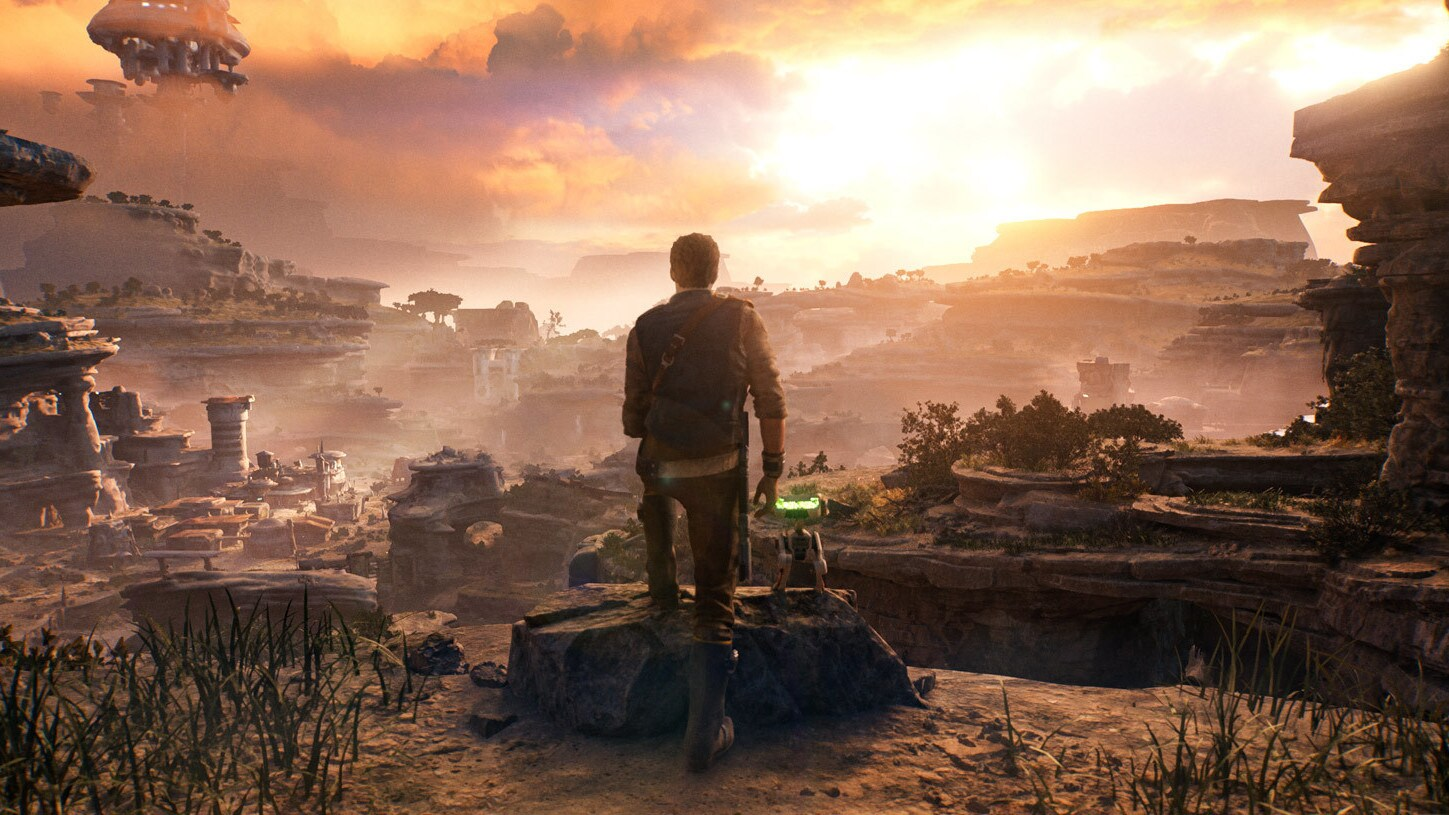
Cal and BD-1 looking at the sunset on Koboh. Image found on starwars.com

So would I recommend Star Wars Jedi Survivor? No, or at least not at full price. I bought my copy of this game during a sale that brought the price down from $70 to $20 USD. And I feel like $15-$20 is the ideal price range for a game of this quality. Paying $70 for an otherwise average video game based on a preestablished franchise with glaring performance issues is too much money. Then again, asking for $70 for any video game is quite the demand, and I feel like the game needs to be as close to perfect as possible to justify that kind of price. Especially when other Souls Likes are typically priced between $40-$50. But honestly speaking, even if the game ran perfectly, I don't think I was in the right head space to enjoy it properly. I've been feeling burnt out on Star Wars content for a while now. So let me ask you a question. What exactly is a Star Wars fan exactly? The biggest problem with Star Wars as a franchise is that there is so much "stuff" with the Star Wars brand on it that you cannot possibly be a fan of EVERYTHING Star Wars related. Especially since each "thing" in the franchise has wildly inconsistent quality. For everything as good as say, Star Wars: Andor there is something as bad as The Star Wars Holiday Special. Jedi Survivor feels like it's the middle of those two extremes. Like it's not even close to the best Star Wars video game, but if it's also nowhere near the worst. It's a perfectly average, some would say mediocre experience. One might even call this game "mid." I give Jedi Survivor 3 stars out of 5. 

Star Wars: Jedi Survivor is the property of Electronic Arts and Respawn Entertainment. Star Wars (the franchise) is the property of Disney. None of the images used here were created by me. Please support the original creators.

Tuesday, August 20, 2024

Stellaris, the strategic space opera simulator. A very complex review

Space. The Final Frontier. In a Galaxy Far, Far Away. Where in the Grim Darkness of the Far Future, the Spice must Flow. You get the idea. Science fiction is a staple of modern entertainment, because there's something fun about speculating how a spacefaring society with technology so advanced it might as well be magic would function, with or without alien life forms. But have you ever thought to yourself, "Gee, I sure would love a needlessly complex strategy game about creating my own sci fi civilization and exploring the cosmos while reenacting my favorite sci fi stories!" Well do I have the game for you.

Image found on Wikipedia.org

Enter Stellaris. Released in 2016, this sci-fi strategy game was developed and published by Paradox Interactive, with the console port being made by Tantalus Media. This is one of the many Grand Strategy games that Paradox specializes in, though the concept of this game is in my opinion an easier sell. Most of Paradox's games are historical fiction, taking place in alternate versions of the distant past. Crusader Kings, for example, is set in Medieval Times, while Hearts of Iron takes place during the World Wars. Stellaris is the odd duck out, taking place in a completely fictional time period, starting roughly 200 years into the future. As such, there's a lot more room for creativity, at least in theory, since you are not bound by historical accuracy. Instead, the goal of Stellaris was to be a love letter to all things science fiction and as such, there are plenty of references to other sci-fi stories sprinkled in all throughout the game.

To be a man in a 2200+ year old society is to live among untold trillions. It is a time to seek out new civilizations and boldly go where no one has gone before. But most importantly, it's the perfect setup for a space opera. And that's basically the entire story of Stellaris. Well, sort of. A big part of this game's appeal is that it features an Emergent Narrative. What that means is that after creating your own civilization (which I will call Empires for the sake of brevity) the story is dictated almost entirely by randomized events and how you choose to deal with them. As well as how you choose to deal with any over Empire that you encounter on your travels. It's a very free-form approach to storytelling, and the result is that it's rare for two or more playthroughs to play out the same way. Though there are a few standard beats. Every civilization starts off isolated and alone in the galaxy, slowly expanding until they contact alien life. Intergalactic superpowers fight, trade and form alliances as the number of unclaimed star systems begins to dwindle and borders begin to take shape. And all civilizations have to deal with a universal threat towards the end that puts the whole galaxy in danger. What happens in between these points is more or less randomized.

But where do you begin with this game? You start at Empire Creation. While you can play as about 20 or so premade Empires, the real core of this game comes from designing your own aliens. Or your own version of Humanity's Future, if you like that sort of thing. And I am letting you know now that this game is DENSE. Paradox games are infamous for their steep learning curves and numerous complexities. And Stellaris is no different. While the tutorial that starts once the campaign begins does help with teaching the player the bare minimum, this is a game that will take more than a little while to get used to. Especially if you prefer more fast-paced, action focused games. This doesn't make Stellaris a bad game, not in the slightest. But its gameplay is meant for a very specific audience, the kind that enjoys solving problems with brains rather than brawn. And the kind of audience that doesn't mind looking up guides on the Internet just to make sense of the convoluted information this game can sometimes throw at you. While I do like games that require you to think and plan ahead like Fire Emblem and X-COM, nothing I have played or reviewed here before has quite as many moving parts as Stellaris. And from what I hear, the rest of Paradox's catalogue boasts a similar level of complexity.

Okay, let's breakdown Empire Creation, since all the important choices start here. Your Empire can be customized in a multitude of ways. Most of it is cosmetic stuff like picking an animated portrait that will represent your aliens/future-humans in some menu screens, or what biome your home planet is, or even designing your own flag. But there are mechanical decisions to be made here, like choosing Authorities and Origins. Authorities are the type of government your civilization uses, whether that be an Imperial Dynasty where the role of leadership is passed down from parent to child in a single family across the generations, or a Democracy where the the leaders are chosen by popularity votes at regular intervals. Origins are basically your Empire's backstory, giving you some nice lore and roleplay potential while also simultaneously changing how the game starts. Some Origins offer really strong bonuses, others exist to add an extra challenge to the campaign to push your management and strategy skills to their limits. For example, the Mechanist Origin allows your Empire to start the game with eight fully operational robots as well as a factory to build even more. The Doomsday Origin will make your home planet explode after 35 (in-game) years, so you have to find a new planet for your people to live on before then or risk your species going completely extinct. But most importantly, there's an option to write/type out a custom biography. This has no effect on gameplay but as an aspiring writer, being able to write custom biographies for fictional civilizations is something that makes me very, very happy.

Image found on SteamDB.com

But the three most important things to worry about are Traits, Ethics, and Civics. Traits are biological strengths and weaknesses your aliens/future-humans have that make them better or worse at certain tasks. Things like enhanced upper body strength, fast learning minds that can invent new tech sooner than everyone else, or extended lifespans to live longer. However, not all Traits are beneficial. Some might make your citizens have a hard time reproducing, others might make them prone to riots. So I know what you're thinking. "Why would I ever pick Negative Traits!?" Well, you see, every Trait is assigned a point value. Positive Traits cost points while Negative Traits give more points to work with. The idea is that you're supposed to pick one or two weaknesses that you think you can live with so you have enough points to unlock the Positive Traits that you actually want. If you are smart about it, you can turn your weaknesses into a net positive.

Ethics are the next main decision and this will greatly determine the "vibe" of your Empire. Ethics are the moral and societal values that your Empire respects and practices. Ethics come in two variants, Moderate and Fanatic. Much like Traits, they will grant bonuses like increased fire rate for weapons or being able to hire extra diplomats, but they also come with downsides like restricting who or what you can wage war with or restricting your ability to build robots. Normally, you can pick any three Ethics of your choosing so long as they do not contradict each other. For example, your Empire can be Militaristic, Spiritual, and Egalitarian because those Ethics do not contradict each other. But your Empire cannot be both Militaristic and Pacifistic since those two Ethics are opposite to each other. Fanatic Ethics are even stronger than their Moderate counterparts, but you can only pick one Fanatic Ethic and one Moderate Ethic at a time. Fanatic Ethics are basically exaggerated versions of their Moderate counterparts, with everything that Ethic represents being cranked up to eleven. For example, a moderately Pacifist Empire will only fight in war to overthrow tyrannical regimes and replace them with something more humane and ethical. A Fanatically Pacifist Empire won't fight in wars at all. The other Fanatic Ethics follow this pattern of being a more exaggerated version of the Moderate counterpart. But again, the benefits of being Fanatic makes the Empire far stronger at whatever they are Fanatic about. Fanatic Militarist Empires have a whopping 30% fire rate upgrade compared to the Moderate version's 10% as an example. Basically, by making a Fanatic Empire, you are sacrificing the versatility of a third Ethic in exchange for greater specialization. Both are valid ways to play. But I do prefer making Fanatic Empires, but that's because I like seeing big numbers get even bigger.

Finally, Civics. Civics are more specialized bonuses that become available based on which Ethics you chose. These also help form the "vibe" of your Empire. While there are some Civics are available to all Empire types, all of the fun Civics are locked behind certain Ethic combos. For example, the Citizen Service Civic requires your Empire to be both Militaristic and Egalitarian, and it allows you to (potentially) build up a bigger navy than everyone else. The Inward Perfection Civic meanwhile requires you to be both Xenophobic and Pacifistic, and it basically cuts you off from the rest of the galaxy while GREATLY boosting the growth of your Empire's economy and population. The other Civics have similar restrictions and similar benefits. You can pick any combination of two Civics that you want as long as you meet the requirements for both. And finally, you can mix and match Traits, Ethics, and Civics for some very powerful or very wacky combos. Like a democratic society of future-human monks with the Inward Perfection and Agrarian Idle Civics, who are so obsessed with preserving the environment that they developed Traits like Communal and Conservationist that allow them to use even less resources for their day-to-day lives. Or a society of hyper-intelligent but physically weak Fanatically Materialist space rats who use the Technocracy and Meritocratic Civics to not only build robots to do all the hard work for them, but structure their entire society around science and knowledge. Or a group of strong and industrial but unruly and stubborn space dragons who are so Fanatically Militarist they took the Citizen Service Civic and Distinguished Admiralty Civic specifically to make the most dangerous navy the galaxy has ever seen. These three are but a taste of the kind of spacefaring civilization that you can make once you learn how everything works.

Okay, so you got your Empire ready and raring to go. Now we can get to the actual gameplay. Stellaris is a fairly hands-off game. You interact with your Empire mostly through a variety of menus. Because unlike every other game, you are controlling AN ENTIRE CIVILIZATION, not just one character. Because of that, you see everything happen at the macro scale. Time is measured in days, months, and years while mere minutes pass in real life. You spend a good chunk of your time just checking an intergalactic map and watching out for meaningful changes like expanding borders or reports of hostile activity. You can zoom in to individual star systems to see your ships and planets in more detail, but you can't get any closer to the action than that. You can give orders to your fleets and ships, and order construction of various facilities on any planets you own. Planets are quite possibly the most valuable resource in the game. Without a planet to build on, you have nothing to work with. The main challenge of Stellaris revolves are the classic Four Ex's of Paradox games. Explore, Expand, Exploit, Exterminate. If you are not doing any of those four things you are, to be blunt, playing the game wrong. You must send out Science Ships to Explore uncharted star systems and survey desirable planets before building on them. You must use your resources to Expand your reach and grow your power. You must Exploit any natural resources you find so you can continue Exploring and Expanding. And if anything gets in your way, you must Exterminate the threat before it can cause any lasting damage to your Empire. All Paradox games, regardless of setting or time period, live and die by the Four Ex's.

Image found on SteamDB.com

Like I said earlier, there are random events that will change the history of your Empire. Maybe your citizens will track down a temple idolizing a long-forgotten god which causes a spiritual awakening among the people. Maybe your science team discovers an ancient, hyper-advanced ancestor and they invent new technology by reverse-engineering the relics left by their forebears. Maybe your king/queen/president got in contact with a Lovecraftian monstrosity that promises unfathomable power in exchange for servitude. All these are a few examples of the random events that can occur in your playthrough. But because of this, how enjoyable your playthrough's story will be is a coin flip. Either you get just the right combination of random events to make a space opera so epic it would get George Lucas and Gene Rodenberry themselves to nod in approval, or you might get eaten by a Devouring Swarm before your Empire has a chance to do anything cool. It depends both on luck and what difficulty you are playing on. And credit where credit's due, Stellaris has dozens of ways of customizing the game in its options, including no less than seven main difficulty options. That said, the difficulty does not dictate where rival Empires start on the intergalactic map, nor does it dictate how aggressive they are. Instead, all difficulty does is determine what kind of economic bonuses an enemy Empire gets at the start of a campaign. An NPC Empire will never attack or antagonize you if your military is equal to or stronger than theirs. Because of this, even Pacifistic Empires still benefit from having a a well-built navy even if they don't plan on using it. The mere presence of a navy will deter would be enemies from attacking. Additionally, you can negotiate with other Empires and form alliances and peace treaties with them.

But rival Empires are not the only dangers in the galaxy. So let's talk about the Crisis Events. Crisis Events are special events that only happen once the campaign reaches certain years. You can change which years it happens in the options menu, but once a campaign starts, the Crisis Years are locked in and cannot be changed unless you start a new campaign from scratch. Anyway, when a Crisis Event occurs, a violently hostile alien will appear somewhere in the galaxy and attack all Empires indiscriminately. What kind of alien is random by default, though again, you can pick something specific from the options menu. These range from space pirate clans banding together to tear down galactic society at large, to living bioweapons that devour all who stand in their path, to a classic Terminator style AI uprising. Crisis Events are incredibly strong, and they exist as a "stress test" for your Empire. If your Empire can survive the Crisis Events, your Empire can survive anything. In fact, there's an entire difficulty slider that exists for no reason than to increase or decrease the power of the Crisis Events. At max strength, Crisis Events can become over 25 times more powerful than normal. If you wish to defeat a 25x Crisis Event, you need nothing short of a perfectly optimized Empire and a foolproof plan that you spent the whole campaign carefully laying out. Anything less will result in failure. Of course, you could turn the Crisis strength down to give your less-than-perfect Empire a fighting chance.

There are also Fallen Empires. Fallen Empires are special Empires that start the game in control of a small area in the galaxy, usually about only five or six star systems. But they also start the campaign with a comically overpowered navy that will curb stomp anyone who angers the Fallen. The Fallen themselves are all themed around the main Ethics. Unlike Crisis Events, who only appear later on in a campaign, the Fallen are present from day one. The only reason the Fallen don't immediately wipe out the other Empires is because they literally cannot expand their borders outside their starting zone. Nor can they replace any casualties should they encounter the rare opponent that can wound them. At least, not until the Fallen Awaken. When a Fallen Empire Awakens, they will start rapidly expanding their borders in all directions and reinforcing their already fearsome fleets. Depending on their Ethics, the Awakened will either give a chance to join them as a vassal state willingly or wipe your Empire off the star charts. The good news is that a Fallen Empire can only Awaken in very rare circumstances. Like if a Crisis Event happens and the Fallen haven't Awakened already, they will Awaken to go fight the Crisis. If there are multiple Fallen Empires in the same galaxy with opposing Ethics, a special event called the War In Heaven will occur where both Empires Awaken at the same time and all the "normal" Empires have to either pick a side in the War or risk getting caught in the cross fire. While it is possible to fight off both sides of the War In Heaven as a neutral party, it is a difficult undertaking, perhaps even more so than fending off a Crisis Event. Again, good planning and optimization is required to survive the War In Heaven.

But how does one defeat such powerful foes? Well you need a strong navy. While ground battles exist in Stellaris, they don't happen anywhere nearly as often as space battles do. And to be honest, the ground battles are probably the weakest part of the game, since it's a fairly barebones system (at the time of writing) that can be easily avoided. And going back to the Four Ex's, you use the resources you Exploited to build warships so you can Exterminate your enemies so you can continue to Explore and Expand in peace. At the start of the campaign the only combat-capable ship type you can build is the humble Corvette. All ships can be outfitted with various weapons such as plasma cannons, railguns, flamethrowers and even deployable drone fighters. But you have to invent that technology before you can use it, so initially your Empire's Corvettes are all armed with nothing more than dinky little lasers. You invent new tech by having a named Scientist lead a research project, with the research options being randomized (noticing a trend?). Research progresses automatically unless the Scientist leading the research project dies, in which case you need to hire a new Scientist to continue the research. 

Image found on SteamDB.com

Once research is finished, your Empire can now use the newly invented tech to give your warships a much needed power boost, and that Scientist can be given a new project to work on in the meantime. While all the different weapons provide unique strategies and fighting styles, generally speaking, you can win most battles by having either bigger guns or more ships than your opponent. This ties in to Fleet Power, a little number that conveniently shows at a glance the combined power of every warship in that fleet. Unless the enemy has built a fleet designed entirely to counter yours, if your Fleet Power is a bigger number you will win the battle. It's probably the simplest thing in this very complicated game. And while it is true that your Fleet Power will gradually lower as your ships take damage and suffer casualties, you can easily repair and replace damaged and destroyed ships so long as you are not in combat. And while it might be tempting to pour all of your resources into your naval fleets the first chance you get, this is actually a bad idea because you have to balance your economy and not drive yourself bankrupt by overinvesting. Instead, you want to build your navy up over time. Like, once every in-game year (roughly equal to ten real life minutes) you can get away with adding three or four ships to your navy. Three or four dozen ships a year is an unrealistic goal, at least with how the in-game economy works.

But you cannot just attack any other Empire without some kind of cause. This is the Casus Belli system. Basically, if you want to go to war with another Empire, you need to give a reason why. The reason also changes the win condition and end result. For example, Liberation Wars are fought to change a rival Empire's Ethics to match the winner's, thus turning them into a potential ally, while Domination Wars are fought to expand the winner's borders by forcibly taking control of the losing Empire's star systems.  The only time you don't need a Casus Belli to wage war is if you have a Civic that lets you ignore the whole system like Devouring Swarm or Fanatical Purifiers. Or if the opponent in question is a Crisis Event or the War In Heaven. Or if your opponent has one of the aforementioned Civics that ignore Casus Bellis. But anyway, once the war starts, you are free to invade your enemies' territory and attack their ships and stations. There is a timer system called War Exhaustion that mostly exists so you can't keep the war going forever. Basically, as both you and the rival Empire take casualties, War Exhaustion for both sides builds up. Once it reaches a certain threshold, you can either settle for a truce or claim absolute victory, based on how well you did in the war. The only criticism I have of the War Exhaustion system is that makes evasive, hit-and-run style navies far more powerful than defensive "stand your ground!" style navies. Because War Exhaustion doesn't build up when you or your enemies retreat from battle, only when your ships and stations are completely destroyed. 

But speaking of planets and economy, let's talk resources. Resources come in five basic varieties. Food, Minerals, Energy, Alloys and Consumer Goods. Food is self-explanatory. It's the stuff to keep your Empire from starving. Energy is both electricity and money. Everything has a monthly upkeep cost of at least one point of Energy, so you need to keep this somewhat high so you don't go bankrupt. Minerals are raw materials for construction. Minerals can be converted into any other resource, and most early construction projects require a few hundred of them on hand. This is probably the most common resource in the game. Alloys are refined metals, needed to build space ships, space stations and (eventually) robots. This is the rarest and most valuable resource. Consumer Goods are luxury products for civilians. Things like books, movies, video games, sports cars, and cell phones. Things that they technically don't need but provide entertainment. This is probably the least useful resource unless you explicitly plan on playing a merchant style Empire that resolves everything with trade deals as opposed to violence (which is a valid way to play the game). Because Consumer Goods only really exists to keep your citizens happy. And happy citizens won't want to start a rebellion to overthrow you. So even though they aren't as important as the other four, it's still worth investing into Consumer Goods. But no matter what, you need to find a habitable planet to build facilities to produce these resources. Farms for Food, Power Plants for Energy, Mines for Minerals, etc. Once you decide what to build, it is again, automatic. Only this time you don't need to have a named character lead the project. You can hire a Governor to watch over that planet (or several planets at once), and while they might speed up the process, they aren't required. Governors mostly exist to provide boosts for the entire planet so long as they remain in office. These boosts are themed around the Governor's personality. Like a Governor with a strong sense of justice will reduce crime on any planet under his jurisdiction while a Governor with a love for agriculture will increase Food production for any Farms on that planet.

There are also advanced resources like Dark Matter and Exotic Gases that are so volatile that your Empire needs to invent new tech just to be able to collect or produce them in the first place. These advanced resources aren't as essential to your Empire's development, but they do let you build bigger and more dangerous weapons, which makes your warships better combatants, which lets you Exterminate your enemies and so and so forth. You should understand how everything comes back to the Four Ex's by now. Anyway, one last important resource are Pops. Pops is the catch all term for any citizen living in your Empire, although I heard somewhere that one Pop is supposed to represent hundreds of people as one unit, because you know, macro scale space game. Pops are needed to work all the jobs to produce every resource mentioned earlier. Pops also have their own needs. They need Food to not starve, they are paid in Energy, and they indulge in Consumer Goods. They also need Housing to rest at night and Amenities to keep them happy. If their needs are not met they might start a rebellion. Which means setting some resources aside to tend to your people's needs, which is yet another reason why overinvesting in your navy is a bad idea. Because if you pour all of your resources into the navy, you won't have anything left to tend to your people. It's all about finding that economic balance.

Image found on SteamDB.com

The final two "resources" we need to talk about are Influence and Unity. Which are more like concepts that build up over time than something physical but that's neither here nor there. Influence is a measure of your political sway. You can spend Influence to Expand your borders by claiming to be the legal owner of a star system. You can spend Influence to give your entire Empire temporary power boosts called Edicts (which do things like boost resource production or shorten construction time). And you can spend Influence doing manipulative, politician type shenanigans. But how do you get Influence? Much like in real life, sci-fi civilizations are not one dimensional clichés, at least when written well. There will almost always be smaller political Factions within your Empire who embody the main Ethics. While the first Factions to appear in your Empire will be the ones whose Ethics are already supported, if the campaign goes on long enough you'll have at least one Faction per Ethic. Making the Factions happy by legalizing their desired policies will earn you Influence. Displeasing the Factions by outlawing their desired policies will halt your Influence gain, though to my knowledge they can't take it away forcibly. At least, I've never seen Influence go into the negatives before, and I put well over 100 hours into this game across four different campaigns. But no matter what, as long as you have more satisfied Factions than displeased Factions, you can still get Influence.

Unity represents your Empire's cultural development and how, well, united your people are. This resource builds up automatically at all times, never going down under any circumstances. Once it reaches a threshold, you will be allowed to unlock a Tradition, which are basically the Influence Edicts but substantially stronger and once chosen, a Tradition will work for the entire rest of the campaign. The Traditions are divided into sets of five all built around a theme. Domination, Expansion, Harmony, Diplomacy, Supremacy and Discovery. If you unlock every Tradition in a set you unlock an Ascension. Ascensions are upgrades that are even stronger than Traditions, though you can only have up to eight per campaign. And when I say that Ascensions are strong, I mean they are ABSURD. These include things like becoming so advanced at robotics your Empire's species uploads their souls into robotic shells so they can live forever, meaning your Scientists and Governors will never die again. Or your Empire's leaders declaring themselves to be the Guardians of the Galaxy, thus making all of your Empire's weaponry deal double damage against Crisis Events. But this brings us to my biggest complaint with Stellaris, and it's something that Paradox and Tantalus have acknowledged themselves, so this is a pretty big deal.

There are two words that will strike fear into the hearts of any seasoned Stellaris fan; Xeno Compatibility. This Ascension right here is responsible for a lot of behind the scenes technical difficulties. What Xeno Compatibility does is it allows your Empire's species to become able to mate and reproduce with any other alien species, thus creating hybrid citizens. Which at first glance doesn't sound that bad, especially for the Mass Effect crowd. The problem here is that the game doesn't put a hard "stop" on how far Xeno Compatibility goes, so it can very easily create hybrids of hybrids, and then make hybrids out of those hybrids, ad infinitum. The result is that the game literally cannot keep up with the infinite hybrids being created by a Xeno Compatible Empire, resulting in frame rate drops or even crashes. This got so bad that in a free update, Paradox added a feature to the options menu that straight up disables Xeno Compatibility and prevents it from even showing up in the Ascension list. Honestly, what I would have done, speaking as someone who never made a video game before but knows how challenging the experience can be, is simply make Xeno Compatibility a massive permanent boost to Pop reproduction speed. Like 50% or even 100%. Just have the hybrid stuff be flavor text. I feel like that one change would make Xeno Compatibility actually usable while still allowing for "hybrids" in your Empire.

And now that I got my gripes with Xeno Compatibility out of the way, let's talk DLC. The other thing Paradox games are known is a ludicrous amount of post-launch support. For better and for worse, most of the post-launch support tends to be in the form of paid expansions that cost additional money (between $5 to $20). And again, Stellaris is no different. At the time of writing there are 12 main expansions that radically alter the game by adding new Civics, new Origins, new structures and ship types, new space creature bosses called Leviathans that your navy can fight, and a bunch of other things you would expect from you average space opera. And also a ton of cosmetic DLC adding new portraits to customize the appearance of your aliens. Is the DLC worth buying? Maybe. I'm not in charge of how you spend your money. But me personally, cosmetic DLC doesn't excite me personally, since I would rather have an expansion that completely transforms the experience than a new look that feels the same to play. That being said, the only DLC that I going to tell you to pick up, if you choose to get this game, is Utopia (which allows you to build giant space stations called Megastructures as well as the option to make your Empire's species a Tyranid/Zerg style hive mind) and Leviathans (which adds the aforementioned bosses). Without those two DLC packs, playing Stellaris feels like playing the demo of a game and not the full experience. Keep in mind that the version I played was just the Deluxe Edition, which comes with Utopia, Leviathans and the Plantoids portrait pack for no extra cost. I don't have any of the other expansions. 

But trust me, Stellaris with the DLC packs is a completely different beast from the vanilla experience. The Apocalypse pack adds the ability to build the Colossus, which is literally just your Empire's own version of the Death Star from Star Wars. Federations has an overhauled diplomacy system that lets you rule the galaxy with the power of friendship and Jolly Cooperation, and allows you do a lot more with peaceful alliances. Nemesis lets you choose to literally Become the Crisis and become a threat to the galaxy so dangerous all of the Empires in the galaxy (including the actual Crisis Events) will team up to stop your evil plans. Synthetic Dawn adds in a metric boat load of content for robot lovers, including the option to make your Empire start as a species of completely mechanical androids. Toxoids is a nice middle ground between a cosmetic pack (adding some poison and pollution themed portraits) while also adding thematically appropriate game content like two new Origins and a ton of toxin-themed Civics and Traits. Megacorps allows you to turn your Empire into what can best be described as Space Amazon and lets you build major businesses on any planet in the galaxy, if it belongs to another Empire entirely. This is both the best and worst thing about Stellaris. The fact that the game is still receiving post-launch support eight years later is impressive. But at the same time, buying absolutely every DLC available is akin to buying a whole new game entirely. So if you are gaming on a budget, only buy the DLC if it has something that you genuinely feel would make the whole game better. I personally consider the portrait packs to be fairly anticlimactic, since most of the changes are mostly cosmetic. The more recent portrait packs have made an effort to include more mechanical changes like new Traits, Origins and Civics, so there's that.

The final gameplay thing that is important to note is that Stellaris does have an optional multiplayer mode, with up to 32 players can each take control of an Empire and meddle in strategies and alliances far more nuanced than what can be done in single-player. In this game mode, real people effectively replace all the NPC Empires. And very generously, only the host of the server needs to own a DLC pack for it to function. As long as the host owns something like Utopia or Federations or Apocalypse or any of the other DLC packs, any other player on that server can access the content those expansions have for free. This is, in a way, the closest thing Stellaris has to a "Try Before you Buy" system. So once again, the power of friendship and Jolly Cooperation can save the day. Or at least, a few dollars from your wallet. I haven't messed with multiplayer that much myself.

In terms of presentation, Stellaris is good for what it's trying to do. This game is, as stated many times, played on a macro scale. You will never get a close look at your cities or citizens. Your named leaders are portrayed by 2D portraits with one or two simple looping animations. But the stars and planets themselves look good. Every time you get a report of a random event, you also get some nice artwork that provides a visual aid, and the artwork is generally pretty good. The different alien portraits are all divided into different taxonomies, like Mammals and Avians. Most of the portraits generally have a good variety to them. There are some portraits that are literally just anthropomorphic animals like foxes or geckos, or humans with a weird thing on their head. But then you have some that look truly alien, like an Avian that looks more like a feathered Christmas tree than an actual bird, or a Fungoid "parasite" that has attached itself to a different alien entirely. Even with just the base game, there's a lot of options for making almost any kind of alien you can imagine. Keep in mind, however, that most of the game is spent looking at the galactic map. And depending on how each Empire turns out in 

In terms of sound, again, the game is good for what it's trying to do. The music is good background noise, but I never felt like listening to the music by itself. The sound effects are better, with a set of recognizable beeps and tunes notifying of of anything noteworthy. There is almost no voice acting whatsoever, with the only voiced dialogue coming from the Advisor, a character that teaches you the basics during the tutorial, while also informing you of import events like war declarations or the completion of research projects. The default Advisor voice is basically a stereotypical British butler voice, with a robotic filter on top of it. The other Advisor voices are locked behind the Synthetic Dawn expansion as well as a few portrait packs such as Necroids and Toxoids. All of these voices are based on the main Ethics and Civics, with a few outliers like the Diplomat and Soldier voices not being based anything in particular. A few favorites of mine are the Cyberpunk, the Necroid, the Xenophile and the Technocrat. The Cyberpunk voice is a walking (or rather, talking) reference to Mike Pondsmith's Cyberpunk series, complete with using fictional slang words like "Preem" and "Frag." The Necroid voice sounds ethereal, sinister and oddly seductive. Which works well for Empires that are trying to be aesthetically creepy or menacing. The Xenophile voice sounds like she's just happy to be of service and is by far the friendliest voice available. The Technocrat voice sounds like a cold and pragmatic scientist willing to do anything he can to unlock the secrets of the universe, consequences be damned. Which works very well for a more morally questionable Empire that focuses primarily on technology. Also, the Technocrat has by far one of the coolest one-liners when you declare war on an opposing Empire. "We shall cure them of their ignorance." The delivery is, as the saying goes, peak cinema. 

So overall, Stellaris is a lot of fun once you learn how to play it properly. The hardest part is sticking with the game long enough to get to that point. Again, there's no shame in looking up guides and walkthroughs just to understand the many moving parts of a Paradox game. That being said, this game is heavily reliant on DLC expansion for most of its features. Stellaris by itself feels like a demo for another, better game without DLC. So if you want to get this game, do yourself a favor and get at least Utopia and Leviathans. Those two expansions add enough content to make the game worth playing at least once. The other DLCs add to the experience, yes, but they don't feel as important as those first two. So this game gets an unusual rating. Stellaris with no DLC gets a 3 out of 5 stars. It's competent, but rather bland due to a lack of actual content to engage with. But with DLC, Stellaris goes up to a 4 stars out of 5. It would be 5 stars if it weren't for the fact that buying every single DLC ever released would cost just as much money, possibly even more so than the game itself.  The good news is that Paradox often puts discounts and sales on some of the more popular expansions, such as Federations and Nemesis. But this is definitely one of those games where you need to spend more than the initial fee to get the full experience, and that can and will be a turn off for anyone trying to enjoy the video gaming hobby while on a budget. 

Stellaris is owned by Paradox Interactive. I have not created any of the images used in this review. Please support the original creators.

Wednesday, March 6, 2024

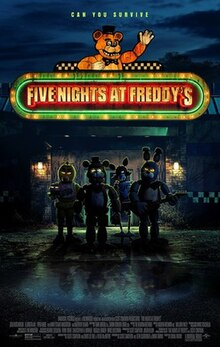
The Five Nights at Freddy's movie was pretty neat. A very robotic review.

So when I reviewed the Five Nights at Freddy's Core Collection bundle, I said I wanted to wait until I watched the movie before reviewing that. Well, I watched it. And I want to talk about it, because as the title of this post implies, it was pretty neat. This post exists primarily as a sequel of sorts to the Core Collection review. As such, I won't cover the lore of the franchise as extensively here as I did there. And Five Nights at Freddy's is a horror franchise that was built on a foundation of deep lore. So if you want more information on the games that this movie is based on, go read that post instead.

Image from wikipedia.org

Here's a very simplified recap of the series for those who need a quick refresher. Five Nights at Freddy's, often called FN@F for short, is a horror game franchise created entirely by one guy named Scott Cawthon. Despite working on budget consisting of shoe strings and paper clips, Scott's quirky little horror series exploded seemingly overnight in terms of popularity, and he become a prominent figure in the world of independent video game developers. Basically, the series revolves around a Chuck E Cheese's style pizzeria that is home to a crew of haunted animatronic performers. A movie based on the games was announced all the way back in 2015 as part of a collaboration between Scott and horror movie studio Blumhouse, but the script went through multiple rewrites before Scott and director Emma Tammi settled on a script they actually liked some time in 2021. The movie would finally release on October 26th of 2023.

Our story follows the life of Mike Schmidt (played by Josh Hutcherson), a down-on-his-luck security guard trying his best to provide for his younger sister Abby (played by Piper Rubio) and solve the mysterious disappearance of his brother Garrett. Following an incident where he violently attacked a man that he mistook for a child predator, Mike is fired from his old job. With his Aunt Jane (played by Mary Stuart Masterson) trying to take custody of Abby away, Mike is desperate to prove he can be a functional member of society and actually hold a job. So he takes the next job that becomes available to him regardless of how sketchy it sounds. Which means he gets a job working the night shift at Freddy Fazbear's Pizzeria, the aforementioned Chuck E Cheese's style restaurant. On top of this, Mike's dreams when he sleeps become increasingly weird. Granted, this is deliberate on Mike's part. He is purposely using lucid dream theory (which is a real thing, by the way) to recreate the past and figure out what happened to Garrett. Though, considering this is a Five Nights at Freddy's story, anyone with even a surface level understanding of the lore can guess what happened to him long before the truth is revealed. But most importantly, the animatronic performers start moving by themselves, without any external assistance.

Oh, and Vanessa is here too. Vanessa (played by Elizabeth Lail) is a mysterious police officer that knows an uncomfortable amount of the Pizzeria's history. I'm not going to sugarcoat it, the main reason Vanessa is here is to explain the lore to newcomers. She tells Mike about the Missing Children Incident, in which at least five kids died inside the Pizzeria while Fazbear Entertainment (the Pizzeria's parent company) covered up said deaths and hid them from the public. She reveals the true nature of the animatronics, which are haunted by the ghosts of the dead kids. She tells him about the Spring Lock suits, which are failed prototypes for robot-costume hybrids that can either be worn like a suit or controlled remotely. She even name drops William Afton, the big bad final boss villain of the whole franchise. Literally every bad thing that happens in FN@F can be traced back to William Afton. Which is why the reveal of what happened to Garrett is not surprising in the slightest for people familiar with the lore.

Image from https://freddy-fazbears-pizza.fandom.com/wiki/Five_Nights_at_Freddy%27s_(Film)/Gallery

But now I want to tell you about the best thing in the whole movie, the animatronics themselves. Every monster here is a real animatronic built and operated by the lovely people from Jim Henson's Creature Shop. While they did use human actors for some scenes that were too complex for normal animatronics, the costuming is so good that I genuinely can't tell the difference. All four of the main monsters look like they stepped right out of the games. Most impressive is Foxy the Pirate Fox. He has by far the most complex design due to his exposed robotic innards, and the Foxy animatronic was so intricate that they needed no less than seven people working together just to make it move around (one for the face, one for the neck, one for each arm, one for each leg, and one to make the whole rig lean forward or backward as needed). Honestly, even if you don't care about the lore or the franchise as a whole, the movie is worth watching just for the animatronics. They are a true spectacle to behold. I do wish they gave the animatronics the pitch-black eyes with the pin-prick white pupils instead of the red eyes they used, since it would look both scarier and more lore accurate, but that is a minor nitpick.

The second best thing about this movie is that it is a real love letter not just to the games, but the fans of said games. There are a lot of references and inside jokes that only make sense to people familiar with the series. And there's some really deep cut references here. Just to give a few examples, there's a scene where Aunt Jane and her gang visit a diner called Sparky's. Sparky was the name of a unused animatronic that was rumored to haunt certain copies of the first game. Scott had to clarify that Sparky wasn't real and that the whole thing was a urban myth that spiraled out of control. Another example, when Mike finds the dead bodies of said gang in the backstage, they've been shoved into costumes based on various monsters from the sequel games and even the spin-off lore novels, such as Shadow Freddy, Eleanora the Doll and Fetch the Dog. But I want to draw attention to two of my favorite references. During the end credits, the movie plays an electropop song simply called The Five Nights at Freddy's Song. This song was a fan-made project made by a band called The Living Tombstone. Evidently, Scott heard the song and loved it so much he decided to make it the official theme song of the whole franchise (with Living Tombstone's permission, of course). And seeing fan-made stuff get a seal of approval from the original creator is always going to be awesome.

The other references I want to talk about extensively happen in that same diner scene described earlier. While coming up with a plan to ruin Mike's life, Aunt Jane is pestered by an overly eager waiter played by Matthew "Mat Pat" Patrick. Mat Pat was the main host of a YouTube channel called Game Theory, which was a web show devoted to solving the biggest mysteries in video game history. Mat Pat has made dozens of videos trying to solve the lore of this series, and has become synonymous with the franchise as a whole. And his character somehow manages to find a way to sneak in the phrase "That's just a Theory!" in casual conversation, a catchphrase that Mat Pat says at least once per video. There's another scene where Abby is riding in a taxi with Golden Freddy, and the taxi driver is played by Cory "CoryxKenshin" Williams, who made humorous play throughs for all the FN@F games. Both Mat Pat and CoryxKenshin are commonly cited as major reasons the franchise got as popular as it did, since these two individuals provided the first game with a lot of Internet publicity. Is the average viewer going to understand who these people are or why they are a big deal? No. Not in the slightest. But again, for people who are involved in the online fan community for this series, these cameos and inside jokes are a pleasant surprise.

Image from imdb.com

The third best thing about the movie is the main villain, William Afton. Spoilers abound for this section. William Afton is played by Matthew Lillard (best known for being the voice of Shaggy from Scooby Do). Afton is first introduced as Steve Raglan, a career consular that not-so-subtly pushes Mike to take the job at the Pizzeria. The reveal that Steve was actually Afton the whole time would have been shocking, had it not been for the fact that Blumhouse spoiled their own twist with the casting. They didn't even bother to pretend that Lillard wasn't playing William Afton. Which means that anyone who knows the lore or paid attention to the casting can guess that the job consular is probably evil. This isn't a bad thing per se, because once William Afton reveals his true nature, he puts on a delightfully hammy performance as a villain. Lillard was clearly having fun being the "bad guy" for once. And honestly, the most quotable parts of the movie come from William Afton. Seriously. Afton yelling things like "SYMMETRY, MY FRIEND!" and "YOU ROTTEN LITTLE BEASTS!" is stuck in my head like an ear worm. And unlike the other characters, William's Spring Trap persona isn't an animatronic. That's a proper costume meant to be worn by a human actor. And apparently, Lillard couldn't see out of the Spring Trap mask, so for all of the scenes where he wore the mask, he was quite literally acting blind. Which I got to imagine must've been an awkward experience, but it was worth it, since William Afton's portrayal here is a major highlight of the movie.

If I had to say anything negative about the movie, I didn't really find the movie that scary. Granted, I'm a long time FN@F fan and I think I've become desensitized to all of Scott's tricks and jump scares. I've mostly stuck around for the lore and monster designs. But a common saying you'll hear about the games is that Five Nights at Freddy's is a "baby's first" horror game. And to put things bluntly, this movie is a "baby's first" horror movie. The violence here is surprisingly tame, especially when compared to other horror movies. The animatronics almost never kill anyone on screen, because the camera conveniently looks away right before the killing blow lands. Or we see only the aftermath of said kills. Don't get me wrong, this movie can be creepy and atmospheric. That's another thing the movie does well. The vibes of the Pizzeria itself are perfect. The issue is that the movie feels like it's holding itself back. Like it has the potential to get super gory and gross but it's really trying not to lose that PG-13 rating so it tones itself down enough to be technically family friendly. Like the goriest thing in the movie is when one of Aunt Jane's gangsters gets the upper half of her body bit off by Freddy, but the bite and remains are framed in shadow to not show any of the grisly details. So the lack of violence leaves me conflicted.  On one hand, I could probably show this movie to my parents and have them not think I'm a masochistic freak for liking something spooky and weird. On the other hand, if you come looking for a thrill, you'll probably not find it here. It's a fairly "safe" movie, all things considered.

I think the biggest divide on your enjoyment of the movie is your view of the table-fort scene. For context, about halfway through the movie, Abby discovers that she can communicate with the ghosts haunting the animatronics through drawings, and being a 10 year old girl, she uses this newfound power to befriend the animatronics and play games with them. This culminates in her roping in Mike and Vanessa into helping the animatronics build a "fortress" out of tables and party supplies. Depending on your perspective, this is either cute and wholesome or cheesy and lame. I'm of the former opinion, myself. Why, you ask? The animatronics are haunted by the ghosts of children. One of the "rules" the ghosts follow is that will not under any circumstances bring deliberate harm to living children. The only reason the animatronics are hostile in the first place is because they hate all adults on principal, and with the only exceptions being the fourth game and the tenth game, every game has you playing as a "grown-up" employee of Fazbear Entertainment. And even then, there's a lore explanation why the Nightmares from FN@F 4 and the Glam Rocks from FN@F: Security Breach are suddenly attacking a child. The former are the physical manifestation of a coma victim's dying dreams (and thus aren't "real"), the latter are being hacked and controlled by a virus. So the ghost kids using their new mechanical bodies to act like kids is lore accurate.

Image from https://freddy-fazbears-pizza.fandom.com/wiki/Five_Nights_at_Freddy%27s_(Film)/Gallery

So let's answer the biggest question. Is this a good jumping on point for people who are new to Five Nights at Freddy's? Not really, no. This movie carries itself with a "by the fans, for the fans" mentality. It's goal isn't to convince newcomers to invest themselves in the rest of the series, but more so to give long time fans (like me) the cinematic experience they've been waiting literal years for. It does attempt to be newcomer friendly, with things like Vanessa explaining the lore and trying to have a somewhat straightforward narrative compared to the deliberately vague "figure it out yourself!" plot of the games. But there's that signature brand of Scott Cawthon weirdness, like how the drawings work or how the ghost kids can interact/harm Mike directly in his dreams Freddy Krueger style. And indeed, looking at other people's reviews of the FN@F movie, people who are already fans tend to rate the movie more highly than people jumping in for the first time. So I'll give two different ratings, just this once. It's an easy four stars out of five for people who already like Five Nights at Freddy's, but is probably closer to a 3 stars out of five for people who aren't already fans of it. There's enough effort and production quality to prevent the movie from going any lower than that. But again, already being a fan of the series does improve the enjoyment factor.

Five Nights at Freddy's is the property of Scott Cawthon, Steel Wool Studios, Blumhouse and Universal Pictures. None of the images shown here belong to me. Please support the official release.