Spencer's Day

Total Pageviews

Showing posts with label strategy game. Show all posts

Sunday, June 1, 2025

Darkest Dungeon, a harrowing challenge that will leave you humbled. A very stressful review

I am no stranger to challenging games with moody, gothic atmospheres. From Dark Souls to Elden Ring, I've played my fair share of "spooky hard games." But there's one game that has completely captivated me. Red Hook's Darkest Dungeon, a cult classic strategy game with a reputation for being fiendishly difficult, and also for being heavily inspired by the writings of the classical horror author H.P. Lovecraft. While it is NOT a Souls Like, this is still a Gothic Horror game about medieval fantasy adventurers fighting nightmarish monstrosities. So it's something that's still within my wheelhouse, as I am the Guy Who Likes Spooky Hard Games. Before we continue, here's a quick content warning. Darkest Dungeon is rated T for Teen by the ESRB and is (at least ostensibly) meant for ages 13 years and older. Despite this, I still feel the need to put a content warning because this game can be... a lot. Expect to see violence, body horror, psychological horror, offscreen self-harm, offscreen debauchery and mild profanity.

Official box art of Darkest Dungeon. Image found on Wikipedia.org

So what exactly is Darkest Dungeon? It's a side-scrolling strategy roleplaying game developed and published by Red Hook Studios, released on January 16, 2016. It gained a following online due to its striking art style, impressive voice acting and fiendish difficulty. It would later get three DLC packs titled Crimson Court, Color of Madness and The Butcher's Circus. The former two being major expansions that add in new areas, classes and bosses while the latter is a Player Vs Player minigame. Not only that, but Red Hook also made a full blown sequel to this game, simply titled Darkest Dungeon II. Taking place in a Victorian Gothic setting, Darkest Dungeon tells you everything you need to know about the story with what is perhaps the most captivating intro to any video game ever. The art and voice acting in the intro is so good that I almost never skip it, and it sets the bleak, oppressive vibe that the game goes for perfectly. To put it simply, this intro makes one heck of a first impression.

In Darkest Dungeon, you play as an unnamed, 19th century noble who had received a letter from a mysterious relative only known as the Ancestor. This unnamed noble is meant to be a self-insert for the player, and as such this character remains unseen for most of the game. I am going to refer to this unseen character as the Heir for the sake of consistency. The Ancestor is already dead by the time the letter reaches the Heir, as he discovered *something* so horrible and terrifying that he took his own life in an attempt to escape whatever it was that he found. The letter he sent gave the Heir legal ownership over the Ancestor's estate, which includes a mansion, a nearby hamlet and the titular Darkest Dungeon. Unfortunately, most of the estate is overrun with monsters, cultists, bandits and many more threats to the Heir's safety. Because the Heir is a member of the aristocracy, their life is too important to set foot on the estate in its current condition. So the Heir hires adventurous mercenaries called the Heroes to clear out the estate in their stead. That's the basic premise, and the story doesn't really get more complicated than that. Most of the lore you learn outside of this intro is about the Ancestor's life before he died. Also, the Ancestor's ghost narrates over the entire game, describing both the story and the in-game battles with flowery prose befitting a Lovecraft protagonist.

The Ancestor, who narrates over the entire game, writes a letter to his family begging them to come home and retake the titular Darkest Dungeon. Image found on MobyGames.com

Darkest Dungeon officially starts with a brief tutorial in which you are ambushed by bandits. Fear not, for the Heir always starts with two Heroes on their payroll already; A Crusader named Reynauld and a Highwayman named Dismas (these Heroes are the only ones with canon names, the other Heroes are given randomized names upon recruitment). These two are your starter Heroes, and they exist mostly to teach you the basics of battle. Combat is turn-based with the turn order being decided by a number called the Speed stat, in which the character with the highest number goes first. Each Hero on your team has four different abilities they can choose to use on their turn. What these abilities are depends on the Hero's class, of which there are 18 (15 in the base game and 3 more in DLC expansions). Some Heroes focus on supporting allies with healing and buffs, others focus on killing enemies quickly with big burst attacks, and others still focus on tanking and defenses. You can have up to four Heroes in the same team, with any class combination you want (including multiple Heroes with the same class). 

Additionally, the Heroes follow a strict marching order, and their place within the marching order changes their abilities. These positions are your backline (far left), your frontline (far right) and two middle positions. Some Heroes want to be certain places more than others. For example, the Arbalest and the Plague Doctor both want to be in the backline, as they are long range fighters who use projectiles and support abilities to keep their teammates alive. The Leper and the Hellion meanwhile want to be in the frontline as they are both melee powerhouses who focus on tearing through enemies with close range attacks. Some classes, like the Grave Robber and the Jester, can even change their position mid battle when using certain abilities. And other classes like the Occultist and the Man-at-Arms don't really care where in the marching order they are, as they have abilities that can be used in any position. 

The last main combat mechanic is Torchlight, which is meant to be a high risk, high reward system. Basically, the lighting during an expedition will gradually get darker as you progress, but you can use torches to restore it. Monsters grow more powerful in darkness, but the odds of finding more valuable items and treasure are increased when the Torch Light gets low enough. If you're feeling very brave (or you're desperate for more money) it could be worth letting Torchlight run out on purpose for the extra rewards. But keeping Torchlight high is safer for your Heroes.

Speaking of safety, I should warn you now that Darkest Dungeon is deliberately designed to be a challenging experience, to the point where it provides a warning saying as much every time you boot it up. Why is this game so difficult, you ask? Because of four main mechanics. First and most obvious is permadeath. When a Hero dies for any reason, that specific Hero is dead for the rest of the game, and anything they were carrying at the time of death is lost forever as well. Secondly, Heroes have two health bars, one for their physical wellbeing and one for their mental health. If their physical health reaches zero, that Hero is put on Death's Door. Despite the name, this event doesn't kill the Hero, but if they get hit while on Death's Door there is a 1-in-3 chance that they will die for real. However, literally any healing spell will remove the "Death's Door" condition. As long as your Heroes are NOT on Death's Door, they will never die from physical injuries.

The Plague Doctor, one of the game's many playable Heroes, suffers a mental breakdown and becomes Fearful. Image found on TrueAchievements.com

But this leads to the third major mechanic of the game, Stress. Stress represents your Heroes' declining mental health, and it will rise the longer a battle progresses. If the Stress meter fills all the way up, the Hero will reach their breaking point and they will gain a random, but usually negative, ailment called an Affliction. These can take the form of extreme fearfulness, paranoia and hopelessness, among others. While Afflicted, the Hero in question will occasionally do things that are detrimental to the team, such as skipping turns or even attacking teammates. If the Stress meter fills all the way up a second time, the Afflicted Hero will have a heart attack that puts them on Death's Door immediately. If they were already on Death's Door at the time this happens, then the heart attack straight up kills the Hero. There is a small chance that a Hero will gain a positive status effect called a Virtue, which instantly heals Stress and provides a power boost for the whole team, but Virtues are rare and should not be relied on. If they happen, great! But don't count on them for victory. Also, Stress is persistent across multiple expeditions and can only be treated by giving that Hero a break. These three mechanics work together in tandem to ensure that battles against even basic enemies can quickly devolve into a life or death struggle if you aren't careful. 

So how do you deal with the horrors of the estate? The answer is by upgrading the hamlet. The hamlet is your base of operations, and from here you can replace casualties recruit new Heroes and outfit them with new armor and weapons. You can also give a Hero the week off and let them visit either the Tavern or the Church. Both of these facilities will heal Stress, but most Heroes will develop a preference for one or the other. You can also send the Heroes to the Sanitorium to cure them of any diseases they may have contracted (diseases, while nonlethal, will still weaken a Hero in addition to other status conditions). You can use a collectible currency called Heirlooms to upgrade the hamlet (thus making each facility more effective), and you can get more Heirlooms by exploring the estate. Upgrading the Heroes themselves does not cost Heirlooms, but instead costs Gold, which is also found within the estate. Keep in mind that a Hero will be unavailable for deployment until the next expedition is complete if they are spending the week at the Sanitorium, Tavern or Church, as these facilities' effects are not instant. In fact, my biggest criticism of Darkest Dungeon is that your Heroes are often forced into long periods of downtime even when they are successful. Like, let's say that a Hero becomes Afflicted and gets infected with a disease. You can only heal one ailment at a time, meaning that if you want that Hero to be back at full strength, you need to wait at least 2 in-game weeks for that to happen. The wait gets even longer if the Hero contracts multiple diseases at once.

An overview of the hamlet, which serves as your base of operations. Image found on MobyGames.com

And speaking of taking the week off, the game measures time in weeks, with one expedition to the estate taking up one in-game week. This translates to about 30 minutes to an hour of real life playtime. On the game's hardest difficulty setting, officially called Stygian mode, you will have a time limit forcing you beat the entire game within 86 weeks or sooner.  Stygian mode also puts a 30% multiplier on the health and damage output of all enemies. So maybe don't try this mode if it's your first time playing, as it is especially sadistic. The last major mechanic concerning the hamlet is that there are random events that can occur. These events are always positive, and include things like discounts at the various facilities, all Heroes belonging to a specific class getting a free level up, or even bringing one dead Hero back to life. This random event is the ONLY way to revive dead Heroes, by the way.

The estate is divided into five main areas, each themed around a different archetypal monster; the Ruins (undead), the Warrens (beast men), the Weald (witches/fungi), the Cove (sea monsters) and finally, the Darkest Dungeon (Lovecraftian horrors). The Crimson Court and Color of Madness expansions add two new areas, also themed around archetypal monsters. The former adds the Courtyard (vampires) and the latter adds the Farmstead (aliens/crystals). All areas have human enemies, which take the form of either bandits or cultists. Once you pick an area to explore, the layout in those areas are randomized. The layout might be a linear hallway during one trip, or a sprawling maze during the next trip. Additionally, each expedition has a quest objective. These quests can range from defeating all enemies, to collecting three specific items, to killing a boss. Normally, your Heroes cannot leave until their current quest is complete. However, you can choose to abandon the quest, which will allow all currently living Heroes to return safely, but you will get reduced rewards for doing so. Keep in mind that if all four Heroes sent on an expedition are killed, you lose access to EVERYTHING that they found. As cowardly as it sounds, it is always better to abandon a quest before you lose too many Heroes, as it is better to come back with some rewards than it is come back with nothing at all.

While exploring any given area, your team may stumble across objects called Curios. These can range from treasure chests, to bookshelves, to confession booths, among many others. Interacting with Curios will produce a random effect, which can be either positive or negative in nature. However, you can use certain supply items on specific kinds of Curios to force a positive effect to occur. For example, you can use a skeleton key on treasure chests to get even more treasure from them than normal. You can use holy water on confession booths to heal Stress. You can clear out a blocked passage using shovels. And there are many more possibilities. The only restriction you have to worry about is limited inventory space. Your Heroes can only carry an absolute maximum of 16 different items, with items of the same type sharing an inventory slot. For example, a single slot can hold either 12 rations, 6 bandages or 4 shovels, but not all of those at once. All supply items are one time use, and if you have any unused supplies once the expedition is complete you will get a refund for your troubles. To quote the Ancestor regarding treasure and supplies; "The cost of preparedness, measured now in gold, but later in blood."

On the subject of Heroes, let's talk about them in more detail. As previously mentioned, the Heroes are divided into classes, with each class having a unique role on any given team. While you can make most team compositions work, some classes work better with others. For example, The Highwayman and Grave Robber are mid-range damage-dealers whose weapons can deal extra damage against enemies with the Marked condition. Neither the Highwayman nor the Grave Robber have any way of Marking a target by themselves. So if you want to get the most out of these classes, pair them up with Heroes who can Mark targets like the Hound Master, the Bounty Hunter or the Occultist. In fact, you can build an entire team of Heroes around Marking enemies so that their teammates can obliterate them. The same practice can be applied with other status conditions, like Bleeding and Blight. Or you can forsake all these fancy status conditions altogether and run a party of three melee powerhouses who overwhelm their foes with sheer strength, and give them a single healer to keep them alive. And if you are in desperate need of Gold, the otherwise unimpressive Antiquarian can multiply the amount of treasure found on an expedition, as long as the other three Heroes do everything they can to protect her. The possibilities are endless. 

You can also customize your Heroes with collectible items called Trinkets that provide a passive boost to certain abilities. Like a scroll that increases the amount of health healing spells restore by 30%, or a bandana that raises the damage of all long-range attacks by 25%. All bosses (excluding the final boss) drop extra strong Trinkets with powerful effects, and most bosses are worth killing just for their Trinkets. The last thing about Heroes you need to worry about is camping. On longer expeditions, the party will be given a log of firewood. Use this item in an empty room and your Heroes will camp for the night. Outside of certain Curio events, camping is the only reliable way of healing Stress mid-expedition. All classes also have special camp abilities, which allows them to either heal Stress even further or give the party some kind of buff. But of course, this game won't let you camp without danger, as every time you set up camp there is a 1-in-3 chance that you'll get ambushed. And said ambushes always start in complete darkness, meaning the enemies will always be at max strength should this happen. Some Heroes, such as the Crusader, Occultist and Vestal, have camping abilities that outright prevent ambushes from occurring. For the sake of your own sanity, make sure at least one of your Heroes has an anti-ambush camping ability. 

A promotional comic depicting the Leper leaving his kingdom for the greater good. Image found on darkestdungeon.fandom.com and darkestdungeon.com

One fun bit of trivia I want to mention about the Heroes is their backstory comics. These comics are not accessible within the game itself, but were made as promotional material. These comics show more of the Heroes' lives prior to the start of the game, and all of them are meant to paint the Heroes in a tragic, or at least sympathetic light. Just to give a few examples, the Crusader was once a farmer with a wife and son who was drafted into a holy war, but he's been fighting for so long he gave up hope on returning home. The Arbalest was forced to run away from home as a child due to an angry mob burning her village down, with the only relic of her childhood being her father's crossbow. The Hound Master was once a police officer with a strong sense of justice, who left the police force in disgust when he found out his commanding officers were part of a cult. My favorite comic goes to the Leper, who was once a fair and just king that was beloved by his subjects. But one day, the Leper contracted leprosy (obviously), and he left his kingdom willingly to spare his people from a potential plague. And keep in mind, the comics manage to communicate these ideas and themes without a single word of dialogue, instead choosing to let the art tell the story by itself. Even if you have no desire to play Darkest Dungeon yourself, I can highly recommend looking at the comics. They are only one page long each and have some hauntingly beautiful artwork.

One last thing about the Heroes before we continue. Each Hero is given a random set of minor strengths and weaknesses called traits. Traits provide either an improvement or a penalty, like 10% extra damage against undead but having -1 Speed. Some traits make it so a Hero can only heal Stress with specific methods, like the Tippler trait, which makes the Hero become an alcoholic who can only heal Stress by drinking at the Tavern. A Hero can have a maximum of five "positive" traits and five "negative" traits, and once that limit is reached, the old traits will swap out for new traits at random intervals. If there's a positive trait you really like and want it to stay on a Hero, you can send them to the Sanitarium to lock that trait in, making it permanent. Likewise, if there's a negative trait that you feel is more trouble than it's worth, you can use the Sanitarium to instantly remove it. While most of the traits are minor enough to not make that big a difference, there is one negative trait that's hugely detrimental and should be removed immediately; Kleptomania. It's exactly what it sounds like, a random chance for that Hero to steal treasure and supplies from the rest of the team. The problem is that there is (to my knowledge) no way to get those items back, as they are pretty much gone forever. For obvious reasons, you don't want a Hero who will steal from their own comrades. Funnily enough, Reynauld, the Crusader given to you during the tutorial, always starts with Kleptomania as his first negative trait. Every playthrough of Darkest Dungeon will involve you sending Reynauld straight to the Sanitorium to cure his Kleptomania as soon as you are able to. This is not negotiable. It's a canon event.

A group of Heroes start a battle against the Swine King, one of the game's bosses. Image found on MobyGames.com

But now it's time to talk about the bosses, which are a major highlight for me. Not only because their designs are creatively monstrous, but they have some neat mechanics that make them more interesting that the regular enemies. Each of the four main parts of the estate have two bosses that need to be defeated three times each (with each rematch being more difficult than the previous battle).The Ruins get the Necromancer and the Prophet, the Warrens get the Swine King and the Formless Flesh, the Weald gets the Hag and the Brigand Pounder, and the Cove gets the Siren and Drowned Crewmen. There are other bosses in the game, but these are the main ones you need to worry about. Anyway, every time you start an expedition to fight a boss, you will get a confession from the Ancestor's ghost where he explains his relationship with the boss in question. Fight these bosses enough times and the Ancestor will reveal more information, both about the boss and about himself. And the more you learn about the Ancestor, the more you learn that he was kind of an awful person in life. Every boss encountered is either one of his failed experiments, a co-conspirator he betrayed or an unfortunate victim who was simply in the wrong place at the wrong time. 

I have more to say about the Ancestor himself, but let's get back to the bosses. All of them have a gimmick that allows the boss to mess with the Heroes' positioning or even the turn order itself. Just to list a few examples of my favorite bosses, the Prophet can "predict" an attack that will hit a random Hero three turns in advance, and if that Hero doesn't switch to a safer spot in the marching order they'll get crushed by a boulder. The Formless Flesh is actually four different creatures fused together, and thus it gets four separate turns for each of its parts. But because these parts share a health bar, damage over time effects like Bleeding and Blight are four times as effective, as these effects activate once per each part's turn (thus dealing damage four times total). The Hag can grab a random Hero and put them in her stew, preventing them from doing anything until the other three Heroes free them by smashing the Hag's cooking pot. My favorite boss is the Brigand Pounder, as it's literally just a really big cannon being escorted by regular human bandits. The cannon can't do anything by itself, but if a Brigand Matchstick Man gets a chance to light the cannon's fuse, all four Heroes get hit with enough damage to instantly put the ENTIRE TEAM on Death's Door. The idea being that you have to kill the Matchstick Man before that can happen, and once he is dead you can focus on whittling down the cannon itself. 

Now let's talk about the Ancestor himself, because he is part of the reason I like this game as much as I do. I know I just called the Ancestor an awful person. But make no mistake, the Ancestor is my favorite character in this whole game, besides the Heroes themselves. Having such a villainous character narrate both the story and the gameplay is such an interesting artistic decision to me. His ghost speaks with a mixture of flowery prose and thinly veiled bitterness. He can go from mourning the decline of the estate and regretting how he handled his original expedition, to proudly boasting about the many ways in which he ruined the lives of the bosses, and somehow both of these views feel in character for him. You could make the argument that he is trying to atone for his sins by helping the Heir retake the estate. But honestly? I don't get the vibe that he even wants redemption. He sounds more annoyed that he died before his plans came to fruition than anything else.

And of course, I have to mention the incredible voice acting of the late Wayne June, who voiced the Ancestor. June brought his absolute A-Game when it came to delivering such verbose narration, and the game is all the better for it. And the Ancestor's callouts during the expeditions are iconic, with memorable lines like "These nightmarish creatures can be felled, they can be beaten!" and "A moment of clarity in the eye of the storm!" My favorite line the Ancestor says is "Monstrous size has no intrinsic merit, lest inordinate exsanguination be considered a virtue!" Because that is the fanciest and most pretentious way of saying "the bigger they are, the harder they fall." And how could I forget THE most famous quote from this game? "Remind yourself that overconfidence is a slow and insidious killer." This quote is is unironically the best piece of advice anyone could give while playing this game. Never assume your Heroes are invincible, as all it takes for an expedition to fail is for you to push your luck too far. Always be prepared for any scenario, including the possibility of your favorite Heroes dying. Heck, you could make the argument that the Ancestor was guilty of overconfidence himself, as the entire reason he did everything he did was because he believed he was above facing consequences for his actions.

The Bounty Hunter smashes his axe into an enemy, destroying it. Image found on TrueAchievements.com

Okay, now that we have discussed most of the game, let's talk about the Darkest Dungeon itself, as it is the location that the game is named after and works under some different rules from other areas. Firstly, it is the only location with non-randomized layouts. This means you could look up a map online and use that information to beeline for the quest objective. Secondly, there are no Curios whatsoever in the Darkest Dungeon. It's meant to be a marathon of extra tough battles with few chances to rest. Thirdly, any Hero who goes to the Darkest Dungeon and survives will never return for a second trip, with the idea being that the Darkest Dungeon was so horrific and traumatizing that it gave that specific Hero permanent PTSD. The only exception to this rule is if you are playing on Radiant mode, the game's version of easy mode. Radiant mode removes this PTSD restriction, though "traumatized" Heroes will start the expedition with the Stress meter at 80% full the moment they return, so you're still discouraged from using the same Heroes again. These traumatized Heroes can still go on expeditions to everywhere else in the estate, and they even give weaker Heroes an experience boost, causing them to level up faster. So they can still contribute to the campaign, even if they won't get a chance to fight the final boss. I would say that the final boss being in the Darkest Dungeon is a spoiler, but come on. Where else would the final boss of a game called Darkest Dungeon be if not in the place literally called the Darkest Dungeon?

Speaking of the final boss, the final battle is really cool narratively, even if it is not as difficult as the other bosses. Full spoiler warning ahead. The final boss is none other than the ghost of the Ancestor himself. Here at the final floor of the Darkest Dungeon, the Ancestor reveals what exactly was the great and terrible *thing* he found that drove him to take his own life; The Heart of Darkness. This ancient being possesses all knowledge of the cosmos, including truths that mankind was never meant to learn. It also feeds on human suffering, and if it eats enough suffering, it can grow strong enough to cause the end of the world. So the Ancestor made a deal with it. The deal was that the Ancestor would be revived as an immortal spirit with access to as much knowledge as he wants, and in exchange, the Ancestor would cause human suffering on an unprecedented scale, thus speeding up the Heart's gestation. The Ancestor knew his relatives would spare no expense in reclaiming the estate. He also knew that plenty of Heroes would "suffer" in the process. But the Heroes were never meant to push as far into the Darkest Dungeon as they did, and as such, the Heart of Darkness is forced to wake up early, which is why the Ancestor is fighting you now. 

The battle against the Ancestor/Heart of Darkness is not a hard fight, but it is a long one. It has four phases and plenty of attacks that can inflict all the major status conditions, but it doesn't have anything you haven't seen before by this point. That is, until you reach the final phase. Once the Heart is down to its fourth and final health bar, it can use its signature move: Come Unto Thy Maker. This "fun" little ability is a guaranteed one-hit kill move. This attack ignores Death's Door and is always 100% accurate. Nothing will save you from Come Unto Thy Maker. The good news is that the Heart can only use this technique twice per battle. The bad news is that the Heart forces the player to choose who gets hit with it. This attack is devastating for obvious reasons, and for a long time everyone (including Red Hook themselves) believed it was impossible to defeat the final boss without suffering casualties. The fact that the game forces you, the player, to choose the target of this attack is adding insult to injury. Yet it works from a narrative standpoint. When you start out, you feel compelled to be a good boss to your Heroes, paying for their healthcare and outfitting them with the finest equipment available. But as they start dying and you get used to replacing the deceased, you start to see less value in your Heroes' lives. Soon enough you realize that unless the Hero in question is fully upgraded (or close to it), it's often cheaper to just fire a half-dead, traumatized Hero and hire a replacement than it is to heal them properly. This battle is basically calling you out for (potentially) becoming just as ruthless as the Ancestor was. After all, at this point you are not only desensitized to the death of the Heroes, you are sacrificing them yourself just for a chance to finish the final battle.

But what if I told you it doesn't have to end that way? As it turns out, some people on the Internet figured out not one, but two different ways to circumvent Come Unto Thy Maker, completely skipping over the sacrifice and outsmarting the developers themselves. The first method is the simplest, but arguably the most dangerous. All you have to do is bring ONLY two Heroes to the final boss fight. You see, the Heart of Darkness can only use Come Unto Thy Maker if at least three out of four Heroes survived long enough to reach the final phase. If there's less than three Heroes on the team by the time you reach this phase, the Heart has no reason to use its signature move. The second method is more complicated, but more satisfying; Figure out a way to kill the Heart in a single turn. The Heart can't use Come Unto Thy Maker if it's dead. I don't know the exact details, nor do I have the time to explain, but there are plenty of YouTube videos out there showing that it can be done.

Regardless of how you choose to defeat the Heart of Darkness, its gestation is halted and forced back into dormancy. But as is tradition with Lovecraftian storytelling, the Ancestor claims that the Heart cannot be permanently destroyed by mortal hands, and that the Heart will return one day to destroy the world. The game ends with the Heir writing a letter to their next of kin, just as the Ancestor did. And the Heir takes their own life to escape the Darkest Dungeon, just as the Ancestor did. And the letter calls in another relative who leads another doomed crusade to retake the estate, just as the Heir did. And then when they defeat the Heart again, that relative will write a letter to their next of kin. And that relative will come to reclaim the estate, defeat the Heart, and write a letter to THEIR next of kin. And so on and so forth. This familial bloodline is now locked in a never ending loop of wasting money and lives on trying to retake this cursed estate, while inadvertently saving the world repeatedly. It's a bittersweet ending, one that's more bitter than sweet. It does create the somewhat humorous mental image that the only thing stopping the end of the world from occurring is a single, stupidly stubborn family of aristocrats with more money than sense who refuse to let this estate go.
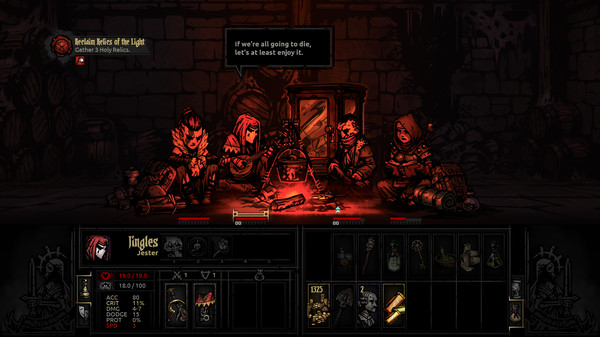
A group of Heroes make camp for the night. Image found on SteamDB.com

In terms of presentation, Darkest Dungeon is stylishly macabre, with a comic book inspired art style with heavy shading and sharp angles on literally everything. The game is so over-the-top in its Gothic Horror aesthetic that it borders on absurdity. I mean, what other video game has a literal leper as a playable character? One detail I love is how all of the Heroes cover their eyes, either with masks, helmets or shadows. Despite having wildly different outfits from a wide range of cultures and time periods, the eye covering is something that is consistent across everyone. The only creatures with visible eyes are the monsters you battle against. I'm sure there's some symbolism there, if you want to read into it. I also like how the vampire enemies added in the Crimson Court are based off of mosquitos instead of bats, thus giving them a more insectoid appearance. It's a rather clever spin on a tried and true monster concept.

The actual animations are a little limited, unfortunately, but there's a certain charm to the Heroes various poses. You see, the only part of the game that is fully animated is walking from room to room. When in battle, the Heroes simply *snap* from an idle pose to a handful of contextual poses based on what is happening at the moment, with no smear frames to make the transition between poses smoother. You'd think this would weaken the visual experience, but in practice it makes the game look and feel even more like a comic book, and I mean this as a compliment. Basically, there is no other video game that looks quite like Darkest Dungeon. The only negative thing I can say about the visuals is that I noticed some mild typos in the captions. Nothing serious, but things like not capitalizing the letter "I" when using it as a first person pronoun, or accidentally putting the plural version of the word when the Ancestor is clearly referring to something singular. It's not a deal breaker by any means, but once you notice the typos, it becomes hard to ignore them.

I've already mentioned the incredible voice talents of Wayne June as the Ancestor, and thus I will not repeat myself. Keep in mind that the Ancestor is the only character in the game who is fully voiced. Everyone else gets comic book speech bubbles containing written dialogue. Anyway, the sound effects are crisp and instantly recognizable. I like how every attack (for both Heroes and monsters) has two different sound effects depending on whether or not the attacker actually hits their target. Like you can hear the weapon whizzing past the target and hitting only empty air, but the if attack strikes true, you can hear the weapon crush through bone and slice through flesh. It's brutal sound design, but it fits the gruesomeness of the game's aesthetics. 

The music meanwhile could best be described as stressful (pun intended again). The battle music (composed by Stuart Chatwood) sounds less like a heroic conflict between good and evil and more like a siren warning of impending doom. The music makes it clear that the Heroes are not welcome in the estate, and its monstrous denizens will show no mercy. And as the Torchlight lowers, the music gets louder, with more instruments and even demonic cackles and growls joining the beat. The only "calm" songs in the soundtrack are the hamlet's theme, simply titled The Hamlet, and the camping music, titled A Brief Respite. Both of these songs are meant to be relaxing and comforting, in their own way. But The Hamlet has a distinctly mournful vibe to it, sounding like something you would hear at a funeral. I don't know what instruments were used to make the soundtrack, as music is something that is not my expertise, but I do know that I would call the soundtrack "good" for what it's trying to do. Would I willingly listen to the combat music while doing chores or something? Not really. But this soundtrack does a good job keeping you immersed in this setting.

Overall, Darkest Dungeon is a brutal game that is most definitely not for everyone. Not to sound like a stereotypical game journalist, but I can see the difficulty being a major turn off for some people. This is not the kind of game you play casually to blow off steam. At the same time, so much care and passion was put into it that I can say with confidence that I greatly enjoyed the 90+ hours I spent with the game. No other game looks, sounds or plays quite like it, and I can respect the artistic vision. The game isn't difficult for the sake of it, there's a point to it. Have you ever heard the phrase, "suffering builds character?" That is the core thesis of Darkest Dungeon, both on a narrative and mechanical level. So I will give Darkest Dungeon 4 stars out of 5. It is really good for what it's trying to do. You just need to be onboard for that kind of experience.

Darkest Dungeon is the property of Red Hook Studios. None of the images used in this review were created by me. Please support the original creators.

Tuesday, September 24, 2024

Frostpunk, survive the apocalypse with the power of steam. A very frosty review

Have you ever wondered what it would take to survive a post-apocalyptic world? Pretty sure anyone who has heard the words "post" and "apocalyptic" in the same sentence had that thought. And one video game in particular asks a much more interesting question. "Can you survive a second Ice Age while still preserving your moral integrity?" That is the question posed by the game we are reviewing today, Frostpunk. A quick content warning before we begin. Frostpunk is rated M for Mature by the ESRB. Because of foul language and the aftermath of violence. And because this game's protagonist can potentially become a tyrannical dictator based on the player's decisions.

Image found on Wikipedia.org

But what exactly is Frostpunk? Developed and published by indie team 11 bit Studios back in 2018, Frostpunk is a city-building survival strategy game where you are in charge of the construction and maintenance of a steampunk city. What's steampunk, you ask? It's a subgenre of science fiction in which you take a civilization from the past (most commonly 19th century England) and give it access to technology far better than whatever they had in real life, with the goal of a steampunk story being to show how technology can change societies either for the better or for the worse. I have a soft spot for steampunk, as it's my personal favorite style of sci fi. Anyway, the aforementioned steampunk city is tasked with surviving the most brutal winter in human history, with the temperature starting at -4 degrees Fahrenheit (-20 degrees Celsius) and only getting worse from there. The game released to a generally positive reception, developing a passionate fan community online. More importantly, 11 bit Studios released a sequel to this game simply titled Frostpunk 2, which is supposed to be much larger in scale than this game. That being said, I'm only reviewing the first game for the simple reason that I have not played Frostpunk 2 yet. 

So imagine. The year is 1886, and things played out mostly the same as they did in real life. America gets colonized only for the colonists to rebel and build a new country from scratch, the Industrial Revolution led to the rabid development of technology, Krakatoa erupted, et cetera. But there's one big difference between real life history and the world of Frostpunk. Instead of global warming, the Frostpunk universe got hit with global cooling. Things cooled down so much that it caused a new Ice Age, which a bunch of scientists named "The Great Frost". The only reason anyone survived the initial blizzards this Great Frost brought forth was because that same bunch of scientists predicted something like this would happen. They created in secret a set of giant heat-producing towers known as the Generators, which provide just enough warmth to create little "safe zones" for the coming winter. As such, the entire population of the British Empire (and presumably the rest of the world) marched up North for months on end to reach these Generators and rebuild society from scratch. Why up North you ask? The in-universe explanation is that the global cooling originated from the South Pole and slowly spread up northward to the rest of the world. So I guess the Generators were placed in the places furthest away from the South Pole in the hope that the Great Frost wouldn't affect those communities as badly, or maybe it was done to give the construction crews more time to finish the project. 

You, the player, are the Captain, the leader of a group of survivors that managed to reach one of these Generators. As such, you decide what gets built and where, what jobs people are allowed to work, and what laws are legalized. Ironically enough, the Captain has more in common with a mayor or a baron than an actual ship captain. The only reason your character is even called a Captain is because they used to command a carrier ship prior to the Great Frost happening, so the title is a holdover from the "good old days." Frostpunk has four main story campaigns (called "Scenarios"), each with a different goal to work towards as well as different starting conditions. Another two were added in a DLC expansion, but thankfully, Frostpunk is actually a solid enough product on its own that it frankly doesn't need DLC to function. So my advice is to only get the DLC if you are absolutely starving for more Frostpunk. But in addition to the main Scenarios, there is also an Endless Mode where you are free to keep playing for as long as you want, or at least until your City gets destroyed. Anyway, the only scenario available right at the start is A New Home.  Surviving past Day 10 of A New Home unlocks the Arks Scenario. Surviving past Day 20 in A New Home unlocks both The Refugees and The Fall of Winterhome. Before I continue describing the Scenarios themselves, let's talk gameplay, because most of what I say is applicable to all playable Scenarios.

In order to accomplish literally anything in this game, you need to assign jobs to your citizens. Each building in your City comes with an associated job, and each building can employ up to 10 citizens at once. They will carry out their jobs automatically during work hours (8:00 to 18:00), but once the work shift has ended, they will go enjoy Free Time. If there are unfinished construction projects during Free Time, the citizens will help out and speed up the process. If not, they go back home to rest up for the night. If the citizen in question is unemployed, he/she will work on construction during both work hours and free time. But a very important thing to remember is that people are not mindless robots. They got needs that must be fulfilled if you want your City to survive. And Frostpunk's gameplay loop is like walking a tightrope. You can fall at any moment unless you maintain a near-perfect balance of all the main resources. 

Image found on en.riotpixels.com

Let me tell you what the average Frostpunk playthrough looks like. You start off with needing to build tents in your City so that your people can sleep comfortably at night, and housing needs wood. So you send some guys to go gather wood from some nearby debris piles. But because this process involves marching through waist-deep snow, some of your workers will get sick from the cold. And sick workers can't work, obviously. So you need to build a medical post to heal your people when they inevitably get frostbite or hypothermia. But people can't work on an empty stomach, so you also need to build a Hunter's Hut so you can hire some hunters to go outside the City and gather food. The only problem with that is that your workers can't eat raw food, it needs to be cooked into something actually edible. So now you need to build a Cookhouse and hire some chefs. And you need roads connecting all of these buildings to the Generator so that your people can actually walk to work without marching through snow, which costs more wood. Only by now, you ran out of salvageable debris, so you need to build a sawmill to chop down some trees. And don't forget, you must find a way to produce enough coal to keep the Generator active at all times, because if the Generator powers down for too long your City will freeze to death. Which means building coal mines, which costs steel, which means you need to build a steelworks to make enough steel to build the coal mines. And steelworks require even more wood. By this point the temperature of the outside world is dropping, so now you have to improve heating and insulation by either upgrading the Generator or replacing all the tents with proper bunkhouses (which costs wood and steel). While everything I just described is going on, you can send Scout Teams to explore the world, and the scouts will come back anything ranging from extra supplies, to more survivors to expand the City's population or Steam Cores. Steam Cores can be used to build the most powerful machines in the game, such as Hothouses that grow edible plants (thus producing twice as much food as a Hunter's Hut), and Automatons, which are giant steam powered robots.

But the most important building that you absolutely must have in your City is the humble Workshop. The Workshop is a place where your smartest citizens get together and do some research. Research projects lead to the invention of new technology that can improve the City in some way. These upgrades can range from making the Generator produce more heat than before, to unlocking newer and better buildings that can produce more resources than their weaker counterparts, or simple passive bonuses that make preexisting structures more efficient. The Workshop is absolutely essential to Frostpunk's gameplay and it is literally impossible to beat any of the Scenarios without building at least one Workshop. My general advice is that unless you're playing the Fall of Winterhome Scenario, your first priority should be building a Workshop at the start of every playthrough. If you are playing Fall of Winterhome, let the Workshop be the second structure you build.

On top of all that, you also have to deal with Hope and Discontent. Think of these two as like health bars for your city. If the City runs out of Hope, your citizens will declare the City a lost cause and will leave, either to die in the frosty wilderness or to (hopefully) join someone else's City. If the City's Discontent gets too high, the people will declare you a tyrant and overthrow you in a violent revolution. Either way, you will lose the game and have to start all over from the beginning. There are ways to raise Hope and lower Dissent, such as building churches and fighting arenas respectively, or promising your people to do a task like collecting enough food to feed the city for a week, or promising to keep the City above a specific temperature for three whole days. Is it stressful keeping track of all this? Yes. But that's like the fun of Frostpunk. It really sells the fantasy of establishing a community that just barely, by the skin of its teeth, manages to survive the impossible. 

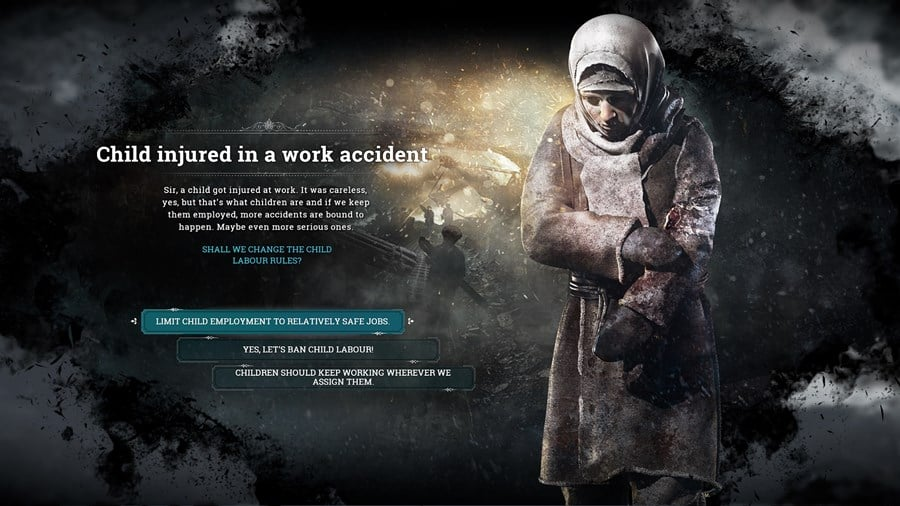
Back on the subject of citizens, the last main thing to know about them is that all citizens are divided into four types; Workers, Engineers, Automatons and Children. Workers are the most common and can work almost any job. The only jobs they that can't work are those that require advanced education, like medical treatment and running the Workshop. Engineers on the other hand, can work in medical posts and Workshops. They can also perform simple labor, but are forbidden from hunting, which Workers can handle just fine. Automatons are giant steam-powered robots that don't need to sleep or eat, can work 24 hours a day without pausing, and are immune to the ever-decreasing cold. They do need to recharge every now and again, but these things are very powerful. Think of Automatons as Workers on steroids. Automatons can work almost any job, and the Workshop can research ways to make Automatons even better. Automatons are also the rarest citizen type in the game. You won't get a lot of these guys, unless you're playing The Arks Scenario. And finally, Children cannot work any jobs at all under normal circumstances, but they still need to be cared for like any other citizen. But notice my choice of words there. They cannot work under "normal" circumstances. And now we get to talk about my favorite thing about Frostpunk, which is how it handles morality.

Image found on trueachievements.com

As the Captain, you have the authority needed to pass laws. You can pick which laws to pass from a branching list, structured like a skill tree from a normal roleplaying game. Not all the laws are particularly nice. In fact, the further down the list of laws you go, the more tyrannical you become. The laws start off sensible enough. Legalizing experimental treatment to save frostbitten citizens is a no brainer. Replacing solid meals with soup because its cheaper to create makes sense when you need make every ration worthwhile. And while it seems harsh at first, extending the work shift from 10 hours a day to 14 hours a day is essential to producing enough resources to finish major construction projects. But as the winter worsens and the needs of your people become more demanding, you will be pushed to pass laws that are dubious at best, and straight up evil at worst. For example, if you are really desperate for more Workers, you can legalize Child Labor, which turns all Children in the City into Workers. Running low on food? You can legalize cannibalism and start turning the deceased into rations. You don't have to pass the unethical laws if you don't want to, in fact there's a secret golden ending that's acquired if you beat any of the main scenarios while practicing only "humane" laws. It's just a lot harder to do a "good guy run" because the evil laws offer some kind of practical benefit at the cost of one's own moral integrity.

And this leads into the biggest aspect of the law system; The Purposes. Without spoiling the story too much, eventually you will have to pick a Purpose for your City, which is some kind of ideology to really bring people together and form a longer-lasting community. Your options are either Order, which rules with militaristic strength and discipline, or Faith, which rules with spirituality and religious devotion. Both of these options unlock a set of unique laws and buildings to match their respective themes. Both of these start off fairly benign. And both of them get really scary when you push them too far. Order seems like the obvious bad guy option at first, since the Order-only laws and Order-only buildings are eerily reminiscent of Big Brother from 1984. I'm talking things like Propaganda Centers and armed guardsmen publicly beating disobedient citizens to the brink of death just to keep the rest of the City in line. But Faith is arguably just as amoral. In fact, for everything Order does, Faith has something that accomplishes the same effect, just with a vaguely religious coat of paint over it. Instead of propaganda, Faith has sermons. Instead of public beatings Faith has "mandatory penance" (which still involves dissenters getting publicly beaten). Order and Faith are ultimately two sides of the same coin.

But the thing you need to remember is that neither Order nor Faith start off evil right away. They always start benevolent, Like Order starts with just a neighborhood watch to keep people safe, watchtowers that lower discontent for anyone living near them and the ability to hire foremen to oversee a building's production (thus making any jobs in that building produce more resources). Faith starts with churches that give Hope to anyone living nearby, field kitchens that raise the temperature of any adjacent building while also providing rations for the area, and houses of healing which work as a decent alternative to traditional infirmaries. Order and Faith only become evil when pushed too far. In fact, the final Purpose law, called New Order or New Faith, is by far the most extreme law in the game and is the only law that will actively cause the deaths of a few citizens. If you legalize New Order, the Captain crowns themselves Supreme Leader of the City and establishes a totalitarian regime, and anyone who opposes the regime (between 12 and 30, depending on the City's total population) will be executed. If you legalize New Faith, the Captain declares themselves to be the second coming of the Messiah and converts the City into a cult with a zero-tolerance policy on any faith that is not the state religion. And just like with New Order, anyone who opposes the cult (again, 12-30 people) will be executed. But hey! At least Hope will be permanently maxed out for the rest of the game! …And it will also be renamed to "Obedience" (for Order) or "Devotion" (for Faith). Because at that point, the people have given up hope for a free society, but are now either too loyal or too scared to leave the City.

But why would you go so far with these Purposes? Because as the situation grows more dire, those "evil" laws might be the one thing allowing you to repair the damage done to your City. Remember, the ultimate goal of Frostpunk is to make sure the City survives the Winter. As long as you have just enough citizens to keep the City operational, you can and will push your people to their absolute limits. Mild spoilers for the A New Home Scenario, but halfway through the story you learn that the closest neighboring City, Winterhome, has been destroyed. This causes an existential crisis in your citizens, since the plan prior to this point was to contact the other Cities and establish trade routes and supply lines so that the Generator communities could survive long term. Because of this, a  group of rebels will start making plans to leave for London. You have 14 days to convince them to stay. And every day that passes, if you don't raise Hope high enough or get Dissent low enough, the rebels will convince another citizen to leave. But those harsher Purpose laws that allow your guards/witch hunters to beat criminals in public or spy on them in their own homes? Those laws let you get the rebels under control. If the rebels get really out of hand, these evil laws might be the ONLY way to get the rebels under control.

Okay, that should cover the "universal" parts of Frostpunk. Let's talk about specific Scenarios.

Image found on trueachievements.com

A New Home. The main Scenario, serving both as a tutorial for the game as a whole and setting the standard for which all other Scenarios are to be judged by. You start in a spacious crater with plenty of building room, 80 citizens and enough supplies to get your first set of buildings established. The win condition here is to simply survive for more than 48 days. Once you make it past day 48, your City is deemed stable enough to not only survive the whole winter, but even beyond it. The final week of this Scenario is positively brutal, as a violent blizzard tears through your City. This Storm will disable Hunter's Huts and Hothouses, meaning that the only source of food your City will have will be whatever rations you stockpiled ahead of time. Additionally, the Storm will force the temperature to start dropping rapidly. Nothing short of a fully upgraded Generator can produce enough heat to survive this. The Storm is the closest thing Frostpunk gets to a boss battle, though you cannot defeat the Storm in any meaningful way. All you can do is prepare, stock up on rations and coal, and pray that your City survives long enough to make it to Day 48. This is also the Scenario with the Londoner rebels, and how you deal with that will also effect the ending.

The Arks. In this Scenario you start in a narrow ravine with significantly less building room and only 45 citizens. All of these citizens are Engineers however, and to make up for their lack of numbers, they also start with an Automaton. The goal of this Scenario is to protect the Seedling Arks, special greenhouses preserving the seeds of every plant in the world. The plan here was to breed some plant life that could survive in a post-Great Frost world. Unlike the other Scenarios, this one has a secret alternative win condition. A neighboring City called New Manchester is falling apart and needs a bulk order of supplies from your City to survive. You can choose to either ignore New Manchester and focusing only on your own City, abandon the Arks to save New Manchester, or try and save both New Manchester and the Arks at the same time. The biggest challenge this mode presents is the fact that your City's population never increases, so the only way to get more workers is to build Automatons. In fact, this game mode can best be described as "Oops! All Automatons!" But this mode is uniquely challenging in its own right. Because depending on how quickly you find New Manchester, you might not have enough time to send them any supplies at all. When I found them there were only three days left before the Storm came. And even if you do find them in time, you still need to have a good enough industry to fund basically two whole Cities at the same time.

The Refugees. In this game mode, you start with only 43 citizens in a star-shaped canyon, making construction somewhat awkward. But true to its name, in this Scenario dozens of refugees will flock to your City in groups of 15, rapidly expanding your population up to 270. The win condition here changes throughout the Scenario. At first, it's to make sure that at least 250 of those 270 refugees survive for a whole week. When that week is over and you succeed, the game keeps going. Then a second wave of refugees comes to your City in groups of 100 people each. Now that doesn't sound too bad at first. There's just one problem. The second wave of refugees are all rich, upper class nobility while the first wave were all peasants and farmers. Also, the working class straight up stole this Generator site, because this specific Generator was meant for only the upper class elites of the British Empire. So there's a lot of bad blood between the two groups and its up to you to decide what to do with the second wave of refugees. Personally, I found this Scenario to be the easiest of the main four. The weather is at its absolute calmest here with not a single Storm in sight, and the only real challenge is making sure you have enough food and housing for all the refugees. And while I like the story here, a classic struggle between the ruling elite and the working class, the ending is oddly anticlimactic. 

The Fall of Winterhome. This Scenario is by far the most challenging and the most complex out of the main four. Winterhome, canonically, was destroyed before A New Home even began. And in this game mode, you start with a fully constructed City in a crater not unlike the A New Home City, with a population of over 600 citizens. But there's just one problem. The previous Captain of Winterhome was a moronic tyrant whose incompetence nearly destroyed the City before the Scenario even began. You want to know how bad the previous Captain was? He built the City with the most awful layout imaginable, with lots of wasted space and redundant roads. He legalized Child Labor for all jobs despite having a large enough adult population to fill out every job opening available. His tyranny and incompetence got so bad that the people of Winterhome overthrew him, but in a final act of spitefulness, the previous Captain torched over half the City, rendering most of the buildings unusable.

Image found on trueachievements.com

In Fall of Winterhome. you play as the replacement Captain, who was chosen to lead by the rebels who overthrew your predecessor. And Fall of Winterhome gives you quite possibly the worst start imaginable. Over half the buildings and roads need to be torn down and replaced, over a third of your 600+ citizens are gravely ill and need medical care immediately, and you have no choice but to enforce some of the laws that the previous Captain passed because there's no way to repeal a law once it is in effect. Which means you get Child Labor whether you want it or not. The win condition is to stabilize the City by removing at least 30 ruined buildings, raising Hope to 50% or better, and lowering Discontent to 25% or less. You have one week to accomplish these three tasks. Once you do, the win condition changes once again. As it turns out, the Winterhome Generator is malfunctioning and your Engineers have no way to repair it. It could have been fixed if the problem was handled earlier, but the previous Captain deliberately ignored the problem until it was too severe to solve. In other words, the previous Captain was so incompetent that he turned Winterhome into a ticking time bomb. So now you have to construct the Dreadnought, a giant armored tank which is effectively a City on wheels, and use it to evacuate Winterhome. This process involves producing a metric boat load of steel, coal and rations. And there's also one last issue to worry about. The Dreadnought, once fully constructed, only has room onboard for exactly 500 people. You have more than 600. While the other Scenarios can, hypothetically speaking, be completed without suffering a single casualty, Fall of Winterhome is the only Scenario where people will die no matter what. Even if you stabilize Winterhome, cure the gravely ill of their sicknesses and construct the Dreadnought in time for the evacuation, at least 100 of your citizens will be left behind so the rest can live.

On the Edge. This is one of the two DLC Scenarios, and serves as a direct sequel to A New Home. In this game mode, you don't have a Generator at all. Instead, you control an outpost being funded by the City from A New Home, with your heat coming from a set of Steam Hubs. And because your heat comes from another City entirely, you are the mercy of their Captain's laws. As such, you have to donate a portion of your supplies every day to keep your outpost running. You can also form political alliances with other outposts, which is the only way to get resources that your outpost doesn't have access to. And because your outpost can only produce steel and steam cores, that means making trade deals with a lot of people if you want to survive here. Also, you have the least amount of building room out of all the Scenarios. True to its name, you are building on the edge of a literal cliff. What makes this DLC amusing in hindsight is that it seems to be a proof-of-concept for Frostpunk 2. Both On the Edge and Frostpunk 2 take place multiple years after A New Home, both On the Edge and Frostpunk 2 focus heavily on political alliances, and both On the Edge and Frostpunk 2 feature the establishment of outpost colonies that donate a portion of their own resources to fund the construction of the main City.

The Last Autumn. This DLC is a prequel Scenario to all the others. Taking place before the Great Frost arrives in the Northern Hemisphere, you are tasked with building one of the Generators that became vital to the success of the other Cities. This Scenario radically overhauls the Purpose laws. Instead of Order vs Faith, it's now Engineers vs Workers. Because this is still the 18th-19th century, worker's rights aren't really a thing. So the Generator project is a massive OSHA violation, and you need to choose between legalizing worker rights to make the project safer, or giving more power to the Engineers so the project can be finished in time. And just like with Order and Faith, the further you go into your Purpose, the more amoral and sinister you become. Just for example, the Workers will literally start a communist rebellion if you give them too much power, and the Engineers will gleefully send dozens, possibly hundreds of people to their deaths just to keep the construction project on schedule. Neither side are saints, but they are canonically the only reason the Cities in the other Scenarios can survive at all, since these guys built the Generators in the first place. This is the only game mode where you don't have to worry about temperature, because the Great Frost isn't here yet. As such, coal isn't as important here as it is in the other Scenarios. The win condition here is to finish construction of the Generator, which is done in stages, and make sure that each stage of the project meets a specific deadline. Failure to keep the project on schedule results in you getting fired.

And finally, Endless Mode. Endless Mode has three different campaign options, two in the base game and one in the DLC. These campaigns are called Serenity, Endurance and Builders. In all three campaigns, you can pick the starting location, which not only includes all of the locations from the main six Scenarios, but even three brand new locations not available anywhere else. Those exclusive options are the Flats, which is an open field with tons of building room, in fact this is the single largest location in the game. But resources are further away than normal in the Flats, so building roads is even more important here. Then there's the Rifts, which splits the available space up with bottomless pits that you have to build bridges over. And finally, there's the Crags, which is a somewhat large field with giant rock formations peppering the landscape, and you have to build your City around those rocks. Additionally, you can enable Hazard Events, which cause randomized problems to occur in your City, such as forcing you to spend twice as much steel to build something or temporarily disabling your hothouses. Personally, I'm not a fan of the Hazard Events, and now whenever I play Endless Mode I turn them off. The most interesting thing about Endless Mode is that it gives you an optional quest to collect relics, which are items that were made before the Great Frost came. These relics provide some nice lore that isn't accessible anywhere else in the game.

Image found on steamdb.info

Anyway, in Serenity mode,  you start with 105 citizens, most research projects already completed and the weather is significantly calmer than normal. Temperature drops are rarer and the Storm (which happens once every 14 days in Endless) now only lasts a single day instead of a whole week like in A New Home. This mode exists for those that don't care about the "survival" part of the survival strategy game and just want to build an aesthetically pleasing steampunk city in peace. In Endurance mode, you start with 80 citizens, the Storm will last for 2-3 days and will gradually become more frequent each time it arrives, and you have just enough supplies to get your first set of buildings up and running. Basically, if you want to do A New Home again but in a different location and with a hypothetically infinite campaign, Endurance mode is for you. Builders mode gives you 125 citizens and works the same way that The Last Autumn does. You don't have a working Generator in this mode yet, and you have to get the Generator operational before the cold becomes too much to handle. 

The only problem with Endless mode (all three versions) is that it almost all of its challenge comes in the first few weeks, and once you get past those first two or three Storms your City is more or less good to go for the rest of time. Now, all the Scenarios are generally pretty short experiences. It only took me 13 hours to complete A New Home, and another six hours to complete both The Arks and The Refugees. I don't remember how long it took Fall of Winterhome but it couldn't have been longer than ten hours at the most. And that sort of length is perfect for what Frostpunk is trying to do. But the problem with Endless mode is once your City survives long enough to be self-sustaining (producing more coal and rations than the City can use up), there's not much that the game can do to put your City in danger. Sure the Storm will come back, but if you can survive it the first time, you can survive it again. And it would even easier to survive it the second time round because you would have access to better technology by then. There's no traditional enemies to fight against in Frostpunk, the only other people you meet are survivors who are more than happy to join your City. And even then, the game has a hard cap of 790 citizens on Serenity mode or 695 on Endurance and Builders mode. Once your City's population reaches those numbers, other survivors will never appear ever again unless you suffer severe casualties in the near future.  There's no political alliances to be made with other Cities, in fact you just straight up don't find any other Cities in Endless mode. You don't even get a rebellion you have to deal with like in A New Home. And once you run out of research projects, laws to pass or room for construction, there's not much left to do. There's an achievement/trophy you can get if your City manages to survive past Day 100 of Endless mode, and I'd say that's a good stopping point for this game mode because you WILL run out of things to do by then.

In terms of presentation, Frostpunk is one of the best examples of the steampunk aesthetic and is just a very pleasing visual and audio experience in general. The whole game carries itself with a somber, melancholic vibe that wants you to reflect on the nature of the human experience. And I'm a sucker for somber, melancholic worlds in fiction. Anyway, every building has a rustic, vaguely Victorian vibe, but with steam pipes pumping heat in and out everywhere. Even the most advanced machines in the game, like the Automaton or the Hothouse, look gritty and weathered. After all, it's kind of hard to keep your tech clean in the middle of an apocalypse. While the 3D models of the citizens look fairly simple, there's more detailed artwork of said citizens that appears during the story events in any given Scenario. One detail I really like is that if you have multiple buildings of the same type right next to each other, their model is changed to look interconnected with branching hallway extensions. This is most obvious on Workshops and bunkhouses. But it makes those buildings feel more complete in a way. Also, the execution animation that plays if you legalize New Order or New Faith is one of the most creatively cruel methods to kill something I've seen in a video game. Said animation involves the victim being chained up, placed on top of the Generator's exhaust vent, and forced to stand there until the next time the Generator releases steam. The sheer force and heat of the vents basically cooks the victim alive. Positively brutal stuff. And if you max out Discontent while New Order/Faith is in effect, then instead of the usual banishment scene, the Captain is given a taste of their own medicine and executed with this exact method. "Reap what you sow" and all that.

The music and sound effects in Frostpunk are exquisite. The way the ice cracks and reforms as the temperature rises and lowers is crisp. The annual barks of the town crier announcing the start and end of every work shift help set the vibe. And said annual barks change depending on which Purpose you chose, with the Faith version of the town crier sounding like a priest and the Order version sounding like a drill sergeant. If you zoom in on specific structures, you can hear some ambient sounds associated with that structure like church bells or the drunken laughter of the local bar patrons. And of course, we got to talk about The City Must Survive, the closest thing the Frostpunk universe has to a theme song. So imagine. Your City is doing well. You got a surplus of coal and rations, sickness is at an all time low, and the overwhelming majority of your citizens have access to proper heating. Then you see the mother of all blizzards approaching on the horizon. You have seven days to prepare for the Great Storm, and as you rescue the last of the survivors from the frozen wilderness, a chilling realization hits you. Your City is not ready. People will die, and there's nothing you can do to stop it. 

And nothing fills you more desperation and dread than hearing The City Must Survive. That one orchestral song is desperation incarnate. When I think of Frostpunk my first thought is that final week of A New Home with the Great Storm battering down on my City. The buildings shutting down from sheer coldness one by one until only the coal mines and infirmaries remained. The people of my City being sent straight to said infirmaries by the dozens due to rapidly spreading frostbite. Forty Workers sacrificing their lives to keep the coal mines operational in such horrid weather. Families perishing in their own homes as the last of the rations run out. And this song, with violins shrieking like it's the end of the World as my City is crushed beneath -230 degree winds. No other event in any video game, movie or book managed to instill in me such despair. And somehow, my City survived. I fully expected to be wiped out completely by the Storm, but against all odds, 492 of my citizens (out of 603) survived. They were beaten, frostbitten and starving, but they survived. And the violins go silent. There is no triumphant chorus of horns to celebrate your victory. Just a peaceful quiet as the surviving citizens reflect on everything they sacrificed to make it this far. This moment right here is now one of my favorite moments in any video game ever. And The City Must Survive is a key factor in making this finale so memorable.

One last thing about the presentation I want to say. At the end of every Scenario, the game will provide some narration recapping all the major decisions you made. While this narration is on screen, you can see a time lapse of your City being built from the ground up. It's a cool way to show how far your citizens have come since the day they arrived at the Generator site. Even if the ending narration taunts you for every evil law you passed and every amoral decision you made. The only criticism I have of Frostpunk's presentation is that I ran into a minor glitch that caused the screen to be covered in a blank white texture, thus preventing me from being able to actually see anything. Reloading to an earlier save was enough to fix the problem, but be aware that such a glitch could happen in your game.

Image found on steamdb.info

Overall, Frostpunk is a somber survival strategy game that succeeds in showing just how soul-crushingly brutal a post apocalyptic setting can be. This game is one of my favorite video games now, and definitely my favorite strategy game. Even if you aren't the biggest fan of strategy games or games along those lines, Frostpunk is an easy game to recommend because it's just a generally high-quality experience. And if you have any interest in steampunk, this is one of the better examples of steampunk in action. So I'd say that Frostpunk gets 5 stars out of 5.

Frostpunk is the property of 11 bit Studios. None of the images used here were created by me. Please support the original creators.

Tuesday, August 20, 2024

Stellaris, the strategic space opera simulator. A very complex review

Space. The Final Frontier. In a Galaxy Far, Far Away. Where in the Grim Darkness of the Far Future, the Spice must Flow. You get the idea. Science fiction is a staple of modern entertainment, because there's something fun about speculating how a spacefaring society with technology so advanced it might as well be magic would function, with or without alien life forms. But have you ever thought to yourself, "Gee, I sure would love a needlessly complex strategy game about creating my own sci fi civilization and exploring the cosmos while reenacting my favorite sci fi stories!" Well do I have the game for you.

Image found on Wikipedia.org

Enter Stellaris. Released in 2016, this sci-fi strategy game was developed and published by Paradox Interactive, with the console port being made by Tantalus Media. This is one of the many Grand Strategy games that Paradox specializes in, though the concept of this game is in my opinion an easier sell. Most of Paradox's games are historical fiction, taking place in alternate versions of the distant past. Crusader Kings, for example, is set in Medieval Times, while Hearts of Iron takes place during the World Wars. Stellaris is the odd duck out, taking place in a completely fictional time period, starting roughly 200 years into the future. As such, there's a lot more room for creativity, at least in theory, since you are not bound by historical accuracy. Instead, the goal of Stellaris was to be a love letter to all things science fiction and as such, there are plenty of references to other sci-fi stories sprinkled in all throughout the game.

To be a man in a 2200+ year old society is to live among untold trillions. It is a time to seek out new civilizations and boldly go where no one has gone before. But most importantly, it's the perfect setup for a space opera. And that's basically the entire story of Stellaris. Well, sort of. A big part of this game's appeal is that it features an Emergent Narrative. What that means is that after creating your own civilization (which I will call Empires for the sake of brevity) the story is dictated almost entirely by randomized events and how you choose to deal with them. As well as how you choose to deal with any over Empire that you encounter on your travels. It's a very free-form approach to storytelling, and the result is that it's rare for two or more playthroughs to play out the same way. Though there are a few standard beats. Every civilization starts off isolated and alone in the galaxy, slowly expanding until they contact alien life. Intergalactic superpowers fight, trade and form alliances as the number of unclaimed star systems begins to dwindle and borders begin to take shape. And all civilizations have to deal with a universal threat towards the end that puts the whole galaxy in danger. What happens in between these points is more or less randomized.

But where do you begin with this game? You start at Empire Creation. While you can play as about 20 or so premade Empires, the real core of this game comes from designing your own aliens. Or your own version of Humanity's Future, if you like that sort of thing. And I am letting you know now that this game is DENSE. Paradox games are infamous for their steep learning curves and numerous complexities. And Stellaris is no different. While the tutorial that starts once the campaign begins does help with teaching the player the bare minimum, this is a game that will take more than a little while to get used to. Especially if you prefer more fast-paced, action focused games. This doesn't make Stellaris a bad game, not in the slightest. But its gameplay is meant for a very specific audience, the kind that enjoys solving problems with brains rather than brawn. And the kind of audience that doesn't mind looking up guides on the Internet just to make sense of the convoluted information this game can sometimes throw at you. While I do like games that require you to think and plan ahead like Fire Emblem and X-COM, nothing I have played or reviewed here before has quite as many moving parts as Stellaris. And from what I hear, the rest of Paradox's catalogue boasts a similar level of complexity.

Okay, let's breakdown Empire Creation, since all the important choices start here. Your Empire can be customized in a multitude of ways. Most of it is cosmetic stuff like picking an animated portrait that will represent your aliens/future-humans in some menu screens, or what biome your home planet is, or even designing your own flag. But there are mechanical decisions to be made here, like choosing Authorities and Origins. Authorities are the type of government your civilization uses, whether that be an Imperial Dynasty where the role of leadership is passed down from parent to child in a single family across the generations, or a Democracy where the the leaders are chosen by popularity votes at regular intervals. Origins are basically your Empire's backstory, giving you some nice lore and roleplay potential while also simultaneously changing how the game starts. Some Origins offer really strong bonuses, others exist to add an extra challenge to the campaign to push your management and strategy skills to their limits. For example, the Mechanist Origin allows your Empire to start the game with eight fully operational robots as well as a factory to build even more. The Doomsday Origin will make your home planet explode after 35 (in-game) years, so you have to find a new planet for your people to live on before then or risk your species going completely extinct. But most importantly, there's an option to write/type out a custom biography. This has no effect on gameplay but as an aspiring writer, being able to write custom biographies for fictional civilizations is something that makes me very, very happy.

Image found on SteamDB.com

But the three most important things to worry about are Traits, Ethics, and Civics. Traits are biological strengths and weaknesses your aliens/future-humans have that make them better or worse at certain tasks. Things like enhanced upper body strength, fast learning minds that can invent new tech sooner than everyone else, or extended lifespans to live longer. However, not all Traits are beneficial. Some might make your citizens have a hard time reproducing, others might make them prone to riots. So I know what you're thinking. "Why would I ever pick Negative Traits!?" Well, you see, every Trait is assigned a point value. Positive Traits cost points while Negative Traits give more points to work with. The idea is that you're supposed to pick one or two weaknesses that you think you can live with so you have enough points to unlock the Positive Traits that you actually want. If you are smart about it, you can turn your weaknesses into a net positive.

Ethics are the next main decision and this will greatly determine the "vibe" of your Empire. Ethics are the moral and societal values that your Empire respects and practices. Ethics come in two variants, Moderate and Fanatic. Much like Traits, they will grant bonuses like increased fire rate for weapons or being able to hire extra diplomats, but they also come with downsides like restricting who or what you can wage war with or restricting your ability to build robots. Normally, you can pick any three Ethics of your choosing so long as they do not contradict each other. For example, your Empire can be Militaristic, Spiritual, and Egalitarian because those Ethics do not contradict each other. But your Empire cannot be both Militaristic and Pacifistic since those two Ethics are opposite to each other. Fanatic Ethics are even stronger than their Moderate counterparts, but you can only pick one Fanatic Ethic and one Moderate Ethic at a time. Fanatic Ethics are basically exaggerated versions of their Moderate counterparts, with everything that Ethic represents being cranked up to eleven. For example, a moderately Pacifist Empire will only fight in war to overthrow tyrannical regimes and replace them with something more humane and ethical. A Fanatically Pacifist Empire won't fight in wars at all. The other Fanatic Ethics follow this pattern of being a more exaggerated version of the Moderate counterpart. But again, the benefits of being Fanatic makes the Empire far stronger at whatever they are Fanatic about. Fanatic Militarist Empires have a whopping 30% fire rate upgrade compared to the Moderate version's 10% as an example. Basically, by making a Fanatic Empire, you are sacrificing the versatility of a third Ethic in exchange for greater specialization. Both are valid ways to play. But I do prefer making Fanatic Empires, but that's because I like seeing big numbers get even bigger.

Finally, Civics. Civics are more specialized bonuses that become available based on which Ethics you chose. These also help form the "vibe" of your Empire. While there are some Civics are available to all Empire types, all of the fun Civics are locked behind certain Ethic combos. For example, the Citizen Service Civic requires your Empire to be both Militaristic and Egalitarian, and it allows you to (potentially) build up a bigger navy than everyone else. The Inward Perfection Civic meanwhile requires you to be both Xenophobic and Pacifistic, and it basically cuts you off from the rest of the galaxy while GREATLY boosting the growth of your Empire's economy and population. The other Civics have similar restrictions and similar benefits. You can pick any combination of two Civics that you want as long as you meet the requirements for both. And finally, you can mix and match Traits, Ethics, and Civics for some very powerful or very wacky combos. Like a democratic society of future-human monks with the Inward Perfection and Agrarian Idle Civics, who are so obsessed with preserving the environment that they developed Traits like Communal and Conservationist that allow them to use even less resources for their day-to-day lives. Or a society of hyper-intelligent but physically weak Fanatically Materialist space rats who use the Technocracy and Meritocratic Civics to not only build robots to do all the hard work for them, but structure their entire society around science and knowledge. Or a group of strong and industrial but unruly and stubborn space dragons who are so Fanatically Militarist they took the Citizen Service Civic and Distinguished Admiralty Civic specifically to make the most dangerous navy the galaxy has ever seen. These three are but a taste of the kind of spacefaring civilization that you can make once you learn how everything works.

Okay, so you got your Empire ready and raring to go. Now we can get to the actual gameplay. Stellaris is a fairly hands-off game. You interact with your Empire mostly through a variety of menus. Because unlike every other game, you are controlling AN ENTIRE CIVILIZATION, not just one character. Because of that, you see everything happen at the macro scale. Time is measured in days, months, and years while mere minutes pass in real life. You spend a good chunk of your time just checking an intergalactic map and watching out for meaningful changes like expanding borders or reports of hostile activity. You can zoom in to individual star systems to see your ships and planets in more detail, but you can't get any closer to the action than that. You can give orders to your fleets and ships, and order construction of various facilities on any planets you own. Planets are quite possibly the most valuable resource in the game. Without a planet to build on, you have nothing to work with. The main challenge of Stellaris revolves are the classic Four Ex's of Paradox games. Explore, Expand, Exploit, Exterminate. If you are not doing any of those four things you are, to be blunt, playing the game wrong. You must send out Science Ships to Explore uncharted star systems and survey desirable planets before building on them. You must use your resources to Expand your reach and grow your power. You must Exploit any natural resources you find so you can continue Exploring and Expanding. And if anything gets in your way, you must Exterminate the threat before it can cause any lasting damage to your Empire. All Paradox games, regardless of setting or time period, live and die by the Four Ex's.

Image found on SteamDB.com

Like I said earlier, there are random events that will change the history of your Empire. Maybe your citizens will track down a temple idolizing a long-forgotten god which causes a spiritual awakening among the people. Maybe your science team discovers an ancient, hyper-advanced ancestor and they invent new technology by reverse-engineering the relics left by their forebears. Maybe your king/queen/president got in contact with a Lovecraftian monstrosity that promises unfathomable power in exchange for servitude. All these are a few examples of the random events that can occur in your playthrough. But because of this, how enjoyable your playthrough's story will be is a coin flip. Either you get just the right combination of random events to make a space opera so epic it would get George Lucas and Gene Rodenberry themselves to nod in approval, or you might get eaten by a Devouring Swarm before your Empire has a chance to do anything cool. It depends both on luck and what difficulty you are playing on. And credit where credit's due, Stellaris has dozens of ways of customizing the game in its options, including no less than seven main difficulty options. That said, the difficulty does not dictate where rival Empires start on the intergalactic map, nor does it dictate how aggressive they are. Instead, all difficulty does is determine what kind of economic bonuses an enemy Empire gets at the start of a campaign. An NPC Empire will never attack or antagonize you if your military is equal to or stronger than theirs. Because of this, even Pacifistic Empires still benefit from having a a well-built navy even if they don't plan on using it. The mere presence of a navy will deter would be enemies from attacking. Additionally, you can negotiate with other Empires and form alliances and peace treaties with them.

But rival Empires are not the only dangers in the galaxy. So let's talk about the Crisis Events. Crisis Events are special events that only happen once the campaign reaches certain years. You can change which years it happens in the options menu, but once a campaign starts, the Crisis Years are locked in and cannot be changed unless you start a new campaign from scratch. Anyway, when a Crisis Event occurs, a violently hostile alien will appear somewhere in the galaxy and attack all Empires indiscriminately. What kind of alien is random by default, though again, you can pick something specific from the options menu. These range from space pirate clans banding together to tear down galactic society at large, to living bioweapons that devour all who stand in their path, to a classic Terminator style AI uprising. Crisis Events are incredibly strong, and they exist as a "stress test" for your Empire. If your Empire can survive the Crisis Events, your Empire can survive anything. In fact, there's an entire difficulty slider that exists for no reason than to increase or decrease the power of the Crisis Events. At max strength, Crisis Events can become over 25 times more powerful than normal. If you wish to defeat a 25x Crisis Event, you need nothing short of a perfectly optimized Empire and a foolproof plan that you spent the whole campaign carefully laying out. Anything less will result in failure. Of course, you could turn the Crisis strength down to give your less-than-perfect Empire a fighting chance.

There are also Fallen Empires. Fallen Empires are special Empires that start the game in control of a small area in the galaxy, usually about only five or six star systems. But they also start the campaign with a comically overpowered navy that will curb stomp anyone who angers the Fallen. The Fallen themselves are all themed around the main Ethics. Unlike Crisis Events, who only appear later on in a campaign, the Fallen are present from day one. The only reason the Fallen don't immediately wipe out the other Empires is because they literally cannot expand their borders outside their starting zone. Nor can they replace any casualties should they encounter the rare opponent that can wound them. At least, not until the Fallen Awaken. When a Fallen Empire Awakens, they will start rapidly expanding their borders in all directions and reinforcing their already fearsome fleets. Depending on their Ethics, the Awakened will either give a chance to join them as a vassal state willingly or wipe your Empire off the star charts. The good news is that a Fallen Empire can only Awaken in very rare circumstances. Like if a Crisis Event happens and the Fallen haven't Awakened already, they will Awaken to go fight the Crisis. If there are multiple Fallen Empires in the same galaxy with opposing Ethics, a special event called the War In Heaven will occur where both Empires Awaken at the same time and all the "normal" Empires have to either pick a side in the War or risk getting caught in the cross fire. While it is possible to fight off both sides of the War In Heaven as a neutral party, it is a difficult undertaking, perhaps even more so than fending off a Crisis Event. Again, good planning and optimization is required to survive the War In Heaven.

But how does one defeat such powerful foes? Well you need a strong navy. While ground battles exist in Stellaris, they don't happen anywhere nearly as often as space battles do. And to be honest, the ground battles are probably the weakest part of the game, since it's a fairly barebones system (at the time of writing) that can be easily avoided. And going back to the Four Ex's, you use the resources you Exploited to build warships so you can Exterminate your enemies so you can continue to Explore and Expand in peace. At the start of the campaign the only combat-capable ship type you can build is the humble Corvette. All ships can be outfitted with various weapons such as plasma cannons, railguns, flamethrowers and even deployable drone fighters. But you have to invent that technology before you can use it, so initially your Empire's Corvettes are all armed with nothing more than dinky little lasers. You invent new tech by having a named Scientist lead a research project, with the research options being randomized (noticing a trend?). Research progresses automatically unless the Scientist leading the research project dies, in which case you need to hire a new Scientist to continue the research. 

Image found on SteamDB.com

Once research is finished, your Empire can now use the newly invented tech to give your warships a much needed power boost, and that Scientist can be given a new project to work on in the meantime. While all the different weapons provide unique strategies and fighting styles, generally speaking, you can win most battles by having either bigger guns or more ships than your opponent. This ties in to Fleet Power, a little number that conveniently shows at a glance the combined power of every warship in that fleet. Unless the enemy has built a fleet designed entirely to counter yours, if your Fleet Power is a bigger number you will win the battle. It's probably the simplest thing in this very complicated game. And while it is true that your Fleet Power will gradually lower as your ships take damage and suffer casualties, you can easily repair and replace damaged and destroyed ships so long as you are not in combat. And while it might be tempting to pour all of your resources into your naval fleets the first chance you get, this is actually a bad idea because you have to balance your economy and not drive yourself bankrupt by overinvesting. Instead, you want to build your navy up over time. Like, once every in-game year (roughly equal to ten real life minutes) you can get away with adding three or four ships to your navy. Three or four dozen ships a year is an unrealistic goal, at least with how the in-game economy works.

But you cannot just attack any other Empire without some kind of cause. This is the Casus Belli system. Basically, if you want to go to war with another Empire, you need to give a reason why. The reason also changes the win condition and end result. For example, Liberation Wars are fought to change a rival Empire's Ethics to match the winner's, thus turning them into a potential ally, while Domination Wars are fought to expand the winner's borders by forcibly taking control of the losing Empire's star systems.  The only time you don't need a Casus Belli to wage war is if you have a Civic that lets you ignore the whole system like Devouring Swarm or Fanatical Purifiers. Or if the opponent in question is a Crisis Event or the War In Heaven. Or if your opponent has one of the aforementioned Civics that ignore Casus Bellis. But anyway, once the war starts, you are free to invade your enemies' territory and attack their ships and stations. There is a timer system called War Exhaustion that mostly exists so you can't keep the war going forever. Basically, as both you and the rival Empire take casualties, War Exhaustion for both sides builds up. Once it reaches a certain threshold, you can either settle for a truce or claim absolute victory, based on how well you did in the war. The only criticism I have of the War Exhaustion system is that makes evasive, hit-and-run style navies far more powerful than defensive "stand your ground!" style navies. Because War Exhaustion doesn't build up when you or your enemies retreat from battle, only when your ships and stations are completely destroyed. 

But speaking of planets and economy, let's talk resources. Resources come in five basic varieties. Food, Minerals, Energy, Alloys and Consumer Goods. Food is self-explanatory. It's the stuff to keep your Empire from starving. Energy is both electricity and money. Everything has a monthly upkeep cost of at least one point of Energy, so you need to keep this somewhat high so you don't go bankrupt. Minerals are raw materials for construction. Minerals can be converted into any other resource, and most early construction projects require a few hundred of them on hand. This is probably the most common resource in the game. Alloys are refined metals, needed to build space ships, space stations and (eventually) robots. This is the rarest and most valuable resource. Consumer Goods are luxury products for civilians. Things like books, movies, video games, sports cars, and cell phones. Things that they technically don't need but provide entertainment. This is probably the least useful resource unless you explicitly plan on playing a merchant style Empire that resolves everything with trade deals as opposed to violence (which is a valid way to play the game). Because Consumer Goods only really exists to keep your citizens happy. And happy citizens won't want to start a rebellion to overthrow you. So even though they aren't as important as the other four, it's still worth investing into Consumer Goods. But no matter what, you need to find a habitable planet to build facilities to produce these resources. Farms for Food, Power Plants for Energy, Mines for Minerals, etc. Once you decide what to build, it is again, automatic. Only this time you don't need to have a named character lead the project. You can hire a Governor to watch over that planet (or several planets at once), and while they might speed up the process, they aren't required. Governors mostly exist to provide boosts for the entire planet so long as they remain in office. These boosts are themed around the Governor's personality. Like a Governor with a strong sense of justice will reduce crime on any planet under his jurisdiction while a Governor with a love for agriculture will increase Food production for any Farms on that planet.

There are also advanced resources like Dark Matter and Exotic Gases that are so volatile that your Empire needs to invent new tech just to be able to collect or produce them in the first place. These advanced resources aren't as essential to your Empire's development, but they do let you build bigger and more dangerous weapons, which makes your warships better combatants, which lets you Exterminate your enemies and so and so forth. You should understand how everything comes back to the Four Ex's by now. Anyway, one last important resource are Pops. Pops is the catch all term for any citizen living in your Empire, although I heard somewhere that one Pop is supposed to represent hundreds of people as one unit, because you know, macro scale space game. Pops are needed to work all the jobs to produce every resource mentioned earlier. Pops also have their own needs. They need Food to not starve, they are paid in Energy, and they indulge in Consumer Goods. They also need Housing to rest at night and Amenities to keep them happy. If their needs are not met they might start a rebellion. Which means setting some resources aside to tend to your people's needs, which is yet another reason why overinvesting in your navy is a bad idea. Because if you pour all of your resources into the navy, you won't have anything left to tend to your people. It's all about finding that economic balance.

Image found on SteamDB.com

The final two "resources" we need to talk about are Influence and Unity. Which are more like concepts that build up over time than something physical but that's neither here nor there. Influence is a measure of your political sway. You can spend Influence to Expand your borders by claiming to be the legal owner of a star system. You can spend Influence to give your entire Empire temporary power boosts called Edicts (which do things like boost resource production or shorten construction time). And you can spend Influence doing manipulative, politician type shenanigans. But how do you get Influence? Much like in real life, sci-fi civilizations are not one dimensional clichés, at least when written well. There will almost always be smaller political Factions within your Empire who embody the main Ethics. While the first Factions to appear in your Empire will be the ones whose Ethics are already supported, if the campaign goes on long enough you'll have at least one Faction per Ethic. Making the Factions happy by legalizing their desired policies will earn you Influence. Displeasing the Factions by outlawing their desired policies will halt your Influence gain, though to my knowledge they can't take it away forcibly. At least, I've never seen Influence go into the negatives before, and I put well over 100 hours into this game across four different campaigns. But no matter what, as long as you have more satisfied Factions than displeased Factions, you can still get Influence.

Unity represents your Empire's cultural development and how, well, united your people are. This resource builds up automatically at all times, never going down under any circumstances. Once it reaches a threshold, you will be allowed to unlock a Tradition, which are basically the Influence Edicts but substantially stronger and once chosen, a Tradition will work for the entire rest of the campaign. The Traditions are divided into sets of five all built around a theme. Domination, Expansion, Harmony, Diplomacy, Supremacy and Discovery. If you unlock every Tradition in a set you unlock an Ascension. Ascensions are upgrades that are even stronger than Traditions, though you can only have up to eight per campaign. And when I say that Ascensions are strong, I mean they are ABSURD. These include things like becoming so advanced at robotics your Empire's species uploads their souls into robotic shells so they can live forever, meaning your Scientists and Governors will never die again. Or your Empire's leaders declaring themselves to be the Guardians of the Galaxy, thus making all of your Empire's weaponry deal double damage against Crisis Events. But this brings us to my biggest complaint with Stellaris, and it's something that Paradox and Tantalus have acknowledged themselves, so this is a pretty big deal.

There are two words that will strike fear into the hearts of any seasoned Stellaris fan; Xeno Compatibility. This Ascension right here is responsible for a lot of behind the scenes technical difficulties. What Xeno Compatibility does is it allows your Empire's species to become able to mate and reproduce with any other alien species, thus creating hybrid citizens. Which at first glance doesn't sound that bad, especially for the Mass Effect crowd. The problem here is that the game doesn't put a hard "stop" on how far Xeno Compatibility goes, so it can very easily create hybrids of hybrids, and then make hybrids out of those hybrids, ad infinitum. The result is that the game literally cannot keep up with the infinite hybrids being created by a Xeno Compatible Empire, resulting in frame rate drops or even crashes. This got so bad that in a free update, Paradox added a feature to the options menu that straight up disables Xeno Compatibility and prevents it from even showing up in the Ascension list. Honestly, what I would have done, speaking as someone who never made a video game before but knows how challenging the experience can be, is simply make Xeno Compatibility a massive permanent boost to Pop reproduction speed. Like 50% or even 100%. Just have the hybrid stuff be flavor text. I feel like that one change would make Xeno Compatibility actually usable while still allowing for "hybrids" in your Empire.

And now that I got my gripes with Xeno Compatibility out of the way, let's talk DLC. The other thing Paradox games are known is a ludicrous amount of post-launch support. For better and for worse, most of the post-launch support tends to be in the form of paid expansions that cost additional money (between $5 to $20). And again, Stellaris is no different. At the time of writing there are 12 main expansions that radically alter the game by adding new Civics, new Origins, new structures and ship types, new space creature bosses called Leviathans that your navy can fight, and a bunch of other things you would expect from you average space opera. And also a ton of cosmetic DLC adding new portraits to customize the appearance of your aliens. Is the DLC worth buying? Maybe. I'm not in charge of how you spend your money. But me personally, cosmetic DLC doesn't excite me personally, since I would rather have an expansion that completely transforms the experience than a new look that feels the same to play. That being said, the only DLC that I going to tell you to pick up, if you choose to get this game, is Utopia (which allows you to build giant space stations called Megastructures as well as the option to make your Empire's species a Tyranid/Zerg style hive mind) and Leviathans (which adds the aforementioned bosses). Without those two DLC packs, playing Stellaris feels like playing the demo of a game and not the full experience. Keep in mind that the version I played was just the Deluxe Edition, which comes with Utopia, Leviathans and the Plantoids portrait pack for no extra cost. I don't have any of the other expansions. 

But trust me, Stellaris with the DLC packs is a completely different beast from the vanilla experience. The Apocalypse pack adds the ability to build the Colossus, which is literally just your Empire's own version of the Death Star from Star Wars. Federations has an overhauled diplomacy system that lets you rule the galaxy with the power of friendship and Jolly Cooperation, and allows you do a lot more with peaceful alliances. Nemesis lets you choose to literally Become the Crisis and become a threat to the galaxy so dangerous all of the Empires in the galaxy (including the actual Crisis Events) will team up to stop your evil plans. Synthetic Dawn adds in a metric boat load of content for robot lovers, including the option to make your Empire start as a species of completely mechanical androids. Toxoids is a nice middle ground between a cosmetic pack (adding some poison and pollution themed portraits) while also adding thematically appropriate game content like two new Origins and a ton of toxin-themed Civics and Traits. Megacorps allows you to turn your Empire into what can best be described as Space Amazon and lets you build major businesses on any planet in the galaxy, if it belongs to another Empire entirely. This is both the best and worst thing about Stellaris. The fact that the game is still receiving post-launch support eight years later is impressive. But at the same time, buying absolutely every DLC available is akin to buying a whole new game entirely. So if you are gaming on a budget, only buy the DLC if it has something that you genuinely feel would make the whole game better. I personally consider the portrait packs to be fairly anticlimactic, since most of the changes are mostly cosmetic. The more recent portrait packs have made an effort to include more mechanical changes like new Traits, Origins and Civics, so there's that.

The final gameplay thing that is important to note is that Stellaris does have an optional multiplayer mode, with up to 32 players can each take control of an Empire and meddle in strategies and alliances far more nuanced than what can be done in single-player. In this game mode, real people effectively replace all the NPC Empires. And very generously, only the host of the server needs to own a DLC pack for it to function. As long as the host owns something like Utopia or Federations or Apocalypse or any of the other DLC packs, any other player on that server can access the content those expansions have for free. This is, in a way, the closest thing Stellaris has to a "Try Before you Buy" system. So once again, the power of friendship and Jolly Cooperation can save the day. Or at least, a few dollars from your wallet. I haven't messed with multiplayer that much myself.

In terms of presentation, Stellaris is good for what it's trying to do. This game is, as stated many times, played on a macro scale. You will never get a close look at your cities or citizens. Your named leaders are portrayed by 2D portraits with one or two simple looping animations. But the stars and planets themselves look good. Every time you get a report of a random event, you also get some nice artwork that provides a visual aid, and the artwork is generally pretty good. The different alien portraits are all divided into different taxonomies, like Mammals and Avians. Most of the portraits generally have a good variety to them. There are some portraits that are literally just anthropomorphic animals like foxes or geckos, or humans with a weird thing on their head. But then you have some that look truly alien, like an Avian that looks more like a feathered Christmas tree than an actual bird, or a Fungoid "parasite" that has attached itself to a different alien entirely. Even with just the base game, there's a lot of options for making almost any kind of alien you can imagine. Keep in mind, however, that most of the game is spent looking at the galactic map. And depending on how each Empire turns out in 

In terms of sound, again, the game is good for what it's trying to do. The music is good background noise, but I never felt like listening to the music by itself. The sound effects are better, with a set of recognizable beeps and tunes notifying of of anything noteworthy. There is almost no voice acting whatsoever, with the only voiced dialogue coming from the Advisor, a character that teaches you the basics during the tutorial, while also informing you of import events like war declarations or the completion of research projects. The default Advisor voice is basically a stereotypical British butler voice, with a robotic filter on top of it. The other Advisor voices are locked behind the Synthetic Dawn expansion as well as a few portrait packs such as Necroids and Toxoids. All of these voices are based on the main Ethics and Civics, with a few outliers like the Diplomat and Soldier voices not being based anything in particular. A few favorites of mine are the Cyberpunk, the Necroid, the Xenophile and the Technocrat. The Cyberpunk voice is a walking (or rather, talking) reference to Mike Pondsmith's Cyberpunk series, complete with using fictional slang words like "Preem" and "Frag." The Necroid voice sounds ethereal, sinister and oddly seductive. Which works well for Empires that are trying to be aesthetically creepy or menacing. The Xenophile voice sounds like she's just happy to be of service and is by far the friendliest voice available. The Technocrat voice sounds like a cold and pragmatic scientist willing to do anything he can to unlock the secrets of the universe, consequences be damned. Which works very well for a more morally questionable Empire that focuses primarily on technology. Also, the Technocrat has by far one of the coolest one-liners when you declare war on an opposing Empire. "We shall cure them of their ignorance." The delivery is, as the saying goes, peak cinema. 

So overall, Stellaris is a lot of fun once you learn how to play it properly. The hardest part is sticking with the game long enough to get to that point. Again, there's no shame in looking up guides and walkthroughs just to understand the many moving parts of a Paradox game. That being said, this game is heavily reliant on DLC expansion for most of its features. Stellaris by itself feels like a demo for another, better game without DLC. So if you want to get this game, do yourself a favor and get at least Utopia and Leviathans. Those two expansions add enough content to make the game worth playing at least once. The other DLCs add to the experience, yes, but they don't feel as important as those first two. So this game gets an unusual rating. Stellaris with no DLC gets a 3 out of 5 stars. It's competent, but rather bland due to a lack of actual content to engage with. But with DLC, Stellaris goes up to a 4 stars out of 5. It would be 5 stars if it weren't for the fact that buying every single DLC ever released would cost just as much money, possibly even more so than the game itself.  The good news is that Paradox often puts discounts and sales on some of the more popular expansions, such as Federations and Nemesis. But this is definitely one of those games where you need to spend more than the initial fee to get the full experience, and that can and will be a turn off for anyone trying to enjoy the video gaming hobby while on a budget. 

Stellaris is owned by Paradox Interactive. I have not created any of the images used in this review. Please support the original creators.