Spencer's Day

Total Pageviews

Showing posts with label survival game. Show all posts

Sunday, August 31, 2025

The Big and Blocky Minecraft Review

 Minecraft is a game that needs no introduction. Everyone with an Internet connection has at least heard of the game. It is one of the most staggeringly successful video games ever made. This silly block-building survival game dominated the 2010's and still has a prominent fandom in the 2020's. And yet I never reviewed it properly. So let's amend that oversight and finally discuss Minecraft fully. 

Minecraft's official box art, as of 2024. Image found on Wikipedia.org

For anyone living under a rock, Minecraft is a first person survival adventure game made by Mojang, which takes place in a world where everything is made of blocks. The trees are blocks, the mountains are blocks, even the animals are blocks. You play as a person made of blocks. You can customize your blocky persona with a variety of costumes called "Skins." The default Skin gives your character the name of Steve, though this admittedly isn't that important since the game lacks any conventional story mode.

Speaking of story modes, Minecraft Story Mode is one of three spin off games based on the original game (the other two being Minecraft Dungeons and Minecraft Legends). But of the three spin off games, Story Mode is the only that is no longer publicly available. To make a long story short, the devs for Story Mode, Telltale Games, went bankrupt and almost their entire catalogue was bought out by other companies. While some of Telltale's projects would eventually get republished (such as their Walking Dead games), no one has tried republishing Story Mode. Somehow, I wrote multiple reviews for Story Mode back when it was still available, but I never reviewed its source material. Not sure how that happened, but here we are. Side note, but those Story Mode reviews are so old that I cannot bring myself to read them in their entirety, as doing so causes me to die of cringe.

Minecraft was first released in 2009, albeit with a caveat. The Beta version was released in 2009, but version 1.0 (which Mojang considers the "full" version) wouldn't release until 2011. In 2014 the legal rights to Minecraft were bought by Microsoft, who have been using the franchise as their main mascot ever since. Because of the game's popularity and open-ended nature, Mojang has added dozens of updates, adding more and more content to the game. As such, "modern" Minecraft is a different beast from its days in Beta. Also, the overwhelming popularity of this game led to the development of not just those spin-off games I mentioned earlier, but also a live action movie starring Jack Black. I haven't watched the movie yet, but I'll write up a review once I do. 

The strangest thing about Minecraft is that the game has been divided into multiple Editions. While the core gameplay is more or less the same across all versions, there are some important differences between them that are worth discussing. Minecraft: Java Edition is the version that's available on PC. This is the original version of the game, and the first to receive new updates. It also has an impressive amount of modding capability, meaning that one could create or download fan-made creatures and items and put them into the game directly. For these reasons, Java is often considered by most of the fandom to be the "definitive" Minecraft experience. The only downside of Java is that it has poor framerate on all but the most advanced computers. 

A player defends their cozy little house from a horde of undead Mobs, with another player staying inside. Image found on minecraft.net

Then there's Minecraft: Bedrock Edition, which is the version available on current-generation consoles (PS5, Xbox Series, etc.). This is the version I am most familiar with. Bedrock has a much smoother framerate than Java, and it has simplified combat. Oh yeah, combat. Quick intermission. In Java Edition, weapons have cooldowns dictating how often you can attack, with certain weapon types having faster cooldowns than others. Swords are the fastest, Axes are the slowest. But the slower a weapon is, the more damage it deals per attack. This cooldown does not exist in Bedrock Edition, so you can attack as fast as you can press the button. 

Unfortunately, Bedrock does not have modding support like Java. Instead, Bedrock has paid DLC packs, which come in a few varieties. There are Skin Packs, which are new costumes for your character. Texture Packs meanwhile change the appearance of all the blocks and creatures to match a certain theme. And finally, Add-Ons change or add onto the core mechanics of the game itself, and function similarly to mods. In fact, there's a few Add-Ons that were originally popular mods for Java before being reworked for Bedrock. These packs are typically sold for about $5 to $15 USD. These aren't needed to enjoy the game, and I personally don't use Add-Ons at all (though I will mess around with Texture Packs from time to time). So my advice is to be responsible with your money. Though this goes for any video game with microtransactions.

The next version is called Minecraft: Mobile Edition, which is (to the extent of my knowledge) the same as Bedrock but with the controls reconfigured to work with mobile devices like IPhone and Android. I cannot speak to the quality of this version, as I never played it. But if you want to play Minecraft on your phone for whatever reason, well, there you go. There's also Minecraft: Education Edition, which reworks the game so that it can be used in schools to teach subjects like math or history. Again, I never played this version, so I cannot speak to its quality. But hey, it's there in case you want it.

Finally, there's Minecraft: Legacy Edition, which is the version available on old-gen consoles (PS3, Xbox 360, etc.). This was the version I started with, and as such I feel a great sense of nostalgia towards it. Unfortunately, this version has been abandoned by Mojang and as such, it hasn't received a single update in over a decade. That being said, this edition was a precursor to Bedrock Edition, and in some ways it was even better than its successor. The standout feature of Legacy Edition was the Tutorial World, a custom-built world that taught the player all the core game mechanics in a fun and natural manner, while also showcasing some large-scale builds to inspire the player's creativity. Bedrock's tutorial, by comparison, is just a series of popups. It's simpler, but the Tutorial World was an incredibly creative way to teach the player and was more in line with the "spirit" of Minecraft.

Thankfully, you could transfer Legacy Edition save files into Bedrock Edition, so those old worlds could live on and still be played on a modern system. The only thing I could say bad about Legacy Edition was that it also had no modding support, and just like Bedrock, you needed paid DLC packs to get any additional content. Legacy's DLC was even more limited than Bedrock, as all of the "old" DLC packs were made by Mojang exclusively. No fan content in sight. Also, world generation was a lot more wacky in this version, as biome placement (more on that later) was completely random.

Minecraft has two main modes, Survival and Creative. Creative Mode is the simpler of the two, as it renders your character invincible, grants the ability to fly and gives you an infinite supply of every resource in the game. This mode exists primarily for people who like the building and artistic side of Minecraft but don't want to go through the challenges of regular gameplay. And there's no shame in that. I have spent hundreds of hours playing this game throughout the years, and I'd wager most of that time was just messing around in Creative Mode.

Two players work together to build a mountainside castle. Image found on minecraft.net

Survival Mode is the real "meat" of the game, as this is where combat and resource management is most prominent. When you start a new Survival World, you are unceremoniously dumped in the wilderness with nothing of value to your name. World generation is somewhat random, as biomes and landscapes will get shuffled around into different shapes and sizes. One World might be a sprawling supercontinent with two dozen wildly different regions to explore, another might be a small island surrounded by hundreds of miles of ocean. If you're looking for a specific kind of World, you can type in a number or phrase into the seed generator, which turns whatever you type into a specific combination of biomes and landscapes.

Everything in the game is, as previously stated, made of blocks. Every block is 1 meter cubed (or 3.5 feet cubed), and can be picked up using certain tools and placed down somewhere else. You can build a wide variety of structures, from simple huts and gardens to giant castles and statues, by rearranging blocks into the desired shape. There are many kinds of blocks, each with their own unique properties. For example, dirt blocks can used as the foundation for most farms, as you can plant crops on top of them. Redstone can be used to construct advanced machines that can handle certain tasks automatically. But the most important block in the game is the humble wooden log. 

Wood is the foundation that Minecraft's core gameplay is built upon. Simply put, it is almost impossible to beat this game without using wood in some capacity. You need wood to build your first shelter. You need wood to craft tools. You need wood to make the Crafting Table, which unlocks more advanced crafting recipes. You need wood to build bridges across perilous chasms. You need wood to build ladders to climb up and down cliffs. You need wood to build fencing for all of your animal farms. You need wood to build vehicles like boats or minecart tracks. It cannot be stated enough just how important wood is.

But how do you get wood, you ask? By punching trees. Is it realistic for a presumably average human to punch a tree down with their bare hands? Probably not. But you got to start somewhere, and in Minecraft, you start by punching trees. But once you have enough wooden logs, you can craft all of the things I just described. And you can collect saplings (which can eventually grow into new trees) by destroying the leaf blocks left behind by recently chopped down trees, so a patient player can get an infinite supply of wood by replanting all the trees they punch/chop down.

Once you have enough wood for your needs, you will inevitably head underground, either by digging a hole or finding a cave. The deeper you go, the rarer and more powerful the gems and metals become. But you can't (normally) skip straight to the best stuff. You are intended to pass through each "tier" of equipment one at a time, with each tier being stronger than the previous one. With the exception of wood, every material can only be mined with a pickaxe made from the previous tier. With a wooden pickaxe you can get stone, with a stone pickaxe you can get iron, and with an iron pickaxe you can get Diamonds. Diamonds are the rarest and highest quality material in the game. And Diamond-tier equipment is so strong that the player becomes borderline invincible. Keep in mind that all tools and armor will break from overuse, and even though Diamond tools have the most durability, they can be broken eventually.

One nitpick I have with Minecraft's progression is how it handles early-game armor. There simply isn't any kind of "wooden" or "stone" armor at all. Instead, The first armor tier is leather, which has terrible defenses compared to the amount of effort and materials needed to craft it. The second armor tier is chainmail, which cannot be crafted at all and only rarely appears inside treasure chests hidden all over the world. Just like with leather, chainmail's defenses aren't worth the effort needed to acquire it. Literally everyone who plays this game will always skip the first two armor tiers and go straight for iron. Leather's one redeeming quality is that leather boots will protect you from sinking into powdered snow, which is a hazard only encountered in "cold" biomes, but it's better than nothing. 

You also need Diamonds to make an Enchanting Table, which is a special block used to upgrade preexisting armor and weapons with magical properties called Enchantments. These upgrades, generally speaking, are so strong that a player with Enchanted gear will almost always defeat a player with unenchanted gear. You are given a choice between three randomized options each time you use the Enchanting Table. Most Enchantments are pretty good, and well worth the investment. Just to list a few examples, The "Sharpness" Enchantment improves the damage output of weapons, while "Silk Touch" allows a tool to pick up blocks that are normally too fragile to pick up (such as glass or leaf blocks). "Infinity" gives ranged weapons, such as bows and crossbows, infinite ammo. And Fire Aspect lets a weapon set a foe on fire upon striking them. 

The only Enchantment I would call outright bad is "Bane of Arthropods," which causes extra damage to spider-type enemies. The problem is that out of the 30+ creatures in this game, only two are classified as spiders. And both of them are so weak that you do not need the extra damage to fight them. In fact, Sharpness deals extra damage to ALL enemy types, including spiders. Thus, Sharpness is literally better than Bane of Arthropods in every conceivable way, as the latter is far too specialized for its own good. 

Minecraft operates on a strict day/night cycle, with each day lasting 20 real life minutes (13 minutes of sunlight, 7 minutes of darkness). Keeping track of this cycle is important, as hostile creatures called Mobs will start appearing once the sun goes down. They can also appear during the day, but only in dark places like caves or roofed forests. The Mobs include classical monsters like zombies, spiders and skeletons, but there's also some weirder beasts like Endermen and Creepers. Each Mob has specific abilities that have to be taken into consideration when fighting them. 

But Mobs are not the only danger in the game. There's also the Hunger Meter, which is basically a countdown showing how much time your character has until they starve. Whether or not you die from starvation is dependent on your chosen difficulty setting. But even on lower difficulties, you still need to keep Hunger full whenever possible, as you can only heal from injuries with a full Hunger Meter. You also need a full Hunger Meter to run at maximum speed. Hunger can be refilled by eating food, obviously. And there's a plethora of ways to get food. The simplest method is to kill an animal (such as a pig or a cow) then cook the meat by placing it inside a Furnace block. 

You *could* eat meat raw, but raw meat doesn't restore as much Hunger, and it has a chance to poison your character. Cooking meat makes it 100% safe for consumption, as well as increasing the amount of Hunger restored. Alternatively, you can plant crops on dirt blocks and start growing your food with a farm. This method takes longer to set up properly, but it can eventually produce much more food than simply killing livestock.

Minecraft's Survival Mode is legendarily open-ended. The game doesn't give you any goals to work towards outside of immediate self-preservation. This is both the best and worst thing about Minecraft's core gameplay. It's great in the sense that Minecraft is quite possibly the most "freeing" game to play. The only long-term goal you have to worry about is whatever goal you give to yourself. You could hunt down the game's bosses, build a giant fortress-city with impenetrable defenses, ride a roller-coaster that's hundreds of miles long, map out the entire world, or create an industrial complex so advanced it can produce thousands of resources with the flip of a lever. And this is not even mentioning all the wacky nonsense that mods/Add-Ons and multiplayer interactions can bring to the table. I firmly believe that the main reason this game got as popular as it did is because nothing else in the industry gives you as much freedom as Minecraft does.

But at the same time, Minecraft offers no guidance for the player at all. Ergo, if you don't have a goal to work towards in mind, you can find the game boring or even frustrating. As such, the game asks a lot out of the player to come up with a goal for themselves and actually stick with it long-term. The closest thing you get to "beating" Minecraft is defeating its two bosses, the Wither and the Ender Dragon. But even then, the game doesn't give you any hint on how to find these bosses. Nor does the game tell you that these bosses even exist. Most Minecraft knowledge is acquired either through word of mouth or through checking the wiki. Which is precisely why the Tutorial world from Legacy Edition was such a good addition. Because it actually gave the player a general idea of what to do for a standard playthrough. 

There is one last quirk to Survival Mode. In addition to all the normal difficulty options (easy, medium, and hard), there is a variant of Survival Mode called Hardcore Mode. Hardcore works the exact same way as normal Survival Mode, with one caveat; the player has only one life to work with. If your character dies while in Hardcore Mode, you will be forced to delete that world forever, completely erasing any and all progress in that world. In the case of multiplayer worlds, Hardcore simply auto-bans you from that world upon death, instead of deleting the world outright. This is the greatest challenge the game has to offer, and not one to be taken lightly. I myself have never tried Hardcore Mode, because I don't really play Minecraft for a challenging experience. I already play enough Souls Likes for that.

The player's character (who is by default named Steve) stands at the top of a mountain, overlooking a nearby village. Image found on Wikipedia.org

Speaking of difficulty, you want to know something that can completely obliterate any sense of challenge? Villagers. Villagers are pacifistic Mobs who will buy and sell various items in exchange for emeralds, a material that is only exists to be used a currency with these creatures. Now, this doesn't sound too impressive by itself. But trading with the same Villager repeatedly causes that Villager to "level up" and offer more exotic deals. What a Villager sells changes based on their job, which can be changed by placing a thematically appropriate block in their home. For example, placing a Smithing table in a Villager's home turns it into a Smith. Placing a composter turns the Villager into a Farmer, et cetera.

At max level, Villagers can sell you some *very* powerful items. You can get Golden Carrots, which are the best food source in the game. You can get Enchanting books with specific upgrades, letting you skip the random nature of Enchanting books/gear normally. You can get Redstone and Glowstone, which are needed for advanced machinery and potions. And you can get Diamond-tier tools and armor. As long as you have emeralds, you can keep buying as much of these items as you want. And you can get emeralds simply by selling surplus crops or other cheap materials back to the Villagers, so everything that they sell to you is technically infinite. Villagers are almost comically overpowered once you understand how to take advantage of their capabilities.

Now let's talk about Minecraft's endgame areas, the Nether and the End. The Nether can be reached by building a portal frame using obsidian blocks (a rare material created by pouring water on lava), then lighting said frame on fire. The Nether is meant to be a fiery, nightmarish hellscape that looks, sounds and feels dangerous. The bottom layer of the Nether is flooded with lava, and water instantly evaporates if you try to bring some with you through the portal. The Nether is also home to some of the most dangerous enemies in the game.

One of the best things to happen to Minecraft was 1.16, also known as the Nether Update. This update reworked the Nether with new biomes, tree types, structures and enemies. It also added a new Mob called Piglins, who are kind of like Villagers, but more difficult to negotiate with. Piglins are normally hostile and will attack on sight, unless the player is wearing golden armor. Additionally, Piglins will only use golden ingots as currency, and their trades are completely random. There is no way to know what a Piglin will give you until you give it some gold first. In other words, Piglin trading is the Minecraft equivalent of gambling. 

The main goal of the Nether Update (besides reworking the Nether) was to make gold more useful, as prior to this update it was considered the worst material in the game. Golden tools and armor were too fragile to justify using, and unlike wood and stone, it wasn't required to access better quality metals or gems. Gold's only redeeming quality was that it could be used to crafting Golden Apples and Golden Carrots. But now gold has an additional niche as both a currency and a deterrent to an otherwise highly dangerous Mob. Also, 1.16 added in a new metal alloy called Netherite, which can be combined with Diamond-tier equipment to make it even stronger than before. Netherite cannot be combined with any material other than Diamond, however.

Three players climb out of a Nether Portal. Image found on minecraft.net

But why would ever want to come to the Nether in the first place? There's a few reasons. Firstly, Netherite allows you to make the best equipment in the game even better, and the desire for more power is intoxicating. Secondly, walking across one block in the Nether is equal to walking across eight blocks in the overworld, so a smart player can use the Nether as a kind of "shortcut" to reach faraway places more quickly. Thirdly, the items needed to access the two main bosses can only be found in the Nether.

To summon the Wither, you need to build a cross made of Soul Sand (a Nether-exclusive block type) and place three Wither Skulls (dropped by Nether-exclusive enemies) on top of it. Once you do this, you are free to fight the Wither itself. The Wither is a beast of mass destruction, capable of blasting through most terrain. Upon defeat, the Wither will reward you with the materials needed to craft the Beacon. This is a special block that bestows one positive effect of your choosing to all players within a 50 block radius. Its effect can be further enhanced by building a pyramid made of iron, gold or diamond blocks (your choice), and then placing the beacon on top of said pyramid. While this is mostly an excuse for an endgame player to show off their wealth, the mining speed bonus can be used to clear out large swathes of land in a timely manner. Overall, a good, if niche, reward for a well-won battle.

Reaching the Ender Dragon is a lot more complicated. In order to reach it, you first need Eyes of Ender, which are crafted using materials dropped by both Endermen and Blazes, the latter of which is a Mob unique to the Nether. These special items are needed to reach the second endgame location, the End. Unlike the Nether, you cannot build a portal directly to the End. Instead, you have to find an End portal frame that has spawned naturally within the world. There is always at least three End portal frames per world, and they will always be underground. To make finding them easier, the Eyes of Ender will always fly towards the direction of the the closest portal frame. Once you find a frame, you have to put 12 Eyes of Ender into it.

After doing all that work, you will be taken to the End, which is a small island floating in the center of an endless void. And the Ender Dragon is already here, ready to battle. The Ender Dragon is nowhere near as destructive as the Wither, nor is it as difficult. In fact, the main challenge comes not from the dragon itself, but a dozen or so crystals that continuously heal the beast. You're expected to find and smash all the crystals in order to turn the Ender Dragon battle into a fair fight.

For a long time, the reward for defeating the Ender Dragon was a tad anticlimactic. You get the Dragon Egg, a decorative block with no special uses outside of looking cool. You also get a new portal taking you back home, and upon entering this portal you receive... A poem. This poem is the ONLY piece of written narrative in the entire game. The poem is written from the perspective of two unknown beings, who (among other things) congratulate the player on surviving for so long in such a perilous environment. After the poem ends, the player is returned to their base. The player won, but the strangeness of the poem and the lackluster rewards made the victory feel a little hollow.

This was changed in Updates 1.9 and 1.11, as both of these updates expanded the End. The biggest change is that there are now multiple portals, which will take the player to more islands within the End. These islands have abandoned cities and floating ships for you to loot, as well as a new Mob called the Shulker. The Shulker is a stationary enemy that shoots darts that temporarily remove gravity on the target. These enemies drop the materials needed to craft Shulker Boxes, which are basically magic backpacks that expand a player's inventory (thus letting them carry more items on their person).

But this isn't the only reward in the reworked End. There's also Elytra wings, found on those floating ships I mentioned. Elytra wings allow the player to literally fly. Or rather, glide. You cannot fly straight up without some assistance, but horizontal movement is just fine. This item provides a massive boost to your mobility, and flying with Elytra is (to my knowledge) the fastest method of long range transport in the game besides Nether shortcuts. Both the Elytra and the Shulker Boxes make the End a more worthwhile adventure.

But what's left for you to do after you beat these two bosses and claim their rewards? Well... Nothing much, really. You can keep playing in that world, expanding your base and working on your personal goals. But as far as the game itself is concerned, you've completed your journey once the Wither and the Ender Dragon have been slain. The only thing left for you to do is wander the world you've explored and marvel at everything you (or your friends) built. That would be your legacy in that world. 

Now that I got the core of Minecraft out of the way, I want to talk about the many updates this game has received. Mojang has added a plethora of content to the game over the years. New biomes, new Mobs, new items, et cetera. Like I said earlier, the Nether Update was one of the best things to happen to the game. The Nether was always the most dangerous location in the game, but with hindsight, it was fairly bland looking and didn't have that many points of interest. Thus, there was no reason to stay there long-term.  The reworked Nether looks a lot better and is actually livable, so you can actually set up a base and live in the Nether as long as you want. Another update I really liked was 1.18, the Caves & Cliffs Update. Caves & Cliffs was actually two updates

A lovely view of Minecraft's landscape. Image found on minecraft.net

In terms of presentation, Minecraft's blocky art style is simple and iconic. In fact, this style is so heavily associated with Minecraft that ANY video game that attempts a blocky art style is going to inevitably be called a Minecraft clone regardless of how similar it is in terms of gameplay. The game does have a vaguely medieval aesthetic, especially in regards to the structures and monster designs, but it doesn't confine itself to any one genre. You can easily building something that looks modern or even sci-fi with the right combination of blocks.

In terms of sound, Minecraft's music is relaxing and cozy. It doesn't have bombastic orchestras or heavy metal rock concerts or anything along those lines. Just a few calming piano notes and some ambient chimes. It's the perfect soundtrack to listen to while reading or writing. Most of the music for Minecraft was composed by C418 (real name Daniel Rosenfield), but as of 2020, a new musician known as Lena Raine took over the role of composer. I mention this because one of Raine's songs, Pigstep, might just be my favorite song in the entire soundtrack. It's so groovy and fun, while being more "exciting" compared to the other songs. At the same time, Pigstep manages to fit in with the cozy vibe that the rest of the soundtrack is going for.

The sound effects are also iconic and memorable. From the popping noise that plays when you pick up an item to the breaking sounds of all the different block types, every sound effect is immaculate. And how could I forget that one ambient sound effect that plays when you enter caves? It's so excessively creepy for an otherwise calm and relaxing game. You get used to it after a while, as the sound effect is purely for ambience and is not meant to signal any kind of danger. But every now and again, it gets you like a bad jump scare.

Overall... What else could I say about this game? There's a reason Minecraft has dominated the video game industry for 16 years. I was actually intimidated at first when I started writing this review. How do you review a game that gives the player so much freedom? This is the video game equivalent of a treasure chest full of LEGO bricks. You may not have any instructions on what to build, but you have all the tools to do whatever you please. I have my gripes with how the game has been handled in recent years. I still miss the Tutorial worlds. I don't really like the idea of fan-made mods becoming paid DLC, especially if their free counterparts are still publicly available. But it feels wrong to give Minecraft anything less than 5 stars out of 5 simply for the sheer cultural impact this game had. It would be like giving Star Wars: A New Hope or Lord of the Rings a low score.

Minecraft is the property of Mojang and Microsoft. None of the images used belong to me. Please support the original creators.

Tuesday, September 24, 2024

Frostpunk, survive the apocalypse with the power of steam. A very frosty review

Have you ever wondered what it would take to survive a post-apocalyptic world? Pretty sure anyone who has heard the words "post" and "apocalyptic" in the same sentence had that thought. And one video game in particular asks a much more interesting question. "Can you survive a second Ice Age while still preserving your moral integrity?" That is the question posed by the game we are reviewing today, Frostpunk. A quick content warning before we begin. Frostpunk is rated M for Mature by the ESRB. Because of foul language and the aftermath of violence. And because this game's protagonist can potentially become a tyrannical dictator based on the player's decisions.

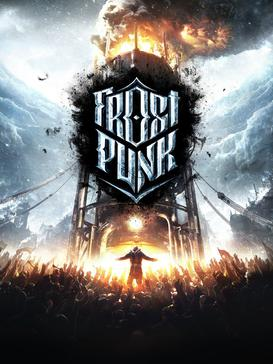
Image found on Wikipedia.org

But what exactly is Frostpunk? Developed and published by indie team 11 bit Studios back in 2018, Frostpunk is a city-building survival strategy game where you are in charge of the construction and maintenance of a steampunk city. What's steampunk, you ask? It's a subgenre of science fiction in which you take a civilization from the past (most commonly 19th century England) and give it access to technology far better than whatever they had in real life, with the goal of a steampunk story being to show how technology can change societies either for the better or for the worse. I have a soft spot for steampunk, as it's my personal favorite style of sci fi. Anyway, the aforementioned steampunk city is tasked with surviving the most brutal winter in human history, with the temperature starting at -4 degrees Fahrenheit (-20 degrees Celsius) and only getting worse from there. The game released to a generally positive reception, developing a passionate fan community online. More importantly, 11 bit Studios released a sequel to this game simply titled Frostpunk 2, which is supposed to be much larger in scale than this game. That being said, I'm only reviewing the first game for the simple reason that I have not played Frostpunk 2 yet. 

So imagine. The year is 1886, and things played out mostly the same as they did in real life. America gets colonized only for the colonists to rebel and build a new country from scratch, the Industrial Revolution led to the rabid development of technology, Krakatoa erupted, et cetera. But there's one big difference between real life history and the world of Frostpunk. Instead of global warming, the Frostpunk universe got hit with global cooling. Things cooled down so much that it caused a new Ice Age, which a bunch of scientists named "The Great Frost". The only reason anyone survived the initial blizzards this Great Frost brought forth was because that same bunch of scientists predicted something like this would happen. They created in secret a set of giant heat-producing towers known as the Generators, which provide just enough warmth to create little "safe zones" for the coming winter. As such, the entire population of the British Empire (and presumably the rest of the world) marched up North for months on end to reach these Generators and rebuild society from scratch. Why up North you ask? The in-universe explanation is that the global cooling originated from the South Pole and slowly spread up northward to the rest of the world. So I guess the Generators were placed in the places furthest away from the South Pole in the hope that the Great Frost wouldn't affect those communities as badly, or maybe it was done to give the construction crews more time to finish the project. 

You, the player, are the Captain, the leader of a group of survivors that managed to reach one of these Generators. As such, you decide what gets built and where, what jobs people are allowed to work, and what laws are legalized. Ironically enough, the Captain has more in common with a mayor or a baron than an actual ship captain. The only reason your character is even called a Captain is because they used to command a carrier ship prior to the Great Frost happening, so the title is a holdover from the "good old days." Frostpunk has four main story campaigns (called "Scenarios"), each with a different goal to work towards as well as different starting conditions. Another two were added in a DLC expansion, but thankfully, Frostpunk is actually a solid enough product on its own that it frankly doesn't need DLC to function. So my advice is to only get the DLC if you are absolutely starving for more Frostpunk. But in addition to the main Scenarios, there is also an Endless Mode where you are free to keep playing for as long as you want, or at least until your City gets destroyed. Anyway, the only scenario available right at the start is A New Home.  Surviving past Day 10 of A New Home unlocks the Arks Scenario. Surviving past Day 20 in A New Home unlocks both The Refugees and The Fall of Winterhome. Before I continue describing the Scenarios themselves, let's talk gameplay, because most of what I say is applicable to all playable Scenarios.

In order to accomplish literally anything in this game, you need to assign jobs to your citizens. Each building in your City comes with an associated job, and each building can employ up to 10 citizens at once. They will carry out their jobs automatically during work hours (8:00 to 18:00), but once the work shift has ended, they will go enjoy Free Time. If there are unfinished construction projects during Free Time, the citizens will help out and speed up the process. If not, they go back home to rest up for the night. If the citizen in question is unemployed, he/she will work on construction during both work hours and free time. But a very important thing to remember is that people are not mindless robots. They got needs that must be fulfilled if you want your City to survive. And Frostpunk's gameplay loop is like walking a tightrope. You can fall at any moment unless you maintain a near-perfect balance of all the main resources. 

Image found on en.riotpixels.com

Let me tell you what the average Frostpunk playthrough looks like. You start off with needing to build tents in your City so that your people can sleep comfortably at night, and housing needs wood. So you send some guys to go gather wood from some nearby debris piles. But because this process involves marching through waist-deep snow, some of your workers will get sick from the cold. And sick workers can't work, obviously. So you need to build a medical post to heal your people when they inevitably get frostbite or hypothermia. But people can't work on an empty stomach, so you also need to build a Hunter's Hut so you can hire some hunters to go outside the City and gather food. The only problem with that is that your workers can't eat raw food, it needs to be cooked into something actually edible. So now you need to build a Cookhouse and hire some chefs. And you need roads connecting all of these buildings to the Generator so that your people can actually walk to work without marching through snow, which costs more wood. Only by now, you ran out of salvageable debris, so you need to build a sawmill to chop down some trees. And don't forget, you must find a way to produce enough coal to keep the Generator active at all times, because if the Generator powers down for too long your City will freeze to death. Which means building coal mines, which costs steel, which means you need to build a steelworks to make enough steel to build the coal mines. And steelworks require even more wood. By this point the temperature of the outside world is dropping, so now you have to improve heating and insulation by either upgrading the Generator or replacing all the tents with proper bunkhouses (which costs wood and steel). While everything I just described is going on, you can send Scout Teams to explore the world, and the scouts will come back anything ranging from extra supplies, to more survivors to expand the City's population or Steam Cores. Steam Cores can be used to build the most powerful machines in the game, such as Hothouses that grow edible plants (thus producing twice as much food as a Hunter's Hut), and Automatons, which are giant steam powered robots.

But the most important building that you absolutely must have in your City is the humble Workshop. The Workshop is a place where your smartest citizens get together and do some research. Research projects lead to the invention of new technology that can improve the City in some way. These upgrades can range from making the Generator produce more heat than before, to unlocking newer and better buildings that can produce more resources than their weaker counterparts, or simple passive bonuses that make preexisting structures more efficient. The Workshop is absolutely essential to Frostpunk's gameplay and it is literally impossible to beat any of the Scenarios without building at least one Workshop. My general advice is that unless you're playing the Fall of Winterhome Scenario, your first priority should be building a Workshop at the start of every playthrough. If you are playing Fall of Winterhome, let the Workshop be the second structure you build.

On top of all that, you also have to deal with Hope and Discontent. Think of these two as like health bars for your city. If the City runs out of Hope, your citizens will declare the City a lost cause and will leave, either to die in the frosty wilderness or to (hopefully) join someone else's City. If the City's Discontent gets too high, the people will declare you a tyrant and overthrow you in a violent revolution. Either way, you will lose the game and have to start all over from the beginning. There are ways to raise Hope and lower Dissent, such as building churches and fighting arenas respectively, or promising your people to do a task like collecting enough food to feed the city for a week, or promising to keep the City above a specific temperature for three whole days. Is it stressful keeping track of all this? Yes. But that's like the fun of Frostpunk. It really sells the fantasy of establishing a community that just barely, by the skin of its teeth, manages to survive the impossible. 

Back on the subject of citizens, the last main thing to know about them is that all citizens are divided into four types; Workers, Engineers, Automatons and Children. Workers are the most common and can work almost any job. The only jobs they that can't work are those that require advanced education, like medical treatment and running the Workshop. Engineers on the other hand, can work in medical posts and Workshops. They can also perform simple labor, but are forbidden from hunting, which Workers can handle just fine. Automatons are giant steam-powered robots that don't need to sleep or eat, can work 24 hours a day without pausing, and are immune to the ever-decreasing cold. They do need to recharge every now and again, but these things are very powerful. Think of Automatons as Workers on steroids. Automatons can work almost any job, and the Workshop can research ways to make Automatons even better. Automatons are also the rarest citizen type in the game. You won't get a lot of these guys, unless you're playing The Arks Scenario. And finally, Children cannot work any jobs at all under normal circumstances, but they still need to be cared for like any other citizen. But notice my choice of words there. They cannot work under "normal" circumstances. And now we get to talk about my favorite thing about Frostpunk, which is how it handles morality.

Image found on trueachievements.com

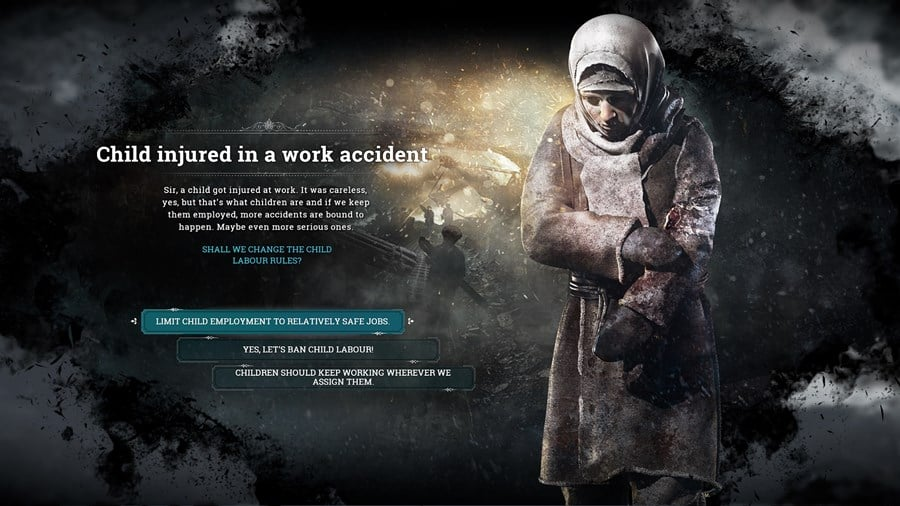
As the Captain, you have the authority needed to pass laws. You can pick which laws to pass from a branching list, structured like a skill tree from a normal roleplaying game. Not all the laws are particularly nice. In fact, the further down the list of laws you go, the more tyrannical you become. The laws start off sensible enough. Legalizing experimental treatment to save frostbitten citizens is a no brainer. Replacing solid meals with soup because its cheaper to create makes sense when you need make every ration worthwhile. And while it seems harsh at first, extending the work shift from 10 hours a day to 14 hours a day is essential to producing enough resources to finish major construction projects. But as the winter worsens and the needs of your people become more demanding, you will be pushed to pass laws that are dubious at best, and straight up evil at worst. For example, if you are really desperate for more Workers, you can legalize Child Labor, which turns all Children in the City into Workers. Running low on food? You can legalize cannibalism and start turning the deceased into rations. You don't have to pass the unethical laws if you don't want to, in fact there's a secret golden ending that's acquired if you beat any of the main scenarios while practicing only "humane" laws. It's just a lot harder to do a "good guy run" because the evil laws offer some kind of practical benefit at the cost of one's own moral integrity.

And this leads into the biggest aspect of the law system; The Purposes. Without spoiling the story too much, eventually you will have to pick a Purpose for your City, which is some kind of ideology to really bring people together and form a longer-lasting community. Your options are either Order, which rules with militaristic strength and discipline, or Faith, which rules with spirituality and religious devotion. Both of these options unlock a set of unique laws and buildings to match their respective themes. Both of these start off fairly benign. And both of them get really scary when you push them too far. Order seems like the obvious bad guy option at first, since the Order-only laws and Order-only buildings are eerily reminiscent of Big Brother from 1984. I'm talking things like Propaganda Centers and armed guardsmen publicly beating disobedient citizens to the brink of death just to keep the rest of the City in line. But Faith is arguably just as amoral. In fact, for everything Order does, Faith has something that accomplishes the same effect, just with a vaguely religious coat of paint over it. Instead of propaganda, Faith has sermons. Instead of public beatings Faith has "mandatory penance" (which still involves dissenters getting publicly beaten). Order and Faith are ultimately two sides of the same coin.

But the thing you need to remember is that neither Order nor Faith start off evil right away. They always start benevolent, Like Order starts with just a neighborhood watch to keep people safe, watchtowers that lower discontent for anyone living near them and the ability to hire foremen to oversee a building's production (thus making any jobs in that building produce more resources). Faith starts with churches that give Hope to anyone living nearby, field kitchens that raise the temperature of any adjacent building while also providing rations for the area, and houses of healing which work as a decent alternative to traditional infirmaries. Order and Faith only become evil when pushed too far. In fact, the final Purpose law, called New Order or New Faith, is by far the most extreme law in the game and is the only law that will actively cause the deaths of a few citizens. If you legalize New Order, the Captain crowns themselves Supreme Leader of the City and establishes a totalitarian regime, and anyone who opposes the regime (between 12 and 30, depending on the City's total population) will be executed. If you legalize New Faith, the Captain declares themselves to be the second coming of the Messiah and converts the City into a cult with a zero-tolerance policy on any faith that is not the state religion. And just like with New Order, anyone who opposes the cult (again, 12-30 people) will be executed. But hey! At least Hope will be permanently maxed out for the rest of the game! …And it will also be renamed to "Obedience" (for Order) or "Devotion" (for Faith). Because at that point, the people have given up hope for a free society, but are now either too loyal or too scared to leave the City.

But why would you go so far with these Purposes? Because as the situation grows more dire, those "evil" laws might be the one thing allowing you to repair the damage done to your City. Remember, the ultimate goal of Frostpunk is to make sure the City survives the Winter. As long as you have just enough citizens to keep the City operational, you can and will push your people to their absolute limits. Mild spoilers for the A New Home Scenario, but halfway through the story you learn that the closest neighboring City, Winterhome, has been destroyed. This causes an existential crisis in your citizens, since the plan prior to this point was to contact the other Cities and establish trade routes and supply lines so that the Generator communities could survive long term. Because of this, a  group of rebels will start making plans to leave for London. You have 14 days to convince them to stay. And every day that passes, if you don't raise Hope high enough or get Dissent low enough, the rebels will convince another citizen to leave. But those harsher Purpose laws that allow your guards/witch hunters to beat criminals in public or spy on them in their own homes? Those laws let you get the rebels under control. If the rebels get really out of hand, these evil laws might be the ONLY way to get the rebels under control.

Okay, that should cover the "universal" parts of Frostpunk. Let's talk about specific Scenarios.

Image found on trueachievements.com

A New Home. The main Scenario, serving both as a tutorial for the game as a whole and setting the standard for which all other Scenarios are to be judged by. You start in a spacious crater with plenty of building room, 80 citizens and enough supplies to get your first set of buildings established. The win condition here is to simply survive for more than 48 days. Once you make it past day 48, your City is deemed stable enough to not only survive the whole winter, but even beyond it. The final week of this Scenario is positively brutal, as a violent blizzard tears through your City. This Storm will disable Hunter's Huts and Hothouses, meaning that the only source of food your City will have will be whatever rations you stockpiled ahead of time. Additionally, the Storm will force the temperature to start dropping rapidly. Nothing short of a fully upgraded Generator can produce enough heat to survive this. The Storm is the closest thing Frostpunk gets to a boss battle, though you cannot defeat the Storm in any meaningful way. All you can do is prepare, stock up on rations and coal, and pray that your City survives long enough to make it to Day 48. This is also the Scenario with the Londoner rebels, and how you deal with that will also effect the ending.

The Arks. In this Scenario you start in a narrow ravine with significantly less building room and only 45 citizens. All of these citizens are Engineers however, and to make up for their lack of numbers, they also start with an Automaton. The goal of this Scenario is to protect the Seedling Arks, special greenhouses preserving the seeds of every plant in the world. The plan here was to breed some plant life that could survive in a post-Great Frost world. Unlike the other Scenarios, this one has a secret alternative win condition. A neighboring City called New Manchester is falling apart and needs a bulk order of supplies from your City to survive. You can choose to either ignore New Manchester and focusing only on your own City, abandon the Arks to save New Manchester, or try and save both New Manchester and the Arks at the same time. The biggest challenge this mode presents is the fact that your City's population never increases, so the only way to get more workers is to build Automatons. In fact, this game mode can best be described as "Oops! All Automatons!" But this mode is uniquely challenging in its own right. Because depending on how quickly you find New Manchester, you might not have enough time to send them any supplies at all. When I found them there were only three days left before the Storm came. And even if you do find them in time, you still need to have a good enough industry to fund basically two whole Cities at the same time.

The Refugees. In this game mode, you start with only 43 citizens in a star-shaped canyon, making construction somewhat awkward. But true to its name, in this Scenario dozens of refugees will flock to your City in groups of 15, rapidly expanding your population up to 270. The win condition here changes throughout the Scenario. At first, it's to make sure that at least 250 of those 270 refugees survive for a whole week. When that week is over and you succeed, the game keeps going. Then a second wave of refugees comes to your City in groups of 100 people each. Now that doesn't sound too bad at first. There's just one problem. The second wave of refugees are all rich, upper class nobility while the first wave were all peasants and farmers. Also, the working class straight up stole this Generator site, because this specific Generator was meant for only the upper class elites of the British Empire. So there's a lot of bad blood between the two groups and its up to you to decide what to do with the second wave of refugees. Personally, I found this Scenario to be the easiest of the main four. The weather is at its absolute calmest here with not a single Storm in sight, and the only real challenge is making sure you have enough food and housing for all the refugees. And while I like the story here, a classic struggle between the ruling elite and the working class, the ending is oddly anticlimactic. 

The Fall of Winterhome. This Scenario is by far the most challenging and the most complex out of the main four. Winterhome, canonically, was destroyed before A New Home even began. And in this game mode, you start with a fully constructed City in a crater not unlike the A New Home City, with a population of over 600 citizens. But there's just one problem. The previous Captain of Winterhome was a moronic tyrant whose incompetence nearly destroyed the City before the Scenario even began. You want to know how bad the previous Captain was? He built the City with the most awful layout imaginable, with lots of wasted space and redundant roads. He legalized Child Labor for all jobs despite having a large enough adult population to fill out every job opening available. His tyranny and incompetence got so bad that the people of Winterhome overthrew him, but in a final act of spitefulness, the previous Captain torched over half the City, rendering most of the buildings unusable.

Image found on trueachievements.com

In Fall of Winterhome. you play as the replacement Captain, who was chosen to lead by the rebels who overthrew your predecessor. And Fall of Winterhome gives you quite possibly the worst start imaginable. Over half the buildings and roads need to be torn down and replaced, over a third of your 600+ citizens are gravely ill and need medical care immediately, and you have no choice but to enforce some of the laws that the previous Captain passed because there's no way to repeal a law once it is in effect. Which means you get Child Labor whether you want it or not. The win condition is to stabilize the City by removing at least 30 ruined buildings, raising Hope to 50% or better, and lowering Discontent to 25% or less. You have one week to accomplish these three tasks. Once you do, the win condition changes once again. As it turns out, the Winterhome Generator is malfunctioning and your Engineers have no way to repair it. It could have been fixed if the problem was handled earlier, but the previous Captain deliberately ignored the problem until it was too severe to solve. In other words, the previous Captain was so incompetent that he turned Winterhome into a ticking time bomb. So now you have to construct the Dreadnought, a giant armored tank which is effectively a City on wheels, and use it to evacuate Winterhome. This process involves producing a metric boat load of steel, coal and rations. And there's also one last issue to worry about. The Dreadnought, once fully constructed, only has room onboard for exactly 500 people. You have more than 600. While the other Scenarios can, hypothetically speaking, be completed without suffering a single casualty, Fall of Winterhome is the only Scenario where people will die no matter what. Even if you stabilize Winterhome, cure the gravely ill of their sicknesses and construct the Dreadnought in time for the evacuation, at least 100 of your citizens will be left behind so the rest can live.

On the Edge. This is one of the two DLC Scenarios, and serves as a direct sequel to A New Home. In this game mode, you don't have a Generator at all. Instead, you control an outpost being funded by the City from A New Home, with your heat coming from a set of Steam Hubs. And because your heat comes from another City entirely, you are the mercy of their Captain's laws. As such, you have to donate a portion of your supplies every day to keep your outpost running. You can also form political alliances with other outposts, which is the only way to get resources that your outpost doesn't have access to. And because your outpost can only produce steel and steam cores, that means making trade deals with a lot of people if you want to survive here. Also, you have the least amount of building room out of all the Scenarios. True to its name, you are building on the edge of a literal cliff. What makes this DLC amusing in hindsight is that it seems to be a proof-of-concept for Frostpunk 2. Both On the Edge and Frostpunk 2 take place multiple years after A New Home, both On the Edge and Frostpunk 2 focus heavily on political alliances, and both On the Edge and Frostpunk 2 feature the establishment of outpost colonies that donate a portion of their own resources to fund the construction of the main City.

The Last Autumn. This DLC is a prequel Scenario to all the others. Taking place before the Great Frost arrives in the Northern Hemisphere, you are tasked with building one of the Generators that became vital to the success of the other Cities. This Scenario radically overhauls the Purpose laws. Instead of Order vs Faith, it's now Engineers vs Workers. Because this is still the 18th-19th century, worker's rights aren't really a thing. So the Generator project is a massive OSHA violation, and you need to choose between legalizing worker rights to make the project safer, or giving more power to the Engineers so the project can be finished in time. And just like with Order and Faith, the further you go into your Purpose, the more amoral and sinister you become. Just for example, the Workers will literally start a communist rebellion if you give them too much power, and the Engineers will gleefully send dozens, possibly hundreds of people to their deaths just to keep the construction project on schedule. Neither side are saints, but they are canonically the only reason the Cities in the other Scenarios can survive at all, since these guys built the Generators in the first place. This is the only game mode where you don't have to worry about temperature, because the Great Frost isn't here yet. As such, coal isn't as important here as it is in the other Scenarios. The win condition here is to finish construction of the Generator, which is done in stages, and make sure that each stage of the project meets a specific deadline. Failure to keep the project on schedule results in you getting fired.

And finally, Endless Mode. Endless Mode has three different campaign options, two in the base game and one in the DLC. These campaigns are called Serenity, Endurance and Builders. In all three campaigns, you can pick the starting location, which not only includes all of the locations from the main six Scenarios, but even three brand new locations not available anywhere else. Those exclusive options are the Flats, which is an open field with tons of building room, in fact this is the single largest location in the game. But resources are further away than normal in the Flats, so building roads is even more important here. Then there's the Rifts, which splits the available space up with bottomless pits that you have to build bridges over. And finally, there's the Crags, which is a somewhat large field with giant rock formations peppering the landscape, and you have to build your City around those rocks. Additionally, you can enable Hazard Events, which cause randomized problems to occur in your City, such as forcing you to spend twice as much steel to build something or temporarily disabling your hothouses. Personally, I'm not a fan of the Hazard Events, and now whenever I play Endless Mode I turn them off. The most interesting thing about Endless Mode is that it gives you an optional quest to collect relics, which are items that were made before the Great Frost came. These relics provide some nice lore that isn't accessible anywhere else in the game.

Image found on steamdb.info

Anyway, in Serenity mode,  you start with 105 citizens, most research projects already completed and the weather is significantly calmer than normal. Temperature drops are rarer and the Storm (which happens once every 14 days in Endless) now only lasts a single day instead of a whole week like in A New Home. This mode exists for those that don't care about the "survival" part of the survival strategy game and just want to build an aesthetically pleasing steampunk city in peace. In Endurance mode, you start with 80 citizens, the Storm will last for 2-3 days and will gradually become more frequent each time it arrives, and you have just enough supplies to get your first set of buildings up and running. Basically, if you want to do A New Home again but in a different location and with a hypothetically infinite campaign, Endurance mode is for you. Builders mode gives you 125 citizens and works the same way that The Last Autumn does. You don't have a working Generator in this mode yet, and you have to get the Generator operational before the cold becomes too much to handle. 

The only problem with Endless mode (all three versions) is that it almost all of its challenge comes in the first few weeks, and once you get past those first two or three Storms your City is more or less good to go for the rest of time. Now, all the Scenarios are generally pretty short experiences. It only took me 13 hours to complete A New Home, and another six hours to complete both The Arks and The Refugees. I don't remember how long it took Fall of Winterhome but it couldn't have been longer than ten hours at the most. And that sort of length is perfect for what Frostpunk is trying to do. But the problem with Endless mode is once your City survives long enough to be self-sustaining (producing more coal and rations than the City can use up), there's not much that the game can do to put your City in danger. Sure the Storm will come back, but if you can survive it the first time, you can survive it again. And it would even easier to survive it the second time round because you would have access to better technology by then. There's no traditional enemies to fight against in Frostpunk, the only other people you meet are survivors who are more than happy to join your City. And even then, the game has a hard cap of 790 citizens on Serenity mode or 695 on Endurance and Builders mode. Once your City's population reaches those numbers, other survivors will never appear ever again unless you suffer severe casualties in the near future.  There's no political alliances to be made with other Cities, in fact you just straight up don't find any other Cities in Endless mode. You don't even get a rebellion you have to deal with like in A New Home. And once you run out of research projects, laws to pass or room for construction, there's not much left to do. There's an achievement/trophy you can get if your City manages to survive past Day 100 of Endless mode, and I'd say that's a good stopping point for this game mode because you WILL run out of things to do by then.

In terms of presentation, Frostpunk is one of the best examples of the steampunk aesthetic and is just a very pleasing visual and audio experience in general. The whole game carries itself with a somber, melancholic vibe that wants you to reflect on the nature of the human experience. And I'm a sucker for somber, melancholic worlds in fiction. Anyway, every building has a rustic, vaguely Victorian vibe, but with steam pipes pumping heat in and out everywhere. Even the most advanced machines in the game, like the Automaton or the Hothouse, look gritty and weathered. After all, it's kind of hard to keep your tech clean in the middle of an apocalypse. While the 3D models of the citizens look fairly simple, there's more detailed artwork of said citizens that appears during the story events in any given Scenario. One detail I really like is that if you have multiple buildings of the same type right next to each other, their model is changed to look interconnected with branching hallway extensions. This is most obvious on Workshops and bunkhouses. But it makes those buildings feel more complete in a way. Also, the execution animation that plays if you legalize New Order or New Faith is one of the most creatively cruel methods to kill something I've seen in a video game. Said animation involves the victim being chained up, placed on top of the Generator's exhaust vent, and forced to stand there until the next time the Generator releases steam. The sheer force and heat of the vents basically cooks the victim alive. Positively brutal stuff. And if you max out Discontent while New Order/Faith is in effect, then instead of the usual banishment scene, the Captain is given a taste of their own medicine and executed with this exact method. "Reap what you sow" and all that.

The music and sound effects in Frostpunk are exquisite. The way the ice cracks and reforms as the temperature rises and lowers is crisp. The annual barks of the town crier announcing the start and end of every work shift help set the vibe. And said annual barks change depending on which Purpose you chose, with the Faith version of the town crier sounding like a priest and the Order version sounding like a drill sergeant. If you zoom in on specific structures, you can hear some ambient sounds associated with that structure like church bells or the drunken laughter of the local bar patrons. And of course, we got to talk about The City Must Survive, the closest thing the Frostpunk universe has to a theme song. So imagine. Your City is doing well. You got a surplus of coal and rations, sickness is at an all time low, and the overwhelming majority of your citizens have access to proper heating. Then you see the mother of all blizzards approaching on the horizon. You have seven days to prepare for the Great Storm, and as you rescue the last of the survivors from the frozen wilderness, a chilling realization hits you. Your City is not ready. People will die, and there's nothing you can do to stop it. 

And nothing fills you more desperation and dread than hearing The City Must Survive. That one orchestral song is desperation incarnate. When I think of Frostpunk my first thought is that final week of A New Home with the Great Storm battering down on my City. The buildings shutting down from sheer coldness one by one until only the coal mines and infirmaries remained. The people of my City being sent straight to said infirmaries by the dozens due to rapidly spreading frostbite. Forty Workers sacrificing their lives to keep the coal mines operational in such horrid weather. Families perishing in their own homes as the last of the rations run out. And this song, with violins shrieking like it's the end of the World as my City is crushed beneath -230 degree winds. No other event in any video game, movie or book managed to instill in me such despair. And somehow, my City survived. I fully expected to be wiped out completely by the Storm, but against all odds, 492 of my citizens (out of 603) survived. They were beaten, frostbitten and starving, but they survived. And the violins go silent. There is no triumphant chorus of horns to celebrate your victory. Just a peaceful quiet as the surviving citizens reflect on everything they sacrificed to make it this far. This moment right here is now one of my favorite moments in any video game ever. And The City Must Survive is a key factor in making this finale so memorable.

One last thing about the presentation I want to say. At the end of every Scenario, the game will provide some narration recapping all the major decisions you made. While this narration is on screen, you can see a time lapse of your City being built from the ground up. It's a cool way to show how far your citizens have come since the day they arrived at the Generator site. Even if the ending narration taunts you for every evil law you passed and every amoral decision you made. The only criticism I have of Frostpunk's presentation is that I ran into a minor glitch that caused the screen to be covered in a blank white texture, thus preventing me from being able to actually see anything. Reloading to an earlier save was enough to fix the problem, but be aware that such a glitch could happen in your game.

Image found on steamdb.info

Overall, Frostpunk is a somber survival strategy game that succeeds in showing just how soul-crushingly brutal a post apocalyptic setting can be. This game is one of my favorite video games now, and definitely my favorite strategy game. Even if you aren't the biggest fan of strategy games or games along those lines, Frostpunk is an easy game to recommend because it's just a generally high-quality experience. And if you have any interest in steampunk, this is one of the better examples of steampunk in action. So I'd say that Frostpunk gets 5 stars out of 5.

Frostpunk is the property of 11 bit Studios. None of the images used here were created by me. Please support the original creators.